Conquering the Publishing Divide: An Interview With Author Jessa Russo

Anyone who knows me knows that I absolutely adore Beauty and the Beast.  So when I stumbled on the announcement for Jessa Russo’s young adult novel, Divide, I knew I couldn’t pass it up. I haven’t finished reading it yet, so rather than bring you my thoughts on it, I’ve invited Jessa to stop by and regale us about her publication journey. This wasn’t her first time at the rodeo, as they say, but what she’s learned should be very insightful for those of us still waiting at the gates.

First, let me introduce you:

Photo of Jessa Russo


Jessa Russo believes in fairytales, ghosts, and Jake Ryan. She insists mimosas were created for Sundays, and that’s not up for discussion. She’s obsessed with the great city of New Orleans — where she’s collected too many beads to count, eventually married her sweetheart, and visited graveyards they don’t include on maps.

She’s loud, painfully honest, and passionate about living life to the fullest, because she’s seen how abruptly it can be taken away.

What began as a desire for reading and writing young adult paranormal has bled into stories of all kinds. From fantasy to pre-dystopian to erotic contemporary, Jessa’s stories always include romance, though she’s given up on pigeonholing her work into a category or genre box.

Jessa was born and raised in Southern California, and remains there to this day with her husband (a classic car fanatic), their daughter (a Tim Burton superfan), and a Great Dane who thinks he’s the same size as his Chihuahua sister.

Entwined, the final installment of Russo’s Ever Trilogy, will be released late 2014, as well as an erotic romance written under a pseudonym. Stay tuned!

~~~

Cover Design for Divide by Jessa Russo

From senior class president to dejected social outcast, with just the flick of a match.

After accusations of torching her ex-boyfriend’s home are followed by the mysterious poisoning of her ex-best friend, seventeen-year-old Holland Briggs assumes her life is over. And it is. But not in the way she thinks.

As Holland learns the truth about her cursed fate—that she is descended from the Beast most have only ever heard of in fairytales—she unites with an unlikely ally, good-looking newcomer Mick Stevenson. 

Mick knows more about Holland’s twisted history than she does, and enlightening as it is to learn about, his suggestion for a cure is unsettling at best. Holland must fall in love with Mick in order to break the spell, and save their future generations from repeating her cursed fate. Having sworn off love after the betrayals of her ex-boyfriend and ex-best friend, this may be difficult to accomplish. 

Complicating things further for Holland and Mick, time runs out, and Holland’s change begins way before schedule. With Holland quickly morphing into a dangerous mythical creature, Mick struggles to save her.

Should they fail, Holland will be lost to the beast inside her forever.

How could you not want to read that? Seriously. Which is why, in honor of Divide’s release last week, I’m going to give you a chance to get your hands on this amazing story. But not until after the interview. Which starts in three . . . two . . . one . . . 😉

~~~

Hi, Jessa! Thanks for being with us today. To kick things off, please tell us a little about Divide. Where did the inspiration come from? What makes it unique from all the other Beauty and the Beast retellings out there?

I’m not sure where the inspiration for any of my projects comes from, honestly. Ideas often pop into my head while I’m driving — which is what happened with DIVIDE — and then I stew on it for a bit until the idea turns into a story or fades away. In this case, I know I’d been hearing a lot about retellings, and I loved the idea, but I wondered how I could make mine different. Then it occurred to me that my beauty was the beast. She was both, both were her. So when NanoWrimo came along in 2012, I sat down to work on The Ever Trilogy, and DIVIDE came out instead.

What’s your favorite (non-spoiler) part of the story?

Honestly, I love the villain in DIVIDE. He’s arrogant and a bit dark, and . . . sexy. I think his introduction to the story is my favorite part of the book. (As well as a private moment down the road with him and my main character, where she happens across him in the middle of the night. But I don’t want to spoil anything.)

What kind of experience should readers expect from your work?

Truth be told, I want readers to escape into my books. It’s as simple as that. Escape. Sometimes I wish I was one of these authors with a great lesson to teach, or a beautiful, moving story of overcoming abuse or self-destruction — which I do have a story of, but won’t be sharing anytime soon as it takes a lot to get that story out on paper — but I honestly think that my creative energy is more focused on the escapism side of fiction. When I read, it’s for that reason alone, so I guess it’s probably normal that my writing is the same way. Day to day life can become repetitive at times — not that I don’t love my life and my family — but I often wake up to a sink full of dishes, or laundry that is never-ending, a tween whose attitude is starting to really, painfully, mirror my own . . . stuff like that. So when I read, I want to escape into the beautiful, butterfly-inducing joy of young love or magical fantasies about Princes and vampires and Vampire Princes. I want that escapism for my readers. I won’t beat you over the head with my beliefs or try to change your mind about yours — you can just pick up my book and find your alternate happily ever after.

Divide will be your third novel. How has its journey differed from that of Ever and Evade? Did it face challenges that the others didn’t, and vice versa?

Um . . . that’s hard to pinpoint. I queried both EVER and DIVIDE, but I was a bit wiser with DIVIDE, a bit more seasoned. With EVER, I thought I was supposed to cast a wide net, querying everyone who’d ever been an agent, seen an agent or known an agent. (A common rookie mistake, I’ve since learned.) I received an insane amount of rejection for EVER — something that probably also had to do with not just the wide net I cast, but the fact that I didn’t hear about critique partners until well into my querying, and by then, I think it was a bit too late for that book, as far as literary agents go. They’d all seen it (all 80 of them), rejected it, and didn’t much care to see the revisions. Anyway, with DIVIDE, I entered a couple contests, then queried a handful or two of agents — one of which was a friend who’d already hinted at wanting to sign me. So DIVIDE had a bit of an easier go at things, but then, second children often do, don’t they? The first child is the one with the gallons of hand sanitizer and safety EVERYTHING, then that second kiddo comes along and can be a dirty little daredevil without the parent so much as blinking an eye. That’s EVER and DIVIDE. 😉

A lot of people assume that once you have an agent, publication is a sure thing. But it isn’t. Can you tell us a little about what it’s like to work with an agency, as opposed to going it alone? Are there any times you would recommend against looking for an agent?

I assumed that too. It’s funny how I continue to grow and learn in this industry — right when I think I’ve figured it all out, something happens to humble me all over again. With EVER, I thought “Okay, well, I wrote ‘The End’, so now I get to publish.” Then I looked up Scholastic — because obviously that’s who I would let have EVER — and realized it wasn’t that easy. Doh! With DIVIDE, I just knew my agent would find a Big 5 publishing house for me right away. Unfortunately, as many of us have found, that just isn’t the case. Rejections began to trickle in. Part of me couldn’t believe it. The other part of me told me my story sucked. (Gotta love that inner writer — she’s not very nice.) What I came to discover was that I’d missed the boat on fairytale retellings. Editors said things like “We already signed all the fairytale retellings we want.” Or, “This is too similar to something we just signed.” It was heartbreaking. I would have to shelve my story. And then I realized that way of thinking was wrong. Maybe I wasn’t the first to remix an old classic, but DIVIDE wasn’t bad because of that fact. And then I realized that DIVIDE didn’t deserve to be shelved.

The fairytale redux genre is incredibly popular right now. What kind of challenges do you think authors face as the market becomes more and more flooded?

Haha, um, see above. 😉 I’d say that if you’re working on a fairytale redux right now (and really, this can go for many other genres as well — paranormal, to name a big one), make it amazing. Make it unique. Make it unlike anything anyone has EVER seen before. But even then, go into it knowing that you may have missed the boat, and if you did, that doesn’t mean your story isn’t worth reading. That doesn’t mean you shouldn’t share it with the world. If I’ve learned one thing about publishing, it’s that just because a large house may not want your story (and there are a number of factors that go into that decision) it doesn’t mean a fanbase of readers won’t gobble up your words as if they are the very oxygen needed to breathe. Because at the heart of every reader is, after all, a desire to read. A hunger for your words. So write the words, create the stories, and share them. Someone will thank you for it, I promise.

What advice would you give to those authors facing the gauntlet of publishing?

Again, see above. Lol! Basically, go into it with an open mind, ready to learn. Then realize that you know nothing, and even after you think you’ve learned it all, you still know nothing. 😉 Why? Because publishing is constantly evolving, constantly growing, changing, spinning, morphing . . . so be open to learning as you go. Always. Oh, and be patient. Rushing something that means the world to you is never a good idea. Don’t race into publishing. You’ll regret it for one reason or another. That I can guarantee.

~~~

Some fantastic words of wisdom in there, no? Thank you, Jessa!

Which leaves only one thing — the giveaway. Because what better way to thank Jessa for her time than to help her celebrate the release of her book? In one week, three lucky people will be walking away with an eBook of Divide. Want it to be you? Click here to enter: Divide eBook Giveaway!

And if you’re feeling extra lucky, the giveaway for my blogiversary is still happening too. The drawings for both will happen on the same day, so be sure to head over there and enter for a chance at some of the other amazing titles up for grabs. 🙂
My Average Day as an Editor (In GIFs)

There have been a lot of GIF posts about what the publishing or writing process is like, but I’ve never seen one for what it’s like on the other side of the fence. Until now. This week, I’m breaking the unspoken rule that writers are never allowed behind the publishing curtain and illustrating what my average day as an editor looks like. And, because I had a request for a post with GIFs, I’m going to use everyone’s favorite sarcastic medium (which means that any of you reading this via an email/mobile device may have to click through to the actual site to see them). Before we dive in, I do want to say that this is solely what my average day looks like — other editors will be slightly different. The moral of this story, though, is that editors need cheerleaders too. You’ll understand by the time we get to the end. Don’t worry. 😉
 

My Average Day as an Editor

 
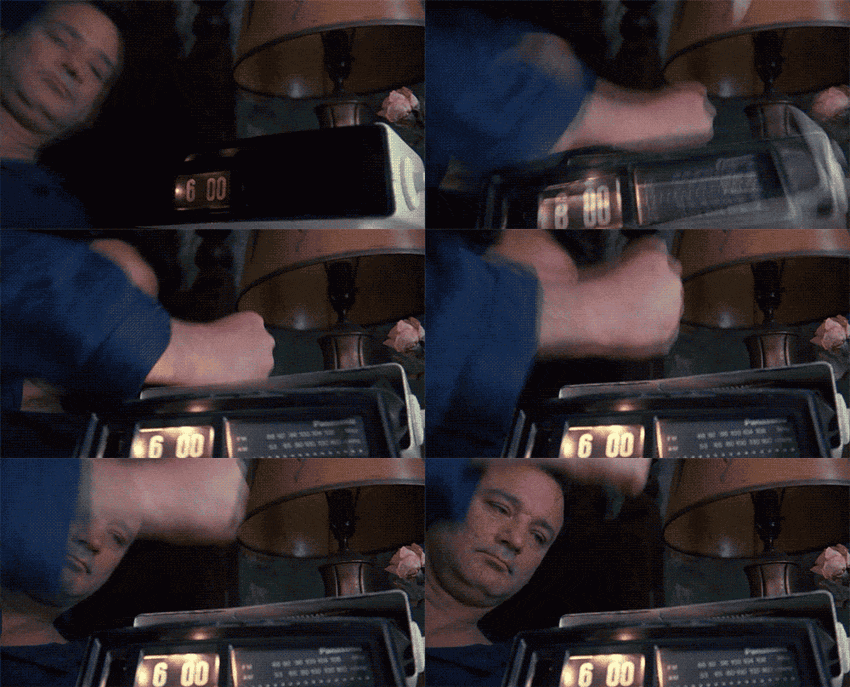
The alarm goes off at 7:30 am and I’m all like:


and . . .


Okay, maybe that’s a lie. It’s actually a lot more like this:


bill-murray-beating-alarm-clock


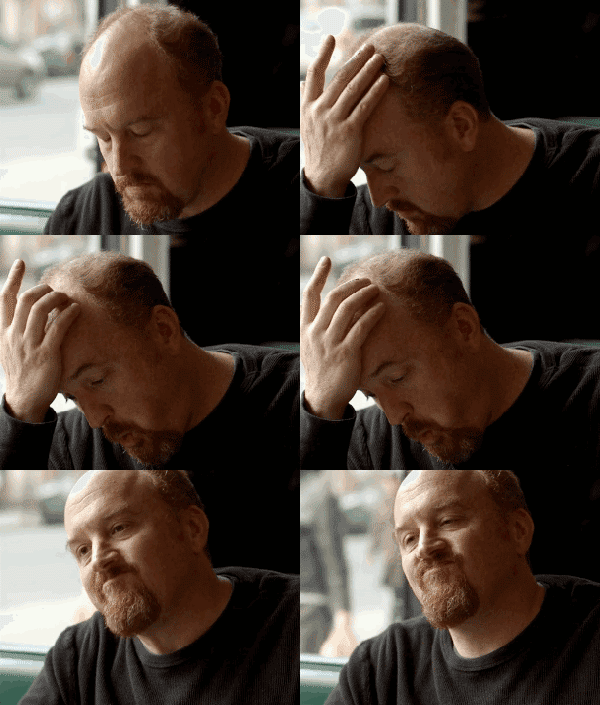
But anyway, I’m up. I’m ready for the day. I’ve got all the things I need to do circling through my head, and I’m ready to tackle them all. Until . . .


louie


I remember that I have to go to work. Not editing work — work work. Because, you know, editing doesn’t pay as well as everyone thinks, and I still have to eat.

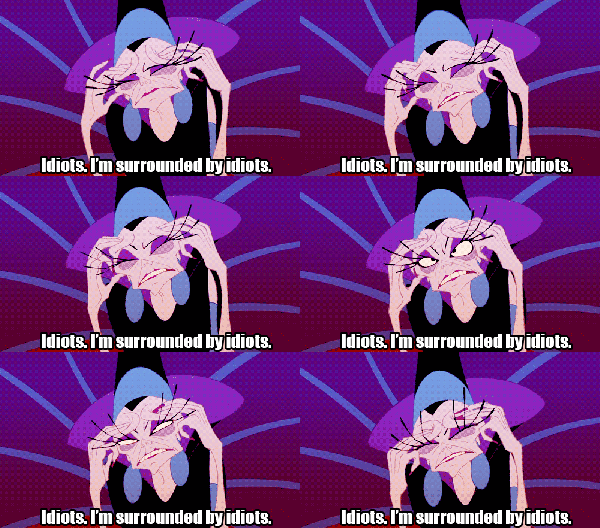
So, for the next five hours, I go punch the clock at the dreaded day job and secretly think to myself . . .
 
idiots


while outwardly doing this . . .


katy-nod-dance


Meanwhile, my inbox is filling up. By the time I actually get to start my day as an editor, I have 64 new emails (that’s a light day). Of those, approximately 1/3 will be submissions, 1/3 will be about the various tasks I assist with at REUTS, and some days, as many as 1/3 are authors freaking out over something. Those days, I tend to open my inbox and immediately think . . .
 
rudd-sucks
 
See, contrary to popular belief, editors work on a lot of projects at once. And writers (yes, you) are a high maintenance bunch, prone to neurotic freak-outs and requiring constant reassurance.
 
cat
 
That’s okay, though. We (as editors) understand, and we love you guys. Really, we do. But some days, you make us do this . . .
 
too-much


Anyway, I’m getting off topic. On those days where my inbox is full of people freaking out, I spend the next several hours holding their hands and providing reassurance. (See, the take away here, writers, is that every time you send one of those freak-out emails, the person on the other side loses valuable time they could have spent actually working on your project.)

**Note, I do not consider status requests and legitimate questions freak-out emails. Those are always welcomed and definitely allowed. 😉 **

By the time that’s done, it’s dinner time. But, before then, I’ll read through a couple of the submissions, which looks something like this:


umno
 
Or . . .
 
James-Earl-Jones-Totes-McGotes2
 
Or sometimes even . . .
 
jon-fan

FattyGenius


And occasionally this (if I’m the odd man out on the voting) . . .
 
not_having_it
 
Then it’s dinner time, and I step away from the computer for the first time all day.

By the time I get back, there’s at least one more freak-out email waiting not-so-patiently for me.
 
wut


frustrated
 
So, I deal with that one too (because I don’t like to leave anyone with more anxiety on their plate than necessary) and then finally, FINALLY, I get to edit. You know, that thing everyone thinks editors spend their days doing, but that we actually only get a few hours with. It’s a victorious moment when I finally get to this part of the day. Like . . .
 
fsa


Then, after investing several more solid hours into the thing I enjoy most, this happens . . .
 
tired
 
So I . . .
 
give-up
 
and . . .
 
exhausted
 
and the whole thing starts over.

And there you have it, my average day as an editor. Sounds like fun, right?
 
thumbs-up-matt-leblanc
 
The point of this (besides getting to have way too much fun with GIFs) is to show you just how hectic an editor’s life can be. We’re not robots who sit and do nothing but edit 24/7. We’re people, with lives and jobs, families and human needs. So cut your editor some slack if they don’t get back to you immediately, or it’s taking longer than you expected to edit your manuscript. We’re not purposely doing these things to hurt you. Editing is a time intensive job, and to do it right, you have to invest that time. The argument I always tell myself when stress threatens to overwhelm me, or someone’s pushing me to meet deadlines that aren’t possible without giving up sleeping, eating, and everyday life, is this — would you rather it be done right? Or be done fast? It’s not a perfect world, and those two can’t coexist. Anyone who claims otherwise is lying. Trust me.
 

**A big thanks to www.reactiongifs.com for supplying all the GIFtastic fun. Be sure to check them out! Their database is phenomenal. :)**

From the Editor’s Desk: A Need So Insatiable by Cecilia Robert

As an editor, (both freelance and under REUTS Publications), I have the wonderful opportunity to see amazing novels during their developmental phase. And I wanted to find a way to share them with all of you as they became available. (I also wanted to find a way to help support the authors that trusted me with their manuscripts.) So think of these posts as my own personal book recommendations, straight from the editor’s desk.

This week’s edition brings you the latest release from self-pub powerhouse Cecilia Robert:
 

A Need So Insatiable

By Cecilia Robert


A Need So Insatiable by Cecilia Robert


“You’ve owned me from the moment I walked into that music room. You’ve wrapped yourself in my heart and mind. I can’t get you out. I don’t want to.” ~ Rafael Van Rees

Sophie Fisher’s life is on fire. If she’s not ducking around corners or slipping out of windows to escape the debt collectors her father’s death has left knocking on her door, she’s dealing with her rebellious, fifteen-year-old sister, Lilli. And, as if that’s not enough, Rafael Van Rees crashes into her life—literally—bringing with him a past the public has no idea of. Can she unravel his mysteries before he unravels her, or will his presence finally force her to face the demons she’s trying to outrun?

Rafael Van Rees prides himself on being in control of his destiny, music and women. As far as he is concerned, his past is a black cloud in the distance–until he meets Sophie, that is, and his world spins out of control in more ways than one. He knows the darkest sins and secrets eventually reveal themselves, but when it comes to Sophie, he’ll stop at nothing to protect her from his past. Even if it kills him.

 
A Need So Insatiable is the first installment in a new Romantic Suspense series. Featuring a split POV between the female and male leads, it’s a fast-paced, high-intensity read that combines all the strengths of romance and mystery.

Sophie is a budding opera singer dealing with a bad hand in life. Orphaned at 24, she’s trying her best to raise her teenage sister and deal with the overwhelming debt her father left her in — debt that comes with a side of vicious loan shark.  She’s a snarky heroine who manages to keep her head up throughout all the turmoil. But the one thing she doesn’t expect is the storm known as Rafael Van Rees.

A prominent maestro and music director, Rafael is a mystery. As far as the public knows, he appeared fully-formed, lacking any shred of a past — an illusion he created on purpose. But that past slaps him in the face when Sophie waltzes back into his life. The only thing he can’t figure out is why she doesn’t remember him. He’s waited for this reunion for 14 years, and he’ll stop at nothing to win her over, even if it means confronting the demons he’s tried so hard to outrun. Moody, passionate, and gorgeous, he’s everything the male lead in a romance should be. I dare any female to read this and not swoon, at least a little bit. 😉

Sophie and Rafael aren’t the only great things about this book, though. There’s also a supporting cast that fills that role to a tee, providing everything from comic relief to the voice of reason for the main characters. And the writing is grounded and realistic. Romances that keep everything flowery and perfect in the love scenes are one of my personal pet peeves. Ms. Roberts didn’t choose that approach, portraying everything (yes, even the sexy parts) in a realistic tone that was both relatable and refreshing. Some people may not like that level of realism, but I did. It made the characters feel more human.

Classified as a New Adult book, A Need So Insatiable does contain some adult (as in mature) content. So if swearing, sex, and moderate violence isn’t your thing, I would recommend against reading this. But if you like your romances with a bit of action, realism, and lots of steam, this book will more than satisfy. And, as a bonus incentive, it’s currently on sale! So take advantage of the release week extravaganza and pick up this little gem for only $0.99! You won’t be disappointed. 😉
 
Sale Banner
 
To learn more about Cecilia and her other YA/NA books, visit her website, or follow her on Facebook/Twitter. And if you simply want to purchase A Need So Insatiable, click here!

Writing Characters With Great Backstories (Without the Backstory)

As an editor, I get to bear witness to all kinds of writing pitfalls. (In fact, I have a post series dedicated to that planned for the near future.) But one of the most prevalent, by far, revolves around divulging exposition — especially of the backstory variety. There are varying degrees of offense, but my personal favorite (and by “favorite”, I really mean eye-roll inducing, hair-pulling, editing nightmare) is when writers feel the need to divulge a character’s entire, complicated life story in the first chapter. Why is that bad? Well, think of it like this: your first chapter is the reader’s introduction to your character. So in real life, it would be like meeting someone for the first time and having them word vomit their life story all over you. What kind of impression does that leave? Yeah, I bet you’d avoid that person like the plague after that.

I can already hear the murmurs of confusion and disagreement.

“But, we have to make sure our characters feel well-rounded and real,” you say, “We don’t want them to feel like cardboard cut-outs or Mary Sues.”

You’re 100% right. But you can do that without resorting to the word vomit introduction. How? Well, that’s what I’m here to show you. 😉
 

Step 1: Creating Backstory

 
Before you can begin to write a well-rounded character, you have to actually make them well-rounded. You need to know that person intimately. They need to be real — as real as your best friend from high school, or your quirky aunt with the 82 cats who lives in a motor home. The best way to do that is by making what’s known as a character profile. (There are tons of templates available online, but this one is particularly thorough.) Document all those tiny little details and experiences that make your character who they are. Don’t just stick to the superficial details, like eye color and body type, but really get to know them.

How’d they get that scar on their right knee?

Who was their first crush, and who broke their heart for the first time?

What’s their strange nightly ritual? And why do they keep that weird nick-knack on their bookshelf?

In a separate document, flesh out your character from top to bottom. Until, like an actor, you can step into their skin and write with their voice. This process is as essential to your novel as plotting is, so don’t skimp. You’ll need to do this for every major character, and, to some extent, the supporting cast as well. You’ll see why here shortly.
 

Step 2: Writing as Character X

 
By now, you should have pages and pages of notes. You’ve created all these exciting experiences and nuances that shape your character’s personality, and you can’t wait to share them all with the world. Right? Wrong. This is where pet peeve #208 (listed above) comes in. Writers assume that since they’ve created all this material, they need to use it. That it’s a disservice to their character not to, and that stuffing every minute detail into their novel is the only way they’ll be able to illustrate just how intricate this person’s life is. But guess what? We’re all intricate, complicated people. And we don’t care that you’ve managed to create another one.

Your character spent 8 months backpacking through Europe three years before the events of chapter 1? Great. Who cares?

Your character has a great grandmother who can bake the world’s best pot roast, but who died ten years before the events of the story? Okay. Sad, but so what?

Your character’s favorite childhood dog only had three legs, but could run like a greyhound? Weird and slightly interesting, but what does it have to do with the story?

My point is, unless one of these anecdotes or facts has a direct affect on the current plot, it doesn’t make it into the book. Why did you just waste hours writing all of that, then? Because, even though it’ll never be stated outright, it will color the way your character reacts to any given situation. Essentially, by creating that profile, you built their “voice”. Every experience we go through changes our fundamental outlook on life and will have a subtle affect on the way we behave, the things we say, and even our perception of a situation. That’s the definition of personality. It’s a reaction filtered through our individual set of traits and life experiences, and is what makes each of us unique.

For example, the character with the three-legged dog is likely to be compassionate toward animals as well as people who are differently-abled. While someone without that particular backstory may be callous and insensitive to the needs of others. The person with the grandma may have a certain affinity for pot roast, reacting to it much differently than someone who’s, say, a vegetarian. And depending on how your character got the scar on their knee, they may have an ingrained fear of something that makes absolutely no sense to anyone else.

It’s the history behind the character that makes them feel real. Even if we never hear the story of every experience, we’ll respond to that feeling of depth, of fullness. It’s not about creating a detailed biography of these fictional people, it’s about making them feel human so readers can connect with them. So go ahead and create those elaborate backstories, but remember, 90% of it will never be used outright in your book. And that’s okay. The authenticity you’ll be able to create for having done this exercise will far outweigh the “wasted” time you put into it. Because, at the end of the day, fiction is nothing without its characters.
 

Step 3: Murder Your Exposition

 
(I make that sound so dramatic, don’t I?)

Exposition has its place, but rarely is it needed as much as writers imagine. Storytelling is about conflict and emotion. And, as they say, “show, don’t tell” whenever possible. Exposition is telling at its worst. It’s that irritating person that walks into the room while you’re trying to watch a movie and forces you to press pause in order to pay attention to them. It breaks whatever action you have happening and says, “look at this irrelevant bit of info” instead. Which is why your final mission for this lesson is to go through your manuscript, find any spot where you stuck a random memory or some other detail from their past, and ask yourself, “Does this really need to be here?” I guarantee, the majority of the time, the answer will be no.

You can convey a lot of backstory simply through subtext and the way the character reacts to the environment and situation around them. Sometimes it is necessary to supply the details, the history, but even then, exposition is rarely the key. Try to find some other way to divulge it whenever possible. Dialogue (although never use dialogue as a convenient vehicle for giving the reader information as it will instantly feel false and unnatural), inner monologues, passing comments, etc. Flashbacks are even preferable to straight info-dump exposition. But if you do have to resort to a flashback, make sure that your character is in an appropriate situation for one. Don’t halt the middle of a battle to have them daydream about how they received a commendation for whatever umpteen years ago. If you do that, congratulations, your character is now dead. Because, while he was standing there daydreaming, the guy he was fighting lobbed his head off.

Once you’ve identified your exposition, strip it out wherever you can. Read the chapter, paragraph, sentence, without it. Does removing it in any way change the clarity of the message? If the answer is yes, then weave it back in, but only as much as necessary. If the answer’s no, bravo! You successfully killed a bit of exposition. And if you just aren’t sure, well, that’s why editors exist. Be ready, though, because they’ll be the first to go after your exposition with a butcher knife.

So, in summary, (since I seem to have rambled more than normal in this post) great characters require equally great backstories. But great writers know when and where to divulge that information, relying heavily on the subtleties of voice and subtext to convey the majority of it. Do they have journals full of notes and character profiles and unpublished material? You bet! How much of that creeps into their actual books? Maybe 10%. But you feel its existence. The work feels authentic, the characters real. Follow in the footsteps of those writers and show us your character without resorting to a word vomit introduction. Readers (and editors) will greatly appreciate it. 😉

The Writing Process Blog Hop

This week, I was invited by the lovely Elsie Elmore to participate in the Writing Process Blog Hop. Normally, this hop is aimed at writers, giving each an opportunity to swap notes on how and why they work the way they do. But Elsie and I thought it might be nice to take advantage of my editorial insight and provide a look at the process from an editor’s perspective.  So we’ve modified the questions slightly in the hopes that my opinions will help those of you currently revising and/or querying for publication.

But first, let’s say hello to the sponsor of this post, Elsie. Without her, I wouldn’t have even known this was happening. So be sure to give her a shout out and check out her hop post from last week: Sharing the Writing Process.

Image of Author Elsie Elmore

Elsie Elmore

Elsie’s Bio:

Outside the city limits on a small patch of North Carolina land, Elsie Elmore lives with her husband, two kids, and two dogs.

She’s a science nerd with creative tendencies. And the stories she writes come to her from life’s experiences after her mind has warped them almost  beyond recognition. Her first YA PNR romance is due out this year from Curiosity Quills.


The Questions:

 
What are you working on?
 
Honestly? Too many things to list. If I were to talk about each one, we’d be here for eons!

The life of an editor is never calm, orderly, or filled with hours of blissful reading. (I just wrote a post about this, actually.) Neither are we typically allowed to reveal what we’re actually working on. But, I can tell you that I recently finished work on the newest release from REUTS Publications: Dracian Legacy. It’s coming out Feb. 25th and is currently available for preorder. 😉

I also have several more titles I’m working on for REUTS, as well as a few freelance projects. To give you an idea of just how busy I am, my calendar is filled with deadlines all the way to the end of December, and I’ve even got a few scheduled for the beginning of 2015! But that’s all I can say. For information on exactly which titles I’ve had my sticky little fingers in, you’ll have to check back. I’ll post an announcement about each under my From the Editor’s Desk series.

But that’s only what I’m doing as an editor. I’m also a writer. (And part superwoman, if you couldn’t tell. ;)) As with editing, I’m never one to commit to a single project. But, for the sake of keeping this relatively short, I’ll only talk about one — Unmoving. It’s an urban fantasy containing shades of Beauty and the Beast, Sleeping Beauty, Inception, and A Christmas Carol. Strange combination, right? Here’s the “official” blurb:

Derek Richards renounced his humanity after losing the woman he loved in a horrific car accident. Like flipping a switch, he turned off his non-cynical emotions –- including compassion and empathy –- and closed himself off from the world. But, three years later, his callous disregard has finally caught up to him.

After watching his current fling angrily storm out, he meanders through the streets of Portland to his favorite spot –- a park bench by the river. His peace and quiet is interrupted by a homeless woman, and he quickly finds himself entangled in a confrontation where money isn’t the only change at stake.

Now, literally turned to stone, he realizes karma’s giving him a second chance. Like Ebeneezer Scrooge minus the helpful ghosts, he has to relive all his bad decisions –- every selfish, incorrect choice he’s ever made –- and reevaluate his life. If he can’t find a way to redeem himself, he’ll spend eternity as a statue. But after what he’s done, maybe he deserves it.

 
Interested? I’ve done something a little crazy and made Unmoving available as a serial subscription, while it’s being written. What am I talking about? Click here for the full details.
 
What helps a writer’s work stand out from others in their genre?
 
Okay, back to editing mode. (Could I have stuck any more sales plugs into that previous section? Jeez!)

This is a hard one to quantify, since there are several ways a manuscript can catch my eye. But, I suppose, I would have to say that the fastest way to hook an editor is to bring something fresh to the table. Nothing is original, not in its entirety, but that doesn’t mean you can’t be unique. The thing about storytelling is that it revolves less around finding a plot no one has told before, and more around how you tell it. Even the most well-known, tired plots can be infused with something different and intriguing — the writer’s voice.

It can be as simple as a unique gift for unusual analogies, or it can be as grandiose as throwing a twist on a familiar concept that we didn’t see coming. But — and here’s the important part, writers — it has to be uniquely, authentically you.

A lot of times, people will hear this kind of advice and work too hard to craft what they think qualifies, resulting in a contrived, artificial style that editors see right through. We don’t want you to tell us the story you think we want to hear, we want you to tell us the story the way you think it should be told. It’s that subtle variance in perception that will make a work stand out, at least for me. None of us live exactly the same lives, so infuse your work with your own personal set of experiences, ideals, and outlooks, and it’ll ring true, rising above the others even in genres that are heavily saturated.

(As a small side note, it is true what they say about trying to follow the trends. While I would never discourage anyone from telling the story they want to tell, they should be aware that if they choose to write about a subject that’s over-saturated — e.g. vampires, zombies, demons — it will increase the difficulty of finding publication. But that doesn’t mean it’s impossible. 😉 )
 
What makes you fall in love with a concept or ms?
 
Hmmm . . . another hard one. This is a highly subjective question, so take what I’m about to say as the opinion of just little ole me. Other editors will have widely varying thoughts on this.

Contrary to what you may think, I don’t look for professional-grade polish. That’s my job, so why would I expect you to have already done it? (Note: most other editors do want this. So I’m definitely odd in this respect.) I look for potential. How do I define that? Well, part of it stems from my personal reading preferences, part of it comes from what I think the market would gravitate toward, and part of it is an assessment of the core message underneath the story.

So when I read a query, I’m not looking at how perfectly you wrote your hook, or how solid your synopsis is, or even if your first 5 pages are grammatically flawless. (That never happens, by the way.) I’m looking at what your story is really about. Things like whether or not the overall plot is intriguing, the character’s voice, and the underlying emotional context your tale is promising to deliver. As a structural (a.k.a. developmental or conceptual) editor, my gift is stripping away all the surface layers and understanding the core of a work. If that core message is engaging, chances are good I’ll overlook any other flaws, because, like I said, those are my job to fix anyway.

If you were looking for more of a bullet-type list, these are things I typically respond well to:

  • Strong MC voice (especially snarky ones)
  • Well-developed and unique world/culture/setting that I haven’t seen before (mostly pertains to speculative fiction genres)
  • A clearly defined message (What are you trying to say through this story? Every story has a message, whether you intended it or not–what’s yours?)
  • An engaging plot that speaks to my sense of entertainment
  • That spark of authenticity I mentioned in the above question’s answer 😉

 
What is the biggest editing tip you could offer that could help writers?

 
Believability and authenticity are king. Regardless of genre. Nothing kills a manuscript faster, in my eyes, than underdeveloped worlds or characters, lack of authentic details, and unbelievable motivations or actions. Storytelling is about emotional resonance. We need to connect with the characters, to live vicariously through them in this world you’ve created. And to do that, it needs to feel authentic and real. Often times, writers forget this fact, going for what I call “cool factor points”. Meaning they throw in far-fetched things that could never possibly happen, and then don’t even try to explain them. Obviously, I’m a fan of fantasy, so I’m definitely not saying that you shouldn’t push the boundaries of reality, just make sure that it feels like it truly could exist that way.

I’ve written quite a couple posts about these subjects, so instead of rambling on for days, I’ll just give you the links. Peruse if you wish. 😉


The second piece of advice I’d give is to divorce your words. This is one that will make going through the process of publication so much easier — on everyone. Often, writers submit their work under the illusion it’s perfect. I mean, why wouldn’t they? They slaved and slaved and slaved, and then slaved some more. But the reality is, a manuscript is never perfect when it lands on an editor’s desk. That’s why we exist. To help you achieve that next level, to provide an objective, expert eye. Can you guess what that means? Yep. We tear your precious, “perfect” baby to pieces and then stitch it back up again.

Now, what do you think happens when an author who’s married to every single word of their manuscript comes face to face with the brutal editing process? Yeah. It’s not pretty. So save yourself some trouble, learn how to detach yourselves from your words, and go into the querying process knowing full well that that “perfect” draft you submit is really just one more revision waiting to happen. Oh, and trust that your editor knows what they’re doing. I swear, we’re really not trying to hurt you on purpose. 😉

I did a longer version of this here: Divorce Your Words; Save Your Story.

That brings my portion of the blog hop to a close. I hope some of what I’ve said is helpful. I am always willing to answer questions, so if you have one about editing, indie publishing, or writing in general, please feel free to contact me. I promise I don’t bite. Most of the time. 😉

My part may be done, but the blog hop is far from over. Head on over to the blogs below and see what others have to say about the writing process. Take it away, ladies!
 

Author Photo of Sarah La Fleur

Sarah LaFleur

Sarah LaFleur:
Until December 2012, Sarah LaFleur was a working pianist and teacher. In the midst of a career change, she started writing a story. Less than 17 weeks later she completed her first full-length novel currently being shopped around for traditional publication.

Who Is Evelyn Dae? was born when Sarah decided to launch her writing persona (lafleurdeplume) on social media. By early September 2013, she connected with a wonderful community of writers and readers who convinced her to publish the website story as an eBook.

Sarah continues to write, and has several projects in the works including a sequel to her first novel, an adult science fiction book that stands alone, and multiple guest blog spots. She lives in the greater Chicago metropolitan area with her children, husband, cats, and piano.
 
Website: http://lafleurdeplume.com
 
Twitter: @lafleurdeplume
 
Facebook: http://facebook.com/lafleurdeplume
 

Author Photo of T.A. Brock

T.A. Brock

T.A. Brock:

T.A. Brock spends her days gleefully plucking words from the chaos of life and dressing them up so they look pretty. Then she calls them stories and tries to convince people to read them. She resides in the great land of tornadoes (Oklahoma) with her husband, two children, and her beloved Kuerig machine.

You can catch her on Twitter @TA_Brock or visit her blog ta-brock.blogspot.com
 

Author Photo of Jamie Ayers

Jamie Ayers

Jamie Ayers:

Jamie Ayres writes young adult paranormal love stories by night and teaches young adults as a Language Arts middle school teacher by day. When not at home on her laptop or at school, she can often be found at a local book store grabbing random children and reading to them. So far, she has not been arrested for this. Although she spent her youthful summers around Lake Michigan, she now lives in Florida with her prince charming, two children (sometimes three based on how Mr. Ayres is acting), and a basset hound. She really does have grandmothers named Olga and Gay but unlike her heroine, she’s thankfully not named after either one of them. She loves lazy pajama days, the first page of a good book, stupid funny movies, and sharing stories with fantastic people like you. Her books include the first two installments of her trilogy, 18 Things and 18 Truths. Visit her online via Twitter, Facebook, or at www.jamieayres.com.