Slightly Damaged Books, Free to Good Home

Well, I finally received my shipment of  Fairly Twisted Tales for a Horribly Ever After hardcovers yesterday. Yes, hardcovers, as in the edition exclusive to the REUTS Publications website. I ordered extras with the intent of showcasing them around Portland, but unfortunately, USPS had other ideas. I don’t know what happened to this poor box, but it must have fallen off at least one truck and narrowly escaped the jaws of the Mail-room Monster. It arrived on my doorstep in a mangled, barely-held-together-with-packing-tape, sad little pile. So I think you can guess what that meant for the precious cargo inside.

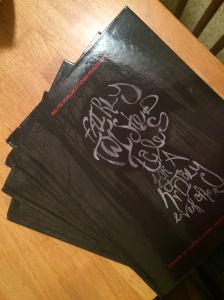
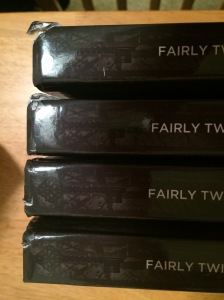
Yep, all but one copy were damaged. I cried. Okay, maybe not outwardly, but I did shed a tear on the inside. Some of the copies were salvageable, but a few were beyond what I would feel comfortable charging money for. Which brings us to today’s post. Not one to waste books (because that’s sacrilege — SACRILEGE, I tell you!), I’ve decided to offer the four worst offenders to anyone willing to give them a good home. Yes, they’re a little rough around the edges; yes, they’re not the pure-bred version we would have preferred, but that doesn’t mean they can’t still be loved. The interiors are pristine. It’s only the spine that got a little munched on. See? I’ll show you:

Image of damaged copies

Another angle of damaged copies

So, whaddya say? Want to give these little guys some place safe and warm? Turn my disappointment into your boon and enter to win here. I’ll choose four winners tomorrow morning and will ship them out by the end of next week. (US only, I’m afraid. Sorry!)

And don’t forget about the other fantastic giveaway currently running here at Nightwolf’s Corner, where you could win a full manuscript edit and custom cover design! That one’s located here; go enter. Seriously! It’s a ridiculous prize and someone’s going to be very lucky when they win it.

An Index of Editing Posts

I’m not feeling especially well this week, so the post I had planned will have to be postponed until next Friday, unfortunately. But I did manage to do some minor reorganizing in the various categories available here at Nightwolf’s Corner. Given my new (this is a relative term, since obviously, it’s been about two years now) identity as Editorial Director for REUTS Publications, as well as my freelance editing career, I’ll be focusing more on posts pertaining to that — tips, tricks, life as an editor snark-fests, that sort of thing. Which means, I’ve now created a special category dedicated to all things editing. (Next week’s post will fall under this new header, actually, and will feature a break-down of the various editorial jobs in the world of fiction publishing.)

In case you’re curious as to what I currently offer by way of editing-related posts, here’s a quick index:

The second new category, for those of you astute enough to notice, is for the contests. I have two annual giveaways I like to do, and rather than clog up the previous category they were under, they’ll now be available under their own heading. Most of them will be closed by the time you peruse them, but they will at least give you a sense of when I do them, and what I tend to giveaway.

Speaking of contests though, there is actually a pretty exciting one currently available. If you missed last week’s announcement, Ashley Ruggirello of Cardboard Monet and I have teamed up to offer a self-publishing author’s dream, for free:

  • A comprehensive, top-to-bottom, full manuscript edit (including structural & line edits)
  • A polished, publish-ready eBook cover design
  • Assistance creating the all-important book blurb
  • A final proofread of the type-set, ready-for-print galley (typesetting/formatting itself is not included though)

Make sure you read the rules posted in last’s week announcement, and then enter via the form! Good luck to everyone participating. 🙂

Announcing the 2014 Holiday Giveaway


Image by Ashley Ruggirello of Cardboard Monet

It’s no secret that Christmas is my favorite holiday, and those that have hung around here for awhile know that I tend to celebrate it by doing a giveaway every year. This year’s no exception, though I am starting it earlier than normal due to the fact it’s my birthday today, and I’m feeling especially generous. 😉

What do I have hidden up my sleeve this time? Something I think many of you will be super excited for. See, I’ve teamed up with the design genius behind the REUTS Publications book covers to bring you a self-published author’s dream — a full-fledged, FREE prize that will take your manuscript from draft to publication-ready. Yep, Cardboard Monet’s Ashley Ruggirello and I have combined our freelance prowess to offer one lucky person the following:

  • A comprehensive, top-to-bottom, full manuscript edit (including structural & line edits)
  • A polished, publish-ready eBook cover design
  • Assistance creating the all-important book blurb
  • A final proofread of the type-set, ready-for-print galley (typesetting/formatting itself is not included though)

It might not be all-inclusive, as you will still need to find a formatter and to create your own marketing materials, but I think you’ll agree that’s a pretty significant monetary value being offered up for free. Every author knows that the two most expensive aspects of self-publishing are the editing and the cover design, so why not take advantage of this rare chance to gain both in one fell swoop?

I’ve got your attention now, yes? 😉

Here’s what you have to do:

Round One:

Starting right now, you can enter to win via the Rafflecopter form. Simply fill out the various possibilities, and your name will be added to the hat. Enter as many times as you’d like until the form closes at midnight on January 2nd, 2015.  On January 3rd, I will select 100 names at random via Rafflecopter’s handy little service. Those lucky people will move on to round two. (And yes, they will be announced on the blog, so you’ll all know who to congratulate.)

Round Two:

This is where the competition gets a little fierce. The 100 winners will be required to submit a query, along with the first 5 pages of their manuscript, via email. (Specific instructions will be sent to the winners on the appropriate date.) I will review them all, and much like an acquisitions editor, I will select the final winner based both on potential and the quality of your pitch. I’ll be looking for the person I think will gain the most value from our help, so your manuscript definitely doesn’t have to be perfect yet, but it does need to be complete. Also, I will consider novellas, but not short stories.

My final decision will be made by January 30th, 2015, and the lucky winner will be announced. So sharpen those pitches, people. Make it so I absolutely have to pick you.

Good luck!

Featured Image: “Sweetheart Ronin” Illustration

Happy Halloween! Originally, I was intending to post my thoughts on literary voice this week, but given that it’s a holiday (and the fact the conference I was supposed to speak at was cancelled), I’ve decided to showcase something a little more spooktacular (yes, horrible pun intended) instead. Some of you may be familiar with the Project REUTSway competition Reuts Publications hosted last year, challenging writers everywhere to pen new and twisted versions of your favorite fairy tales. No? You don’t remember that? Well, you’re in luck then, because it just so happens to have released today. That’s right, FAIRLY TWISTED TALES FOR A HORRIBLY EVER AFTER is available in eBook now! And will be available in a special hardcover edition in a couple weeks. I highly suggest you all check it out; it’s amazing!

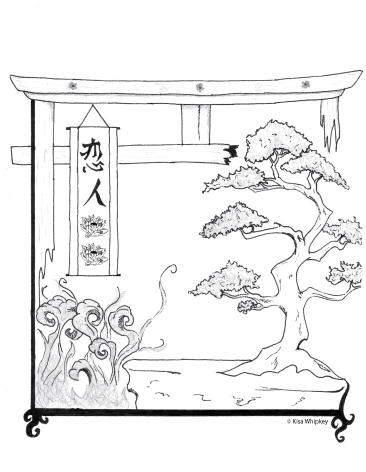
But that’s not the point of today’s post (okay, not the whole point). I’m actually going to do a rare art feature. See, I was lucky enough not only to be involved with the selection of the gruesomely fantastic tales in the anthology, but also to create one of the many illustrations included within its pages. And trust me, there are some truly beautiful works of art in this thing. Want a taste? Well then, let me present my illustration for a story called “Sweetheart Ronin” by the talented Suzanne Morgen:

"Sweetheart Ronin" Illustration by Kisa Whipkey


Created to evoke the style of the setting (Japan, in case you’re wondering), this piece is a combination of traditional drawing with pencil and Sharpie (yes, Sharpie. Who knew, right?) and digital vector graphic created in Adobe Illustrator. In order to understand the significance of the elements, you’ll have to read the story, which can be located here. Buy it. Seriously.

And for those of you curious about Project REUTSway, click here. The 2014 competition, featuring challenges rooted in world mythology, kicks off tomorrow and runs all November long. So if you’re looking to flex those writing muscles, but NaNoWriMo is too daunting/impossible, head on over and check it out. Who knows? Maybe I’ll end up drawing an illustration for you in next year’s anthology. 😉

Featured From the Archives: The Anatomy of a Successful Short Story

Reuts Publications announced the impending return of their Nano-inspired writing contest — Project REUTSway — this week. Which means that (hopefully) there is a horde of eager writers rubbing their hands together in anticipation. (If you’re not sure what I’m talking about, be sure to click above and sign up for the VIP notification list.) It also means that those same writers will be sharpening their proverbial pencils to craft — in rapid-fire succession, no less — four brand new short stories. So what better time than now to dredge this post up from the archives?

Anyone planning on entering PRW (as the REUTS team affectionately calls it), listen up. Here are three things you’ll want to keep in mind as you strive to impress the judges (*ahem* me *ahem*). Let me hand you the key to success on a silver platter; you’ll thank me later. 😉
 

The Anatomy of a Successful Short Story

by Kisa Whipkey

Originally Posted on 12/13/13

 
Short stories. Some people love them, others can’t stand them. But no one can deny they’re an entirely different creature from novels.

This week, I’ve been judging entries for the ProjectREUTSway competition held during the month of November. Buried amid 144 short stories, I started to think about what exactly makes one “successful.” I think most of you know by now that I, myself, published three, so this is a topic that hits very close to home. It’s also one I’ve never really stopped to think about. Until now. Because, let’s face it, short stories are strange. Similar to novels and yet completely dissimilar, they require a certain — almost magic — recipe to really shine. I don’t believe in the undefinable though (at least not when it comes to writing), so let’s see if we can’t identify the exact ingredients that make short stories such a unique form of storytelling.

Short stories are often considered a novelist’s training wheels, the idea being that someone can learn the basics of storytelling through short stories and then graduate into novels. But that’s not exactly what happens. Because, in reality, they require two different skill sets to pull off well. A short story is not a truncated novel, nor is a novel an elongated, rambling short story. Rarely can the concept for one be turned successfully into the other. And yet people still try. Why? Because short stories have been given a bad rap. Novels take all the glory, leaving short stories to rot in creative writing jail like fiction offenders. They’re looked down on as an inferior form of narrative, an eighth grade diploma to the novel’s PHD. After all, the only difference between them is length, right?

Wrong.

There are three things a successful short story must have: brevity, focus, and telling. Yes, you heard me, telling. But before you get your knickers in a bunch, let me explain further.
 

1. Brevity

 
Novelists are taught the value of brevity. But even the most refined novels still sprawl, meandering through details and settings and other things short story authors simply can’t afford. Literally every word matters in a short story. No detail is extraneous. If we mention the light blue collar on a random cat, you can bet that collar is important somehow.

The same holds true for the words themselves. Novelists are allowed to write sentences like this:

She paused, grabbing the handle of the stainless steel refrigerator and pulling it open with a subtle flick of her wrist.

(Hey, no comments on the quality. Clearly, I know that sentence is atrocious. I’m proving a point. 😉 )

That’s 21 words to say this:

She opened the refrigerator door.

Yes, that may be a bit exaggerated, but you see what I mean, I hope. When you only have maybe 5000 words of space, every letter has to serve a purpose. Successful short stories know this, and the language/storytelling is as finely honed as a scalpel. If it doesn’t somehow move the plot along, impart valuable information, or absolutely have to exist, it doesn’t.
 

2. Focus

 
I’m a firm believer that every story should have a message, a reason for existing. But maybe that’s because I started out as a short story author. Whenever I come up with an idea, I identify the core message first, before the setting, characters, or even plot. For example, The Bardach is a story about identity, Spinning is about fate, and Confessions is about losing faith. Even Unmoving has a focal point. At its core, its about compassion. This type of focused narrative is one of the more notable differences between a short story and a novel.

Short stories are single-minded. Like a starving man spotting food, they keep their eyes on the prize. None of this wandering off into detours, flashbacks, subplots or other shenanigans that novels get away with. Nope, they have one message, one plot, one climatic moment that everything points to. And, interestingly enough, short stories are typically driven by an event, rather than a character. The focus is on the action, not the person doing it.

How does this translate into our recipe for success? Well, you’ll be able to feel the underlying drive in a really good short story. You’ll walk away from it remembering the message, not necessarily the characters. So make darn sure you know what you’re saying, both literally and subtextually.
 

3. Telling

 
All right. I know this is the one you were waiting for. After all the times “show, don’t tell” has been beaten into your head, you simply can’t believe I’d actually stand here and advocate telling, can you? Well, I’m not really.

See, the thing is, showing is still 100% better than telling. But, telling is allowed in a short story. Due to the limited amount of time you have to impart your narrative, there’s really no way around it. You don’t have the luxury of wasting thousands of words, or even hundreds, showing us the back-story. Nor can you illustrate anything directly outside the timeline of the main event, regardless how important it may be. So that only leaves one option — telling. You should still avoid the dreaded info-dump if you can, but slipping in the occasional line of summary, or a paragraph of back-story, won’t automatically earn you peer derision. Well, most of the time, anyway.

Successful short story authors are masters of knowing when to tell and when to show. (Which, by the way, I am not. Just wanted to clarify that in case anyone thought I was going to be cocky and throw myself on that list.) They give you just enough information — typically in the form of telling — to make their worlds/characters feel as fleshed out as a novel’s, but not so much that you really notice. They cover a lot of ground in a really short amount of time, making this the hardest skill on the list. It actually requires mastery of the other two to pull off, which is why I listed it last.

And there you have it; the anatomy of a successful short story. Learn how to control these three elements and your short fiction will stand out in a pile like little beacons. And let’s all try to stop viewing short stories as the lesser form of fiction. They’re not inferior. Just different.