Slightly Damaged Books, Free to Good Home

Well, I finally received my shipment of  Fairly Twisted Tales for a Horribly Ever After hardcovers yesterday. Yes, hardcovers, as in the edition exclusive to the REUTS Publications website. I ordered extras with the intent of showcasing them around Portland, but unfortunately, USPS had other ideas. I don’t know what happened to this poor box, but it must have fallen off at least one truck and narrowly escaped the jaws of the Mail-room Monster. It arrived on my doorstep in a mangled, barely-held-together-with-packing-tape, sad little pile. So I think you can guess what that meant for the precious cargo inside.

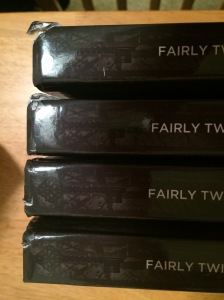
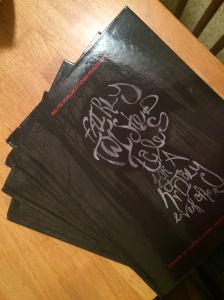
Yep, all but one copy were damaged. I cried. Okay, maybe not outwardly, but I did shed a tear on the inside. Some of the copies were salvageable, but a few were beyond what I would feel comfortable charging money for. Which brings us to today’s post. Not one to waste books (because that’s sacrilege — SACRILEGE, I tell you!), I’ve decided to offer the four worst offenders to anyone willing to give them a good home. Yes, they’re a little rough around the edges; yes, they’re not the pure-bred version we would have preferred, but that doesn’t mean they can’t still be loved. The interiors are pristine. It’s only the spine that got a little munched on. See? I’ll show you:

Image of damaged copies

Another angle of damaged copies

So, whaddya say? Want to give these little guys some place safe and warm? Turn my disappointment into your boon and enter to win here. I’ll choose four winners tomorrow morning and will ship them out by the end of next week. (US only, I’m afraid. Sorry!)

And don’t forget about the other fantastic giveaway currently running here at Nightwolf’s Corner, where you could win a full manuscript edit and custom cover design! That one’s located here; go enter. Seriously! It’s a ridiculous prize and someone’s going to be very lucky when they win it.

An Index of Editing Posts

I’m not feeling especially well this week, so the post I had planned will have to be postponed until next Friday, unfortunately. But I did manage to do some minor reorganizing in the various categories available here at Nightwolf’s Corner. Given my new (this is a relative term, since obviously, it’s been about two years now) identity as Editorial Director for REUTS Publications, as well as my freelance editing career, I’ll be focusing more on posts pertaining to that — tips, tricks, life as an editor snark-fests, that sort of thing. Which means, I’ve now created a special category dedicated to all things editing. (Next week’s post will fall under this new header, actually, and will feature a break-down of the various editorial jobs in the world of fiction publishing.)

In case you’re curious as to what I currently offer by way of editing-related posts, here’s a quick index:

The second new category, for those of you astute enough to notice, is for the contests. I have two annual giveaways I like to do, and rather than clog up the previous category they were under, they’ll now be available under their own heading. Most of them will be closed by the time you peruse them, but they will at least give you a sense of when I do them, and what I tend to giveaway.

Speaking of contests though, there is actually a pretty exciting one currently available. If you missed last week’s announcement, Ashley Ruggirello of Cardboard Monet and I have teamed up to offer a self-publishing author’s dream, for free:

  • A comprehensive, top-to-bottom, full manuscript edit (including structural & line edits)
  • A polished, publish-ready eBook cover design
  • Assistance creating the all-important book blurb
  • A final proofread of the type-set, ready-for-print galley (typesetting/formatting itself is not included though)

Make sure you read the rules posted in last’s week announcement, and then enter via the form! Good luck to everyone participating. 🙂

Video Games: The Future of Book Publishing?

There are whispers in the halls of publishing about how the future of books will slowly evolve into the business model seen in the video game industry. But no one seems to be able to define exactly how that will happen, or which facets will be adopted. And frankly, I just don’t see it. In fact, I’d even go so far as to posit that the people spreading these whispers have little to no understanding of how the video game world actually works. I realize that’s a potentially polarizing assertion to make, but here’s why I think this: see, I actually come from the video game industry. I have a degree (that I rarely talk about) in video game art and design, and I’ve been to the Game Developer’s Conference multiple times. So I know how the video game industry works. And publishing is already structured similarly; there’s nothing left to glean from the video game industry that hasn’t already been incorporated into publishing, or vice versa.

But, just for the sake of argument (and because no one else out there seems willing to break this prediction down and explain it), let’s do a little compare/contrast analysis.

From where I stand, there are only four possible areas where the business models of the video game industry and publishing coincide:

  • Distribution
  • Interactivity
  • Production
  • Content

So let’s explore each one and see if we can’t figure out exactly what these vague whispers and predictions are talking about.
 

Distribution

 
Since I’ve heard these claims from people who are largely on the indie side of the spectrum in publishing, this is my top contender for what they’re looking at. And largely why I suspect people haven’t done their research. There seems to be a misconception floating around about the distribution channels involved in producing a video game. The assumption is that games go direct from the developer to the audience. That’s not exactly true. Even for casual games (otherwise known as the time-killing awesomeness on your phone).

Games, just like books, have multiple parties involved in the making and publishing of a title. It starts with a developer, yes, but that developer then has to secure the interest of a publisher (sound familiar?), and then said publisher needs to find a distributor to actually disperse the thing into the world. So, to simplify, it looks like this:

Game Developer –> Publisher –> Distributor –> Audience

And, in comparison, this is what traditional publishing looks like:

Author –> Publisher –> Distributor –> Reader

There are varying steps that factor in to each that I’m not documenting, (such as agents in publishing, or outside investors in video games), but the basic formula, is, at its heart, very similar. Even if you look at the indie side of things in both industries, the model is the same, minus one step in the middle:

Game Developer/Author –> Distributor –> Reader/Audience

 Video games also struggle with the same divide between traditional publishing and indie, where the AAA titles (as they’re called) are the ones that are mass distributed to brick-and-mortar stores and garner media attention, acclaim, and the all-important exposure needed to succeed. While, on the other hand, the indie titles are left to duke it out for visibility in the digital jungle of the various app stores. Again, it all sounds very familiar, doesn’t it? So where is the innovation and industry-changing business model we’re supposed to be looking to? Not here, unless I’m missing something. So let’s move on.
 

Interactivity

 
This would be another possibility for what the self-proclaimed Seers of Publishing are predicting, and in some ways, I can see why they’d say it. But I still don’t think it will ultimately come to pass, and here’s why:

Video games are a very different form of entertainment from books. Both rely on the idea of escapism, of transporting the consumer to another world where they can step outside their own reality and immerse themselves in someone else’s. But the way they accomplish it is fundamentally different. Games are an active form of entertainment, requiring the user to literally interact with the game world. Books are passive, relying on the reader’s ability to visualize and imagine the words on the page as a real scenario. (Note that I’m basing this observation on a scale of  interactivity, and not on the level of imagination/brain involvement required.)

So, in theory, if books were to go this direction, we’d need to increase the level of interactivity to simulate the gaming experience, right? Well, then let me point you to these lovely things, which already happen to exist:

  • Choose your own adventure books: Immensely popular with young readers in the 80’s, these books required their audiences to put themselves in the character’s place, choosing how they would handle the scenario and seeing the immediate consequences of that action. Notice I said they were popular in the 80’s, though. Meaning they fell out of favor almost as quickly as they rose. They still exist, but they’re rare and outnumbered, by far, by the more traditional forms of reading material.
  •  

  • Enhanced books/eBooks: Yes, this is a thing. There are experimental authors and publishers out there who are trying to find ways to bridge the gap between traditional print and multimedia. Some examples include Booktracks (which pairs a soundtrack with your novel, using auditory cues and music to create a richer immersion for the reader), puzzles deciphered while reading, and enhanced books that are almost more like apps, featuring animations and sound effects. Cool ideas, yes, but again, not very popular with readers.
  •  

  • Supplemental Materials: These are almost more marketing related than anything, but I’ve seen authors create real-life scavenger hunts and multimedia apps that go along with their story and world, engaging their fans in new and immersive ways. Essentially, they quite literally marry the video game industry with publishing, but not in a way that truly enhances the reading experience. It’s additional to that basic action, rather than replacing/modifying it.

 
Which brings us to my point, the reason why I don’t see books becoming more like video games — books were never meant to be truly interactive. If anything, they compete with film for their audience’s attention, because film is another passive form of entertainment. Both of these mediums have always been about observing. Yes, they can affect us, making us feel emotions and form bonds with fictitious beings in ways that might have us wondering about our sanity, but their point is to detail observations, impart information, and deliver messages that transcend our day-to-day lives and make us empathize with, or understand, the world around us. Gaming is entirely different, more akin to physical activity in the way it engages the brain. You won’t often find gamers who spend hours mulling over the morality of murdering that NPC (non-player character) they saw appear on the screen for half a second. Because the act of gaming is about reflex, instinct, and less about deep philosophical thoughts and musings.

But that’s a conversation for a later day. Today’s point is that readers don’t necessarily want to interact with books. They simply want to read them. And until that changes, I don’t see interactivity becoming the hot trend publishing will steal from the gaming industry.
 

Production

 
Ah yes, production. This is where I most often see a lack of understanding about how games are made. There’s this underlying idea out there that games are easy to create, that the time invested in them is minimal in comparison to the profit. And just like the first point, distribution, that’s not entirely true.

The AAA titles — the big ones everyone hears about, the Halos and Dragon Ages and Skyrims of the world — take, on average, 3-5 years to produce. And that’s with teams of several hundred people. You have game designers, artists/animators, programmers, actors, PR/marketing/administrative staff, and sound engineers involved, and it’s as time intensive as creating a feature film. The reason these are considered AAA titles is because they have budgets that rival cinema blockbusters. It’s no small feat to release a game of this scale, and with the advances in technology, gamers are becoming more and more expectant of this level of quality. Anything that falls below this often earns derision and ridicule.

The casual games (think the ones on your phone that most people consider mindless wastes of time) are less intense, but still generally require at least a small team of people to invest months or even years of their life into their creation. There are a few really astounding individuals that have found success doing it all on their own, but those are the exception, not the rule.

All right, how much of what I just said sounded familiar to all you writers out there? I’m guessing all of it. Because again, it’s not dissimilar to the way the book industry already operates. You have the Big 5 publishers (with the equivalent of blockbuster budgets) publishing a select few, super prominent titles, and guess what? On average, it takes 2-3 years from the time they sign you to the time your book is in stores. And then we have the indies, where the timeline is much shorter, but you still have a team of experts (editors, cover designers, formatters, etc.) helping you put out a product that is largely under-respected by the world.

So what’s to be learned from the gaming industry here? They’re fighting the same equality battle that publishing is, and frankly, they’re not doing any better than we are on that front.
 

Content

 
This is the last possible area that could potentially be what the predictions are talking about. But they have it backwards. See, the divide between gaming and books isn’t being bridged because books are becoming more like games, it’s because games are becoming more like books. There’s a movement within the gaming industry to include stronger storytelling in games. Let’s face it, up until maybe five years ago, games were not hailed for their storytelling prowess. And that’s because 90% of games were written by game designers, people who focus more on what makes a game fun than anything else. They created the game mechanics (the rules) and built from there.

And then along came companies like Bioware and Bethesda and Square Enix, and suddenly storytelling started to become more important, leading to the employment of actual game writers. So now we have video games that actually include epic narratives with quality writing, bringing the worlds of literature and gaming one step closer together. But that’s not publishing noticing the strengths in the gaming industry and adjusting accordingly, that’s the gaming industry glomming onto the strength publishing already had — story.

Which brings us to the conclusion of our analysis. As you can see, for someone standing with a foot in both industries, this prediction of publishing turning into the gaming industry makes little sense. I simply don’t see the shiny new path these people are touting. But that doesn’t mean it doesn’t exist. If someone out there has a better understanding of exactly what this vague statement for publishing’s future means, I would love to be enlightened. Please share  your thoughts on this interesting topic in the comments. Do you see publishing moving toward video games, and if so, in what way? I’m sure I’m not the only one out there dying to know. 😉
Serial to Series, and Self-Pubbing by Accident

The following is a guest post (and part of the blog tour for her self-published novella that I’ll introduce at the end) by my good friend and fellow editor, Cait Spivey. It’s excellent information, as usual, but stay tuned after the post for some special announcements and cool reveals regarding Cait’s non-editorial efforts. I don’t want to take up too much space, so without any more preamble, here’s Cait!
 

Serial to Series, and Self-Pubbing by Accident

by Cait Spivey


I always considered myself a traditional publishing kind of girl. I figured I’d be happy to do a little marketing, get myself out there to events, and schmooze, but would prefer to have the support of a press to help me along. Self-publishing was fine and dandy, but not my speed.

Fast-forward a year or so into my publishing journey. I’d been querying a high fantasy to agents – -angling for that New York deal — with good interest but no contracts, and working on some other side writing projects. A sci-fi inspired by the “what if the Doctor were female?” question. And a little story about a girl being stalked by spiders.

I liked this little story. I liked the main character, Erin, whose voice came to me so easily. I’d originally planned it to be a full-length novel, but as I wrote, it became clear that this wasn’t a novel. It was the groundwork for something much larger.

So I finished it at almost 17,000 words, and wondered what the hell to do with it: too short to query, too long to be a short story. I thought about cutting it down and sending it to literary magazines, but there was no way to cut 10k  words without completely changing the story. I thought about expanding it, but the ending was utterly fixed to me, and while I could have come up with more to pad the rest, it would have become out of proportion to the climax.

One of the presses for which I edit, Curiosity Quills, offers a few serials through their website, as does Kisa, my gracious host for today, and a number of other writerly friends I’d made. So I got the idea: why not put my spider story on my own blog? Otherwise, it was just going to sit rotting on my hard-drive.

I mocked up a little cover featuring a beautiful spider photographed by my friend Jo (http://thebrokenshelf.com/), scheduled all nine posts, and off we went. As the end of the run drew near, I thought it might be nice to have the whole thing available for download, as like a pdf or something. So this past March, I formatted I See the Web, made myself a less spider-rific cover that better represented the story, and uploaded it to Smashwords for free download when the serial run was over.

Then I realized: I’d self-published it.

And I’d done so with barely a scrap of marketing or other pre-launch build-up. Still, the book was downloaded pretty steadily, so after about a month of having the book up for free, I published it to Amazon through KDP and changed the price to $0.99.

I turned away from I See the Web and focused on other projects for a little while, but my little novella was still out there, still trucking along. As those other projects got more serious and as I made definitive decisions about my goals for the future, I decided it was time to come back and give Erin her due. If I wanted the book to do well, and if I wanted to bring attention to the sequel I was writing, I needed to give a proper marketing effort.

The result is this blog tour and cover reveal.

To say it’s been a learning experience would be an understatement, and if I can impart any advice, it would be this: have a plan ahead of time. While my experience with I See the Web has pretty much worked out, the past few months would no doubt have gone a lot better sales-wise if I’d thought ahead, made deliberate choices, and set specific goals.

Another important piece of advice: don’t treat any of your work as a throw-away. The reason I didn’t do much planning with I See the Web is because I thought it was going to be just a one-off, something unconnected to the rest of what I wanted to accomplish. Totally untrue! Not only is it my first published work, a place nothing else can ever supplant, it’s also become the anchor for a far-reaching series of loosely connected books, novellas, and short stories within The Web’s universe. While reading I See the Web won’t be necessary for any of those other stories, it will add to those reading experiences.

There are plenty of publishing paths available to authors these days and, for the most part, one is not better than any other. It may take some time to decide which one is right for you and your project, and that’s okay. But you can’t let publishing sneak up on you.


Pretty sound advice, no? I think a lot of us (myself included) could benefit from her lessons. I know I have a tendency to forget about certain projects, deeming them less worthy than others of time in the limelight and/or love. But she’s right; they’re all part of my writing career and deserve the respect of my attention.

But I promised goodies and reveals, and since I don’t have any for my own work that you don’t already know about, I’m happy to introduce you to Cait’s. First, here’s the information and buy links for I See the Web:

I See the Web by Cait Spivey

Seventeen-year-old Erin has a lot to look forward to, even if it suddenly seems like everywhere she turns there’s a spider staring at her. She’s finally out to her friends and family, surprising exactly no one. When Dawn, the love of her tender teenage dreams, corners her in the library, a whole new world opens up to Erin. From here on out, it’s all make-out sessions with her beautiful girlfriend in rooms stacked high with books.

Until the spiders start whispering.

Turns out the spiders aren’t just stalking her for kicks. They need her to be their voice, their vessel, whatever that means. But their timing is crap, because there’s no way Erin is giving up her human life just when things are starting to get amazing. Too bad the spiders just won’t quit. Like it or not, Erin will have to choose, and it won’t be nearly as easy as she thinks.

Amazon | Barnes & Noble | Smashwords

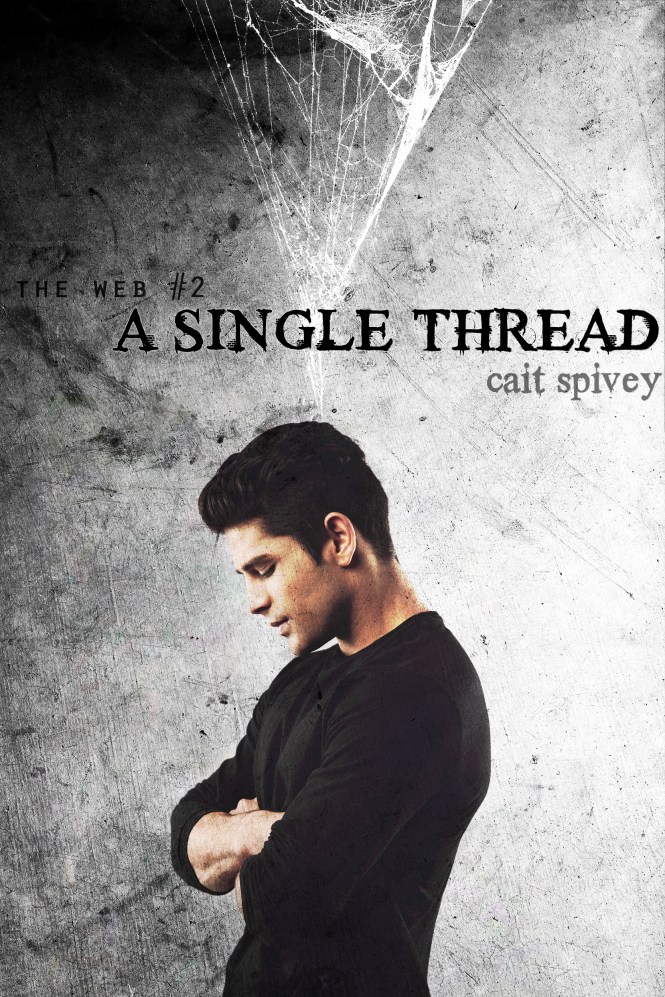
And now, I’m thrilled to help reveal the cover for I See the Web‘s highly anticipated sequeal, A Single Thread:

A Single Thread by Cait Spivey

It’s been two weeks since Morgan Fletcher’s little sister, Erin, disappeared before his eyes in a flurry of spidersilk and blood. Probability says she’s dead; but when Erin comes to him in a dream, Morgan’s eyes are opened to a level of reality where probability doesn’t mean jack. His sister sees the web of time, and she’s got news for him: trouble is coming.

A cryptic riddle and flashing images of the future are all Morgan has to go on in order to save a mystery boy from a gruesome death. That’s if he even believes what’s happened to Erin. Is her spider-whisperer persona for real, or has his grief at losing her caused him to totally crack?

With a life at stake, Morgan isn’t taking any chances. Madness or no madness, he has to solve Erin’s riddle before it’s too late.

Releasing October 31st, 2014

And, because that’s not enough to convince you that Cait’s awesome and you should totally go support her, here’s a ridiculously amazing book trailer for A Single Thread:

Book Review Wednesday: The Curse Merchant by J.P. Sloan

Yes, I know, it’s technically Tuesday, but since this will be occupying the spot of glory on my blog until Friday, I thought we could let that slide. Besides, I’m part of this here spiffy blog tour:

Tour Banner for The Curse Merchant

And no, I’m not lying. The banner does say the tour ended yesterday, but this is the date I was given. So, this is the date I’ll supply my review. Right after I give you the obligatory information about the book.
 

The Curse Merchant

by J.P. Sloan


Cover for The Curse Merchant

My Rating: 4/5 Stars


Dorian Lake spent years cornering the Baltimore hex-crafting market, using his skills at the hermetic arts to exact karmic justice for those whom the system has failed.

He keeps his magic clean and free of soul-corrupting Netherwork, thus avoiding both the karmic blow-back of his practice and the notice of the Presidium, a powerful cabal of practitioners that polices the esoteric arts in America. However, when an unscrupulous Netherworker interferes with both his business and his personal life, Dorian’s disarming charisma and hermetic savvy may not be enough to keep his soul out of jeopardy.

His rival, a soul monger named Neil Osterhaus, wouldn’t be such a problem were it not for Carmen, Dorian’s captivating ex-lover. After two years’ absence Carmen arrives at Dorian’s doorstep with a problem: she sold her soul to Osterhaus, and has only two weeks to buy it back. Hoping to win back Carmen’s affections, Dorian must find a replacement soul without tainting his own.

As Dorian descends into the shadows of Baltimore’s underworld, he must decide how low he is willing to stoop in order to save Carmen from eternal damnation… with the Presidium watching, waiting for him to cross the line.

This book starts with a bang. From the first sentence, we know we’re in for two things: a snarky narrator (and it’s no secret I adore a snarky lead) and a gritty, rough-around-the-edges kind of read. And neither disappoints.

Dorian Lake crafts hexes and charms fueled by the karma of the person purchasing them. But he avoids anything involving the darker arts of the Netherwork. That is, until an old flame reappears and pulls him head-first into turmoil. Now, in order to save Carmen, Dorian has to find a way to replace her soul, all while evading detection from both his rival — the man responsible for Carmen’s predicament– and the Presidium, who essentially police the use of magic.

One part gritty police procedural/spy novel, one part supernatural thrill-ride, The Curse Merchant is definitely intriguing. I found the world building to be generally well-done, with lots of attention paid to the history and back-story of both the craft and the characters. The structure of the story was a bit disjointed in places, as the narrator has a tendency to drift down memory lane, but the wit and tongue-in-cheek sarcasm more than made up for that. Fast-paced and full of twists and turns, Sloan definitely knows how to keep his audience hooked. But I found his take on magic, especially the karma angle, to be the most intriguing. It was refreshingly original.

I wouldn’t recommend this to readers who prefer their books to be clean, as swearing and violence are both very present. But for those who don’t mind a little grit in their fantasy, this book is a great find. With a lead character whose charm and integrity endear him immediately, and a plot that will have you questioning your own sense of morality, The Curse Merchant is everything a great urban fantasy should be. The only reason I didn’t give it five stars is because I felt it could have been a little better edited. But that’s no reflection on the author’s talent, and doesn’t sway me from recommending his work to fans of the genre.

**Disclosure Statement: I received a copy from the publisher in exchange for an honest review. **


About the Author:

J.P. Sloan is a speculative fiction author … primarily of urban fantasy, horror and several shades between. His writing explores the strangeness in that which is familiar, at times stretching the limits of the human experience, or only hinting at the monsters lurking under your bed.

A Louisiana native, Sloan relocated to the vineyards and cow pastures of Central Maryland after Hurricane Katrina, where he lives with his wife and son. During the day he commutes to the city of Baltimore, a setting which inspires much of his writing.

In his spare time, Sloan enjoys wine-making and homebrewing, and is a certified beer judge.

J.P. Sloan

Website | Facebook | Twitter