Featured From the Archives: Why do you . . . (Insert Creative Verb Here)?

As the 2nd year anniversary of my blogging experiment draws near, I realize I’ve reached the point where many of my followers probably haven’t read the older posts. So periodically, I’m going to feature one of those archived gems (which pretty much means I ran out of time and/or motivation that week) and give you a chance to discover them again. (Or, for the first time, as the case may be.)

Today’s feature is one that hopefully doesn’t offend too many people. But with all the various blog hops going around (like the ones I, myself, have participated in recently), and posts about what it means to be a (insert whatever creative term you were reading about), it seemed like the perfect time to showcase this again. (Plus, I’m feeling a tad under the weather, and my pesky muse decided to high-tail herself out of the plague zone. ) So, to kick off my new/old series, I present: Why Do You . . . (Insert Creative Verb Here)? A snarky, honest post about what we’re all really thinking when you ask us this. (Warning, contains tongue-in-cheek sarcasm and blunt reality. Read with your serious-meter on half.)

Oh! And don’t forget, I still have that fantabulous (yes, that’s a word. Shut it before I hurl this NyQuil bottle at your head) giveaway I’m running in honor of my upcoming blogiversary. I’ve already received over 300 entries, so three lucky people will be receiving the book they chose from the list. And if you’d like to make it four (and to see whether or not what I’m saying is a cold-med induced hallucination) click here!

Back to the post!

Why Do You . . . (Insert Creative Verb Here)?

By Kisa Whipkey

(Originally Posted on 5/11/12)

This is probably the most-asked question of creative people -– sometimes even by other creative people. And it’s one of the more irritating ones, because it’s such a hard thing to quantify. It’s like asking someone why their eyes are blue, or why they were born in the morning. How do you answer that? So, understandably, the answers to why someone’s creative vary wildly depending on the person. You’ll hear things like:

“I’m not sure, I just do.”

“Because it makes me happy.”

“Because it’s therapy for me; it helps me express myself.”

And my personal favorite, “I do it for me.”

Now, the truth is, all of these answers are sugar-coated, watered-down replies meant to make the artist look more artsy; to make the listener think, “ooo, aren’t they cool? They’re so mysterious and vague.” Personal satisfaction is great, but you go to the gym for personal satisfaction, you don’t pour weeks, months, years, heart and soul into a project just for personal satisfaction. I mean, don’t answers like that just seem so full of themselves? Why narcissism is encouraged within the arts is beyond me, but the more self-involved the answer, the more prestige points an artist receives. And the more frequently you’ll hear responses like the above.

Personally, I view every one of those answers as a cop-out. Because ultimately, statements like that are rarely true. And before you get up on your high horse and scream “controversy!” while flooding my comment box with all the reasons I’m wrong, hear me out. If creativity is such a personal thing (which I’m actually not arguing, because it is), why would anyone share its products? All those artists, authors, and musicians that claim they only create for themselves are lying. The proof is in the sheer fact that they made said creation available for public consumption. If it was truly just for them, it would be stashed in a vault somewhere, guarded by large, vicious dogs, and fiercely protected until its location was lost in the afterlife. Not put on public display for all to judge. But that’s not the case, is it? Because they shared their work with the world.

(The only exception may be personal diaries and journals, which are never truly intended to be shared, but in reality, are almost always found and read anyway.)

When I’m asked this question of why I (insert creative verb here), I have a generalized, self-important, prosaic answer that I’ll give. (Who doesn’t want to earn some prestige points?) I simply say that the reason I (chosen creative verb of the moment) is that I never realized not (doing said creative verb) was an option. And this is partly true. Creativity just came naturally. Like breathing. But just like the answers I listed above, that lovely little sound-bite, while somewhat accurate, is not the real motivator behind my masterpieces. (See? Don’t I just automatically sound more brilliant because I called them that?)

The brutal, honest truth is something none of us “Artistes” like to admit, because it makes us seem desperate and needy, and those two adjectives are a far cry from cool and mysterious. We don’t want to be put in the same category as your psycho ex that Facebook stalks you. But the reason all those artists, authors, and musicians refuse to admit, is that we create because we want validation. Public approval. Fame, glory, and all that jazz. Just like when we were little kids and we ran to Mommy looking for approval on our latest blob of mismatched crayon wax we were certain looked like the cat, we offer up the fruits of our labor to the public eye. With the sole intent of being lavished in praise for our awesomeness.

When you think about it, it’s not really that hard to see why this is the real motivator behind creativity. It’s the same reason we post status updates several times a day and then check back obsessively, waiting for those little thumbs-up signs to appear that means someone likes us, someone agreed. We’re cool. It’s human nature to seek praise from those around us; it makes us feel good, worthwhile, valued. Does that mean all artists are shallow, attention-seeking ho-bags? No. Do we all secretly want to preen while you sing our praises and tell us how awesome we are, so we can humbly pretend we didn’t already know that? You betcha.

Ultimately, though, it’s receiving feedback of any kind (although preferably of the worship-my-brilliance variety) that motivates us to hit that upload button, to submit that manuscript, or to step out on that stage. It’s often said that creativity doesn’t happen in a vacuum. And I 100% agree. Without that input from others, your creative side will shrivel and die like a thirsty plant locked in a closet. Which is why, whenever someone answers with the angelically selfish response of , “I (whatever) for me,” I find myself annoyed. Why is it OK to feed your narcissistic ego by pretending that success means nothing to you and you don’t care what anyone else thinks, but not OK to admit the truth? You did it for the same reason I do –- to feel good when others tell you your creation is something wonderful.

And for those out there that feel this question, this “Why do you . . . (insert creative verb here)?” is a perfectly legitimate conversation starter, it’s really not. You’re just going to be lied to. Few of us will man up and admit, “I did it to be rich and famous. Duh.” You’re much better off asking questions that actually have quantifiable answers. Ask why we do things a certain way, or what did we mean with X, instead of something as innocuous as why do you create?

Hey, nobody said honesty always had to be pretty. And I did warn you that snarky rants were a definite possibility. But let the barrage of offended comments commence anyway. 😉
Elitism in the Arts

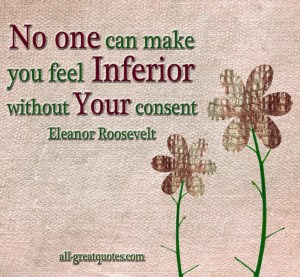
No-one-can-make-you-feel-inferior-without-your-consent-Eleanor-Roosevelt-1024x946
 
This is a post I’ve dreaded writing, because in order to do so, I have to relive some painful memories. But I feel like this is a message that needs to be said. And so, though it comes from a negative part of my life, I’ll try my best to keep it positive. First, some raw honesty:

Throughout my creative journey, I’ve tried many different branches. And I’ve felt like an outsider every time. The writing community has been welcoming, but recently, I realized that the literary one is a completely different beast, and that I will once again be facing down the enemy of being different. This isn’t a battle that’s new to me, though. In art, I was ostracized for being too commercial. In the Martial Arts, I wasn’t traditional enough. And in writing, I’m not literary, coming from a film background rather than one in English. But, you see, the problem isn’t me. Those are all things I’ve been told, things that have created scars I’ll never fully erase. They’re not the product of a lack of ability, or talent. No, they’re the product of a phenomenon that should never exist — elitism.

People hold the arts up as this ideal place for individuality, where you’ll be free to express yourself without fear of judgement and prejudice. But those people are wrong. Rooted in subjectivity, the arts are actually worse than other industries. Instead of embracing the different, the weird, the innovative, they shun it, viciously tearing down anyone who dares to try something new, or becomes too popular. And who can blame them? People who do things differently risk the status quo. And we can’t have that. (Even though that’s the motto flying on our brilliantly-colored flag of creativity.)

Humans are pack animals, no matter what we’re led to believe. And nowhere do you see that penchant for cliques more prominent than in the arts.

I came face to face with it for the first time in college. (Now, you should know that I went to college at the ripe age of 16, so I was still highly impressionable.) There I was, testing my wings for the first time in what I thought was a safe environment to do so. College is all about experimenting, right? Finding one’s self, and blah blah blah. Well, I had the good fortune to find a college professor whose close-minded bullying nearly had me hanging up my pencils for good.

I don’t know the story behind what was happening in that woman’s life, but that also shouldn’t matter. She was an educator, someone entrusted to help mold the minds of our youth. And she abused that power. I was stuck with her for three classes that semester — color theory, figure drawing, and beginning painting. Things started off great. I’d never been exposed to formal art classes, so I was a sponge, putting my best into every assignment. (I’m also a perfectionist with a compulsive need to get A’s, so you can connect the dots on my level of participation.) She seemed to like me, and I did well in all three classes. Until one day, about halfway through the semester, when she asked me the fated question I would learn never to answer honestly — what kind of artist do you want to be? Stupid me, I told her the truth:

“I want to be an animator,” I said, not realizing that word was akin to the most vulgar thing in the dictionary.

She looked like I’d spat in her drink. She backed away from me, a completely disgusted look on her face, mumbled something snide and walked away. After that, my grades plummeted, she wouldn’t call on me during class, and it was like I didn’t exist. But the kicker was the final project for the painting class. The assignment was to create an abstract painting that had no clear top or bottom. I’d never done abstract before, but I did my best, following the assignment to the letter.

Like all teenagers, I was battling some emotional instability, so I tried to capture that turmoil in paint. Doesn’t get more “tortured artist” than that, right? Well, when it came time for the final critique, this woman took my painting to the front of the class, turned it on its side and said, “Oh my God, where’s Bambi?” (Yes, that’s a direct quote.) I’ve never seen a room full of young people so silent. I swear, they all stopped breathing, staring at me with wide eyes as this teacher continued to ridicule me in front of them all, informing me I had failed because clearly, I had portrayed a forest fire.

I left that class in tears, dropped out of school and gave up on art for the next five years. All because I’d made the mistake of uttering the “A” word.

That’s not the only time I’ve run into that kind of elitist attitude either. Over the years, I’ve been accused of plagiarism (because I happened to write a sci-fi story that featured a weapon mildly resembling a light saber), told I wasn’t good enough to amount to anything, and been patronized because I don’t do things by the majority norm. And I know I’m not alone. These kinds of experiences are par for the course in the arts.

You want to be a singer? Too bad, you suck.

You want to paint? Well, you’re not Van Gogh, so you may as well give up.

You want to be published? Every door will be slammed in your face.

Overcoming adversity is the very definition of being an artist. But it doesn’t have to be that way. So what if someone wants to play the violin with their toes. Or paints murals on street signs. Or writes something a little rough around the edges. It doesn’t make them any less of an artist. The different creative communities claim to be so welcoming and open-minded, but instead, offer only elitism and rejection. If you’re not the alpha of the pack, then you’re the scapegoat. Or worse, lost somewhere in the middle, amongst a sea of sheep.

What’s the point to all this? Simple — don’t let yourself fall prey to elitism. Words have power, whether they be said in jest or seriousness. And that power lasts. To those of us in a position of authority (agents, editors, publishers, teachers, etc.) I implore you to think about what your rejections do to the people who receive them. So it wasn’t your cup of tea. That’s fine, but be nice about it. There must be something good you can give them, some piece of encouragement and/or advice. There’s no reason to get up on a high horse and strip them of their dignity. It’s our job to be the mentors, to help people achieve their creative dreams. Falling into the pack mentality is easy to do, but if we all try a little harder to remember our humanity, and not our need to feel important, we can eliminate experiences like those I went through.

And for those of you who have suffered, or are suffering, under the sword of elitism, keep your head up. Just because one person says you can’t, does not mean you can’t. It took me a long time to get over what that painting teacher said, and I would have destroyed the piece if my mom hadn’t saved it. But I’m glad she did, because I no longer see the emotional turmoil it represented. I see a fire-breathing dragon. It’s a reminder of what I’ve overcome, and that it’s okay to fight for your dreams. So remember, as the great Eleanor Roosevelt said, “No one can make you feel inferior without your consent.” We all have a choice. We can become victims, or we can become dragons. I chose to be a dragon, to fight back against elitism and approach my creativity with strength and resolution. Which will you be?


Abstract Painting

Untitled

by Kisa Whipkey

Copyright: 2000
All Rights Reserved

The Writing Process Blog Hop: Take Two

Before you start, yes, I know I’ve already written a post about this. But Jon over at Jumping From Cliffs (you should totally check him out! His posts are full of dry wit and helpful advice) tagged me again, this time as a writer. What do I mean, “this time”? Well, if you recall, the last post was morphed slightly to impart my views on the process as an editor. Not necessarily my views as a writer. But, contrary to how it may seem, I am actually still a writer. Editing may have taken over my life, and I may often feel like I’m trying to bail out my sinking schedule with a spoon, but that doesn’t mean I’ve given up on my writing. In fact, quite the contrary.

So Jon has graciously given me a second chance to participate in the blog hop, not as freelance editor extraordinaire, or even Editorial Director for REUTS Publications, but as just little old me, the author.

How does it work? It’s really quite simple: I answer the following four questions and then send you off to read about some truly amazing folks. And trust me, the four I’ve chosen each have something unique to offer that you won’t want to miss.

But first, the questions:
 
1) What are you working on?
 
I already spoke about Unmoving in that previous post. So, rather than repeat myself, I’ll talk about the series it’s part of as a whole. (If you want to find out more about Unmoving specifically, simply click here.)

Unmoving is the first in a long urban fantasy series (I think I’m up to about 15 plot bunnies) that I’ve dubbed The Synchronicity Series. For those unfamiliar with the term, “synchronicity” is a psychological theory developed by Carl Jung. In it’s simplest definition, it means you find meaning and connection between two seemingly unrelated events. This concept is the foundation of the series, making its presence in the series name an obvious, yet essential, choice.

Each book technically stands alone. Unlike other series, there’s no common character, or place, or even theme linking them all together. How is that a series? Hold on, you’ll see. Instead of the usual conventions that link a book to its sequels, I use the principle of synchronicity. Each book contains at least one Easter egg, what I’ve been calling a jump-off point, a place where the various plots in the series momentarily intersect. It could be a brief encounter on the street, a phone conversation someone overhears, or even something seen along the road, but somewhere in each book, you’ll meet the main character of the next one. The characters all lead completely separate lives, so to each, the jump-off point is an irrelevant, unrelated event in the grander plot of their story (one you’ll get to see from both sides), but to the reader, it has meaning. If you’re willing to look for it.
 
2) How does your work differ from others in the genre?
 
Aside from what I just outlined? Hmm, that’s a hard one.

I suppose I would say that my work tends to be very multilayered and complex. It’s never just one genre. I tend to pull from several — fantasy, horror, thriller, mystery, etc. — to make one strange and twisted blend. Then I’ll infuse that with another layer of psychological torture and a dash of cinematography. I’ve always said that I don’t write like a writer. I write like a film director. So I think, (well, hope) there’s a definite cinematic feel to my generally somber stories.

But even though my work is classified as dark, there’s always a ray of hope laced through it. And there’s always a message buried somewhere. Nothing pretentious or preachy, just something subtle that I hope readers will pick up on and that will give them pause to think.

Does that qualify as different? You tell me. 😉
 
3) Why do you write what you write?
 
Honestly? Because I don’t know how to write anything else. As a reader, my tastes are as varied as they come. But when it comes to writing, only one thing comes out — dark fantasy. Fantasy has always been my go-to genre of choice, and until recently, it was more of the high/dark fantasy variety. I never expected to branch off into urban or paranormal. So maybe that’s a good sign. Maybe I’m not as rigidly defined as I think. I do suspect that I’ll always stay somewhere within the speculative fiction genres though, as trying to create a contemporary novel literally boggles my mind. I truly don’t understand how its done, how you create tension and conflict without the aid of something supernatural. (The fascinating part is that I totally get it when it comes to editing. It’s only my writer half that’s completely baffled by it.)

Maybe that makes me a little dense as a writer, but I choose to think of it as self-knowledge. I know exactly what I’m meant to write, so why bother trying to force something different?
 
4) How does your writing process work?
 

I actually wrote an overly detailed version of this about a year and a half ago: How Does She Come Up With This Stuff?

But the short answer, for those that don’t want to sludge through that previous post, is music. I have a very strong connection with music (as most writers do) and literally everything I do creatively stems from it. The core story idea directly correlates to the song that inspired it, although I seem to have a distinct gift for taking even the happiest, sweetest songs and making them dark and twisted. (Unmoving being the prime example. It was inspired The Script’s “The Man Who Can’t Be Moved”.)

I’m not a big outline person, though I do tend to write very linearly. So once I have an idea, I only create the bare minimum in terms of a road-map. I’ll block in the scenes on a spreadsheet, with only a few words to summarize the goal. This allows the writing to remain very organic, while still progressing steadily toward the final point of the tale. Technically, I suppose I fall somewhere between a pantser and a plotter, since I like to have a sense of direction, but also like to be surprised by the details that appear as I’m writing.

That concludes my portion of today’s program. Now, I get to introduce you to four of my favorite people:
 
Priya Kanaparti: Author of Dracian Legacy, Priya is a ray of sunshine. Seriously. There’s something about her voice that feels warm and happy, even when she’s writing the most heart-wrenching scenes. Her enthusiasm for life is infectious, and she’s probably one of the sweetest people you’ll ever meet. She’s also extremely determined and focused. Her regimented writing schedule leaves me in awe. I’m sure she’s got a few tips and tricks we could all benefit from, so be sure to check out her writing process in the next few days!
 
Drew Hayes: Drew is one of the funniest people I know. His posts are full of sarcasm and brilliantly wicked analogies that have me laughing out loud on a regular basis. Author of several self-published works, including a serial web novel, and the upcoming The Utterly Uninteresting and Unadventurous Tales of Fred, The Vampire Accountant, Drew has experienced all the various forms of publication. His latest experiment — live-writing a novel during the month of April — is one you definitely won’t want to miss!
 
Cait Spivey: Fellow editor, and newest member of the REUTS Publications family, Cait has plenty of insight to offer. Author of the serial short story I See the Web, as well as several NA novels, she also bridges the fence between writing and editing. Her blog features a lot of helpful articles on writing and publishing, and I highly recommend it. She shares a lot of the same viewpoints I do, so if you enjoy Nightwolf’s Corner, you’ll find a lot to love in Cait’s work too. 😉
 
Summer Wier: Summer is one of the most genuine, supportive people I’ve ever met. She’s also a brilliantly gifted writer. Her debut YA novel is currently making the querying rounds, but she’ll have three short stories in the REUTS Publications anthology of retold fairy tales releasing this fall. Her posts range from book reviews to personal experiences in the writing world, but the one thing contained throughout is her signature wit and humble honesty. So definitely show her the love she gives to the writing community and check her out!
 
And, of course, be sure to stop by Jumping from Cliffs. Jon has been one of my favorite bloggers for a long time now, and his quick wit never disappoints.
 
Andrew Toynbee is another person I’ve had the pleasure of getting to know, as we (along with Jon) started blogging around the same time. He, too, is participating in the blog hop, and his post is nothing short of epic. So if you’re looking for even more writer awesomeness, be sure to check it out!

Next week, I’ll have something insightful and snarky for your reading pleasure. What that will be? I don’t know yet. So if you have a request, now’s a great time to let me know. 😉 Until then, happy reading!

How I Became an Editor

I’ve had some requests recently for the story of how I became an editor. Which means I have to pull on my big girl shorts and do that thing I don’t like to — talk about myself. Blerg. (Yes, that’s a word. At least, in the House of Whipkey. ;P ) Those who have lingered around these parts for a while know that I do tend to make my posts personal, relying on self-deprecation and personal experience to impart advice, tips, and (I’d like to think) humor. But rarely do I actually talk about just me, as in my life story. Making what’s about to happen the perfect example of what I said not to do in my post about exposition a few weeks ago.

I’m not one to leave a request hanging though, so **deep breath** here goes:
 

How I Became an Editor

 
When someone sets out to become an editor, there’s a very clear path they usually take — love books, realize they’re kind of a nerd for grammar, excel in English classes, graduate with an English degree, move to New York, become someone’s coffee gofer for a bunch of years, and then poof! Editor status. Yeah, that’s not the path I took. My journey to editor-land looks more like the one taken by an ADD squirrel in the middle of nut season. In fact, I never set out to become an editor at all. Editing was always on my radar, but it was one of those mystical, unattainable jobs — like astronaut, or unicorn breeder. I never actually saw myself becoming one. I just didn’t understand how to get there, what series of life choices ended with that shiny prize.  And so, I set my sights on a different career altogether.

I’m getting a little ahead of myself though. If we go back to the very beginning of the story, you’ll see that I was always destined to find my way into editing. One of my first memories as a kid (like young, before I could read, kid) is taking every single picture book I owned and stacking them on the floor. I’d then sit next to that massive pile taller than I was, and read them one at a time. Except, as I just noted, I couldn’t read yet. So I would look at the pictures and make up my own version of the story. Now, some of you might be thinking that sounds like a writer more than an editor (and a massive red flag for OCD). But the thing is, I didn’t actually create new stories. I took what I knew of the existing one (because my parents were awesome and read to us a lot) and then changed accordingly. Which, in case you haven’t put two and two together yet, is one of the main things an editor does.

Reading remained one of my favorite activities as I grew up, often becoming the highlight of a lazy summer day. (When you live an hour away from civilization and the nearest neighbor kid is like two miles away, there’s not much else to keep you entertained.) I also dabbled in writing and drawing. I actually thought I’d be a writer, until I turned eleven and saw this:


And, like the proverbial spotlight from heaven, complete with angels singing, I found my calling. (Or so I thought.) From that point on, I was dead-set on the fact I wanted to be an animator. I taught myself everything I could about traditional animation, (via various Disney books) and even spent cold winter evenings out on the back porch with a light table my dad built for me, drawing away.

I kept that dream alive for a long time, intending to go to Cal Arts (California Institute of the Arts) for college and then, eventually, work for Disney. But, by the time I got to college-age, I chickened out. And then, shortly thereafter, the traditional 2D animation industry died. So I bounced around a couple of Junior Colleges for a while before finally transferring to a State University. What did I pursue there? English. I tried their art program for about a semester, but fine arts and I are like oil and water. They don’t like me because I’m too “commercial”, and I don’t like them because they’re pretentious and close-minded. But that’s a story for another time.

During my obsession with animation, I kept writing. (In fact, the majority of my current 300 + plot bunnies originally started life as animated movies.) I decided that if I couldn’t pursue art (which had been made abundantly clear by some horrible experiences with art professors), I’d fall back on my second love and become a writer. I loved my classes, and did well for a couple semesters. I started writing more frequently and finally felt like maybe I’d found a career path.

Enter the worst romantic mistake I ever made.

You know that ex that makes you shudder with revulsion and embarrassment when you think about them? Yeah, I happened to find mine right as I was trying to figure out my writing style. His lack of support and pretentious condescension (he’d already graduated with an English degree and thought he was better than, well, the world)  resulted in my giving up. On everything. I quit writing, I quit school, and I ended up working in the mall. Yes, the mall. It was a dark time in my life.

Fast forward about 3 years. I’d dumped his sorry ass, moved back home with my parents, and was floundering around for some direction. I worked on repairing the psychological damage that relationship had caused and picked up all the things I’d let go, but never forgotten about — writing, drawing, martial arts. Happiness returned, but I was still a twenty-four-year-old living with my parents. And that scared me. I refused to be thirty and living at home. So I started reconsidering applying to Cal Arts, breathing life into my original dream again. The animation industry had changed completely, though. 2D animation didn’t really exist anymore. 3D was all the rage. And I wasn’t (and am still not) that good at 3D.

Which brings us to career epiphany #2 — video games need animators too. I was playing Bioware‘s Jade Empire and watching the beautiful load screens rotate between levels, when I realized: “they must need artists for video games. Maybe I could do that.” (Don’t ask where I thought video games came from before that moment. Apparently, they just magically appeared out of thin air.) After a bit of research, I stumbled on Westwood College Online and their Game Art and Design degree program. Hallelujah! Direction. I enrolled, and three years later, walked away with a degree in video games. Still intending to pursue animation, mind you.

Overpriced piece of paper in hand, I started investigating my job options. I even attended the Game Developer’s Conference, where all the game industry professionals gather to trade notes. (Unlike the other gaming cons, you don’t see any costumes, just nerds in business suits.) I found myself gravitating toward the lectures/classes on writing more than the ones on animation though. Which led me to the idea of becoming a game writer. I’d been writing during all this flailing, so game writing seemed like a natural progression, combining two of my loves into one. All right, I thought, I’ve found my niche. I’ll apply to Bioware (which had taken over Disney’s exalted place as the ideal company to work for) and finally start my career.

Once again, fear kicked in and I chickened out. Instead, I opted to move (with my fiance, because during my flailing, I managed to meet the most amazing guy ever) to Portland to spend about a year near my sister. (Yes, I just said that move was supposed to be temporary. Clearly, I got stuck, because that was four years ago now and we’re still here.) Since Portland doesn’t have any game companies that I’m aware of (at least, they didn’t back then) I decided to pursue my own thing, going into freelance art instead. (Are you starting to wonder when we’ll get to the editing? Don’t worry, we’re almost there!)

I joined Deviantart in 2011, and started Nightwolf A.D.E. (which stands for art, design, and editing). Overwhelmed by the level of artistic talent on the site, I ended up frequenting the literature forums, and eventually realized I could try my hand at freelance editing. (I’d done a lot of editing over the years in writing groups, or as favors for friends, so I knew I was at least moderately talented at it.) I scored my first client in the summer of 2012, and, not three months later, stumbled on a call in the job postings about a new press looking for editors. And voilà! I became an editor.

So there you have it — my long and winding journey to becoming a professional editor. Was it something I always wanted to do? Yes, I think so. Though it was never at the forefront of my thoughts the way other careers were. (Remember, I viewed it as elusive and impossible to achieve). Did I set out to do it? No. It found me. But I do firmly believe in the idea of fate, and that everything happens for a reason. My path may not be the straightforward, traditional one, but that doesn’t mean I’m not exactly where I’m supposed to be. If I hadn’t chickened out of going to Cal Arts all those years ago, I wouldn’t have tested the waters of being a writer and published three short stories. If I hadn’t moved home when I was twenty-four, I wouldn’t have met my loving husband, or gotten my degree. If I hadn’t let fear drive me to Portland instead of Edmonton, I wouldn’t have joined Deviantart. And if I’d stayed focused solely on art, I never would have found REUTS and my true love of editing.

So, I suppose, the point I’m trying to make is that you don’t have to follow the beaten path to become an editor. If you love it, (and have what it takes), then you’ll find a way. Or, like me, it will find you. 😉

Life Lessons of the Martial Arts: Revisited

This week has been a little on the rough side. I’m not going to divulge the details, other than to say it’s not a week that will be remembered fondly. I’m actually still in the process of recovering from the emotional fall-out, and that generally includes a remedy of three things: chocolate, uplifting music that will bolster my shattered confidence, and remembering the lessons I learned while training in the martial arts. To that end, I’m going to do something unprecedented and re-visit a post I did about this time last year.

There’s a stigma in the martial arts that once you stop physically training, you’re no longer a black belt. While there is some merit to that argument — since, without practice, your self-defense skills rapidly become rusty — I humbly disagree. Those that learn the real lessons of the martial arts never lose them. They might not be able to do the most impressive jump spinning kick anymore, and they might not remember all their forms, but they still practice the things that make them better people, that make them black belts. Instead of an outward display, it’s internalized, crossing over into every aspect of their lives. So even though I’m currently on hiatus from my physical training, I don’t consider myself a former black belt. The intangible gifts I was given through Tang Soo Do are ones I’m grateful for every day, and they will continue to shape my life, my relationships, and how I conduct myself, whether or not I ever return to my training.

Which is why I felt this post needed to surface from the archives again. It’s not just an argument for why everyone should train in the martial arts, it’s a reminder to myself. These are things I strive to embody, and I know with absolute certainty that the situations referenced above would have played out quite differently if it weren’t for a few of these qualities. So thanks, Tang Soo Do. Without you, I wouldn’t be the person I am today.

And since I couldn’t say it any better than I did in that original post, I give you:
 

Life Lessons of the Martial Arts


by Kisa Whipkey

(Originally posted on 3/1/13)

 
Last week I mentioned how I apply a tenet I learned in the martial arts to my everyday life, and since it’s about time I branched away from writing/publishing to show my other categories some love, I think that’s a topic deserving of elaboration. What I’m about to say won’t be news to any of you that have trained, but to those of you unfamiliar with the martial arts, it may be enlightening.

There are three reasons that automatically come to mind when someone says they want to start training:

  • Discipline
  • Fighting/Self-Defense
  • Exercise

And for the most part, that sums up 90% of anyone’s motivation for enrolling. But there’s a lot more to the martial arts than that. Yes, it will help your unruly child learn to respect their elders and shut their mouth without the aid of duct tape. Yes, you will learn self-defense and how to fight. And yes, you will lose weight and tone muscle from all the exercise. But you’ll also miss the much richer elements of personal growth that society never glorifies if you only focus on those three things.

I learned a long time ago that you can easily spot someone who’s made it to black belt. Partly because all martial artists have a certain way of moving; a certain poise and grounded familiarity with their body that screams “black belt” a mile away. And partly because of the way they conduct themselves. There’s a reason they say martial arts is a way of life. It’s because, by the time you reach black belt, your training has gone beyond the physical techniques and has become an ingrained part of your outlook on the world.

Every style has their own philosophies and tenets, but I think there are several that are universal. Not because they’re part of an unwritten code of martial arts brethren, but because they’re the principles that make someone a better person. Things that should be common sense but that have been lost over the years to the majority of society. What are they? Let’s take a look and find out.

Integrity:

In a world where selfishness reigns, it’s refreshing to find someone that actually understands this word. And I would bet that 9 times out of 10, that person is/was a martial artist. Why? Because this is one of the core principles instilled by training. It’s also one of the first that spills over into everyday life. Integrity can be anything from keeping your word, to doing what’s right even when it’s not easy or for your own benefit, to taking responsibility for your actions. This is an attitude that translates to success in everything from school, to personal relationships, to career. A person with integrity is someone that can be counted on, and that’s a sure-fire way to the top of any pack.

Humility:

The second tell-tale sign of someone who’s spent time in the martial arts is humility. People who have learned this have an easier time connecting with others. Nobody likes a braggart, and arrogance is a one-way ticket to alienating all your potential allies. Martial artists learn the fine line of being confident in their abilities without the need to brag. (Well, most do anyway.) And that translates into things like leadership roles, community involvement, and personal satisfaction. Just like integrity, humility is a trait that instantly earns you respect and appreciation, without having to demand it.

Perseverance:

News-flash: life’s hard. It’s all too easy to throw in the towel and just give up, becoming complacent with whatever hand you’ve been dealt. Getting a black belt isn’t easy, either. It involves dedicating yourself to intense workouts, potential injuries and having to hit the floor hard. A lot. You will get knocked down, and you will get hurt. But you also learn how to get back up, how to roll with the punches, and how to achieve any goal you put your mind to, one step at a time. I think the parallel should be obvious. You can apply that same philosophy to anything in life, be that earning a college degree, starting a successful business, or just being present for your family. With a little perseverance, anything is possible.

Situational Awareness:

Self-defense is becoming more and more important, especially for women and young people. So many horrible acts of violence could have been averted if the victim had been more aware of their surroundings, or had avoided putting themselves in danger in the first place. Yes, the martial arts are about fighting, but more importantly, they’re about learning how not to fight. They teach you the self-control to walk away from situations that are turning ugly, and they teach you not to do so many of the stupid things that get people in trouble, like going places alone in the middle of the night, taking drinks from strangers that you didn’t see mixed, or getting in random cars with people you don’t know. The first act of self-defense is knowing how to assess the risks around you; a lesson I wish we taught in schools.

Altruism:

This one may come as a little bit of a surprise to those outside of the martial arts family, but it’s actually a pretty big element in our training, especially the higher ranks. Most styles promote giving back to the community, whether that be the studio itself or the community at large. Some even use it as a criteria for advancement. Which is why you’ll find a lot of black belts volunteering in their communities. The idea of paying forward the time and effort that was given to you, of showing pride and commitment to the people and places around you, is one that translates well into other aspects of life. You don’t have to join the Red Cross, or Habitats for Humanity, or some other grand organization of do-gooders to make a difference. Simply volunteering in your child’s classroom, helping a coworker with a hefty project, or donating your time at a library/care facility will make the world a better place. Wouldn’t it be nice if we all learned that a few moments of selflessness can make all the difference to someone in need? Maybe we wouldn’t see so much violence then.

Those are just a few of the positive affects I’ve seen the martial arts have. Every student will choose the lessons that resonate most sincerely with their own lives, and may not need every one, but you can guarantee they’ll be given the tools just the same. Whether you’re thinking of enrolling your child in the local studio, or whether you’re considering it for yourself, take a moment to think about what I’ve said here. Remember that it’s not just about learning to punch, kick, yell and break things. It’s about learning to be the best version of yourself. If that doesn’t convince you the martial arts are worthwhile, then I’m not sure what will.

And to my fellow martial artists out there, what lessons have you learned in your training? Share the ones I missed in the comments below. 😉