My Average Day as an Editor (In GIFs)

There have been a lot of GIF posts about what the publishing or writing process is like, but I’ve never seen one for what it’s like on the other side of the fence. Until now. This week, I’m breaking the unspoken rule that writers are never allowed behind the publishing curtain and illustrating what my average day as an editor looks like. And, because I had a request for a post with GIFs, I’m going to use everyone’s favorite sarcastic medium (which means that any of you reading this via an email/mobile device may have to click through to the actual site to see them). Before we dive in, I do want to say that this is solely what my average day looks like — other editors will be slightly different. The moral of this story, though, is that editors need cheerleaders too. You’ll understand by the time we get to the end. Don’t worry. 😉
 

My Average Day as an Editor

 
The alarm goes off at 7:30 am and I’m all like:


and . . .


Okay, maybe that’s a lie. It’s actually a lot more like this:
 

bill-murray-beating-alarm-clock


But anyway, I’m up. I’m ready for the day. I’ve got all the things I need to do circling through my head, and I’m ready to tackle them all. Until . . .
 

louie


I remember that I have to go to work. Not editing work — work work. Because, you know, editing doesn’t pay as well as everyone thinks, and I still have to eat.

So, for the next five hours, I go punch the clock at the dreaded day job and secretly think to myself . . .
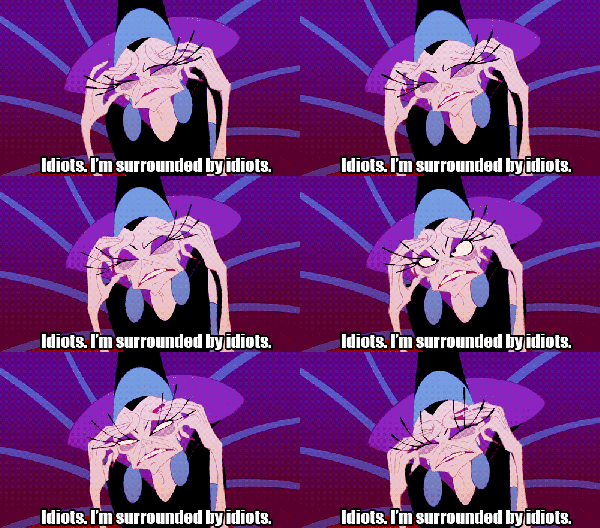
 
idiots


while outwardly doing this . . .


katy-nod-dance


Meanwhile, my inbox is filling up. By the time I actually get to start my day as an editor, I have 64 new emails (that’s a light day). Of those, approximately 1/3 will be submissions, 1/3 will be about the various tasks I assist with at REUTS, and some days, as many as 1/3 are authors freaking out over something. Those days, I tend to open my inbox and immediately think . . .
 
rudd-sucks
 
See, contrary to popular belief, editors work on a lot of projects at once. And writers (yes, you) are a high maintenance bunch, prone to neurotic freak-outs and requiring constant reassurance.
 
cat
 
That’s okay, though. We (as editors) understand, and we love you guys. Really, we do. But some days, you make us do this . . .
 
too-much


Anyway, I’m getting off topic. On those days where my inbox is full of people freaking out, I spend the next several hours holding their hands and providing reassurance. (See, the take away here, writers, is that every time you send one of those freak-out emails, the person on the other side loses valuable time they could have spent actually working on your project.)

**Note, I do not consider status requests and legitimate questions freak-out emails. Those are always welcomed and definitely allowed. 😉 **

By the time that’s done, it’s dinner time. But, before then, I’ll read through a couple of the submissions, which looks something like this:


umno
 
Or . . .
 
James-Earl-Jones-Totes-McGotes2
 
Or sometimes even . . .
 
jon-fan

FattyGenius


And occasionally this (if I’m the odd man out on the voting) . . .
 
not_having_it
 
Then it’s dinner time, and I step away from the computer for the first time all day.

By the time I get back, there’s at least one more freak-out email waiting not-so-patiently for me.
 
wut


frustrated
 
So, I deal with that one too (because I don’t like to leave anyone with more anxiety on their plate than necessary) and then finally, FINALLY, I get to edit. You know, that thing everyone thinks editors spend their days doing, but that we actually only get a few hours with. It’s a victorious moment when I finally get to this part of the day. Like . . .
 
fsa


Then, after investing several more solid hours into the thing I enjoy most, this happens . . .
 
tired
 
So I . . .
 
give-up
 
and . . .
 
exhausted
 
and the whole thing starts over.

And there you have it, my average day as an editor. Sounds like fun, right?
 
thumbs-up-matt-leblanc
 
The point of this (besides getting to have way too much fun with GIFs) is to show you just how hectic an editor’s life can be. We’re not robots who sit and do nothing but edit 24/7. We’re people, with lives and jobs, families and human needs. So cut your editor some slack if they don’t get back to you immediately, or it’s taking longer than you expected to edit your manuscript. We’re not purposely doing these things to hurt you. Editing is a time intensive job, and to do it right, you have to invest that time. The argument I always tell myself when stress threatens to overwhelm me, or someone’s pushing me to meet deadlines that aren’t possible without giving up sleeping, eating, and everyday life, is this — would you rather it be done right? Or be done fast? It’s not a perfect world, and those two can’t coexist. Anyone who claims otherwise is lying. Trust me.
 

**A big thanks to www.reactiongifs.com for supplying all the GIFtastic fun. Be sure to check them out! Their database is phenomenal. :)**

Featured From the Archives: Why do you . . . (Insert Creative Verb Here)?

As the 2nd year anniversary of my blogging experiment draws near, I realize I’ve reached the point where many of my followers probably haven’t read the older posts. So periodically, I’m going to feature one of those archived gems (which pretty much means I ran out of time and/or motivation that week) and give you a chance to discover them again. (Or, for the first time, as the case may be.)

Today’s feature is one that hopefully doesn’t offend too many people. But with all the various blog hops going around (like the ones I, myself, have participated in recently), and posts about what it means to be a (insert whatever creative term you were reading about), it seemed like the perfect time to showcase this again. (Plus, I’m feeling a tad under the weather, and my pesky muse decided to high-tail herself out of the plague zone. ) So, to kick off my new/old series, I present: Why Do You . . . (Insert Creative Verb Here)? A snarky, honest post about what we’re all really thinking when you ask us this. (Warning, contains tongue-in-cheek sarcasm and blunt reality. Read with your serious-meter on half.)

Oh! And don’t forget, I still have that fantabulous (yes, that’s a word. Shut it before I hurl this NyQuil bottle at your head) giveaway I’m running in honor of my upcoming blogiversary. I’ve already received over 300 entries, so three lucky people will be receiving the book they chose from the list. And if you’d like to make it four (and to see whether or not what I’m saying is a cold-med induced hallucination) click here!

Back to the post!

Why Do You . . . (Insert Creative Verb Here)?

By Kisa Whipkey

(Originally Posted on 5/11/12)

This is probably the most-asked question of creative people -– sometimes even by other creative people. And it’s one of the more irritating ones, because it’s such a hard thing to quantify. It’s like asking someone why their eyes are blue, or why they were born in the morning. How do you answer that? So, understandably, the answers to why someone’s creative vary wildly depending on the person. You’ll hear things like:

“I’m not sure, I just do.”

“Because it makes me happy.”

“Because it’s therapy for me; it helps me express myself.”

And my personal favorite, “I do it for me.”

Now, the truth is, all of these answers are sugar-coated, watered-down replies meant to make the artist look more artsy; to make the listener think, “ooo, aren’t they cool? They’re so mysterious and vague.” Personal satisfaction is great, but you go to the gym for personal satisfaction, you don’t pour weeks, months, years, heart and soul into a project just for personal satisfaction. I mean, don’t answers like that just seem so full of themselves? Why narcissism is encouraged within the arts is beyond me, but the more self-involved the answer, the more prestige points an artist receives. And the more frequently you’ll hear responses like the above.

Personally, I view every one of those answers as a cop-out. Because ultimately, statements like that are rarely true. And before you get up on your high horse and scream “controversy!” while flooding my comment box with all the reasons I’m wrong, hear me out. If creativity is such a personal thing (which I’m actually not arguing, because it is), why would anyone share its products? All those artists, authors, and musicians that claim they only create for themselves are lying. The proof is in the sheer fact that they made said creation available for public consumption. If it was truly just for them, it would be stashed in a vault somewhere, guarded by large, vicious dogs, and fiercely protected until its location was lost in the afterlife. Not put on public display for all to judge. But that’s not the case, is it? Because they shared their work with the world.

(The only exception may be personal diaries and journals, which are never truly intended to be shared, but in reality, are almost always found and read anyway.)

When I’m asked this question of why I (insert creative verb here), I have a generalized, self-important, prosaic answer that I’ll give. (Who doesn’t want to earn some prestige points?) I simply say that the reason I (chosen creative verb of the moment) is that I never realized not (doing said creative verb) was an option. And this is partly true. Creativity just came naturally. Like breathing. But just like the answers I listed above, that lovely little sound-bite, while somewhat accurate, is not the real motivator behind my masterpieces. (See? Don’t I just automatically sound more brilliant because I called them that?)

The brutal, honest truth is something none of us “Artistes” like to admit, because it makes us seem desperate and needy, and those two adjectives are a far cry from cool and mysterious. We don’t want to be put in the same category as your psycho ex that Facebook stalks you. But the reason all those artists, authors, and musicians refuse to admit, is that we create because we want validation. Public approval. Fame, glory, and all that jazz. Just like when we were little kids and we ran to Mommy looking for approval on our latest blob of mismatched crayon wax we were certain looked like the cat, we offer up the fruits of our labor to the public eye. With the sole intent of being lavished in praise for our awesomeness.

When you think about it, it’s not really that hard to see why this is the real motivator behind creativity. It’s the same reason we post status updates several times a day and then check back obsessively, waiting for those little thumbs-up signs to appear that means someone likes us, someone agreed. We’re cool. It’s human nature to seek praise from those around us; it makes us feel good, worthwhile, valued. Does that mean all artists are shallow, attention-seeking ho-bags? No. Do we all secretly want to preen while you sing our praises and tell us how awesome we are, so we can humbly pretend we didn’t already know that? You betcha.

Ultimately, though, it’s receiving feedback of any kind (although preferably of the worship-my-brilliance variety) that motivates us to hit that upload button, to submit that manuscript, or to step out on that stage. It’s often said that creativity doesn’t happen in a vacuum. And I 100% agree. Without that input from others, your creative side will shrivel and die like a thirsty plant locked in a closet. Which is why, whenever someone answers with the angelically selfish response of , “I (whatever) for me,” I find myself annoyed. Why is it OK to feed your narcissistic ego by pretending that success means nothing to you and you don’t care what anyone else thinks, but not OK to admit the truth? You did it for the same reason I do –- to feel good when others tell you your creation is something wonderful.

And for those out there that feel this question, this “Why do you . . . (insert creative verb here)?” is a perfectly legitimate conversation starter, it’s really not. You’re just going to be lied to. Few of us will man up and admit, “I did it to be rich and famous. Duh.” You’re much better off asking questions that actually have quantifiable answers. Ask why we do things a certain way, or what did we mean with X, instead of something as innocuous as why do you create?

Hey, nobody said honesty always had to be pretty. And I did warn you that snarky rants were a definite possibility. But let the barrage of offended comments commence anyway. 😉

How I Became an Editor

I’ve had some requests recently for the story of how I became an editor. Which means I have to pull on my big girl shorts and do that thing I don’t like to — talk about myself. Blerg. (Yes, that’s a word. At least, in the House of Whipkey. ;P ) Those who have lingered around these parts for a while know that I do tend to make my posts personal, relying on self-deprecation and personal experience to impart advice, tips, and (I’d like to think) humor. But rarely do I actually talk about just me, as in my life story. Making what’s about to happen the perfect example of what I said not to do in my post about exposition a few weeks ago.

I’m not one to leave a request hanging though, so **deep breath** here goes:
 

How I Became an Editor

 
When someone sets out to become an editor, there’s a very clear path they usually take — love books, realize they’re kind of a nerd for grammar, excel in English classes, graduate with an English degree, move to New York, become someone’s coffee gofer for a bunch of years, and then poof! Editor status. Yeah, that’s not the path I took. My journey to editor-land looks more like the one taken by an ADD squirrel in the middle of nut season. In fact, I never set out to become an editor at all. Editing was always on my radar, but it was one of those mystical, unattainable jobs — like astronaut, or unicorn breeder. I never actually saw myself becoming one. I just didn’t understand how to get there, what series of life choices ended with that shiny prize.  And so, I set my sights on a different career altogether.

I’m getting a little ahead of myself though. If we go back to the very beginning of the story, you’ll see that I was always destined to find my way into editing. One of my first memories as a kid (like young, before I could read, kid) is taking every single picture book I owned and stacking them on the floor. I’d then sit next to that massive pile taller than I was, and read them one at a time. Except, as I just noted, I couldn’t read yet. So I would look at the pictures and make up my own version of the story. Now, some of you might be thinking that sounds like a writer more than an editor (and a massive red flag for OCD). But the thing is, I didn’t actually create new stories. I took what I knew of the existing one (because my parents were awesome and read to us a lot) and then changed accordingly. Which, in case you haven’t put two and two together yet, is one of the main things an editor does.

Reading remained one of my favorite activities as I grew up, often becoming the highlight of a lazy summer day. (When you live an hour away from civilization and the nearest neighbor kid is like two miles away, there’s not much else to keep you entertained.) I also dabbled in writing and drawing. I actually thought I’d be a writer, until I turned eleven and saw this:


And, like the proverbial spotlight from heaven, complete with angels singing, I found my calling. (Or so I thought.) From that point on, I was dead-set on the fact I wanted to be an animator. I taught myself everything I could about traditional animation, (via various Disney books) and even spent cold winter evenings out on the back porch with a light table my dad built for me, drawing away.

I kept that dream alive for a long time, intending to go to Cal Arts (California Institute of the Arts) for college and then, eventually, work for Disney. But, by the time I got to college-age, I chickened out. And then, shortly thereafter, the traditional 2D animation industry died. So I bounced around a couple of Junior Colleges for a while before finally transferring to a State University. What did I pursue there? English. I tried their art program for about a semester, but fine arts and I are like oil and water. They don’t like me because I’m too “commercial”, and I don’t like them because they’re pretentious and close-minded. But that’s a story for another time.

During my obsession with animation, I kept writing. (In fact, the majority of my current 300 + plot bunnies originally started life as animated movies.) I decided that if I couldn’t pursue art (which had been made abundantly clear by some horrible experiences with art professors), I’d fall back on my second love and become a writer. I loved my classes, and did well for a couple semesters. I started writing more frequently and finally felt like maybe I’d found a career path.

Enter the worst romantic mistake I ever made.

You know that ex that makes you shudder with revulsion and embarrassment when you think about them? Yeah, I happened to find mine right as I was trying to figure out my writing style. His lack of support and pretentious condescension (he’d already graduated with an English degree and thought he was better than, well, the world)  resulted in my giving up. On everything. I quit writing, I quit school, and I ended up working in the mall. Yes, the mall. It was a dark time in my life.

Fast forward about 3 years. I’d dumped his sorry ass, moved back home with my parents, and was floundering around for some direction. I worked on repairing the psychological damage that relationship had caused and picked up all the things I’d let go, but never forgotten about — writing, drawing, martial arts. Happiness returned, but I was still a twenty-four-year-old living with my parents. And that scared me. I refused to be thirty and living at home. So I started reconsidering applying to Cal Arts, breathing life into my original dream again. The animation industry had changed completely, though. 2D animation didn’t really exist anymore. 3D was all the rage. And I wasn’t (and am still not) that good at 3D.

Which brings us to career epiphany #2 — video games need animators too. I was playing Bioware‘s Jade Empire and watching the beautiful load screens rotate between levels, when I realized: “they must need artists for video games. Maybe I could do that.” (Don’t ask where I thought video games came from before that moment. Apparently, they just magically appeared out of thin air.) After a bit of research, I stumbled on Westwood College Online and their Game Art and Design degree program. Hallelujah! Direction. I enrolled, and three years later, walked away with a degree in video games. Still intending to pursue animation, mind you.

Overpriced piece of paper in hand, I started investigating my job options. I even attended the Game Developer’s Conference, where all the game industry professionals gather to trade notes. (Unlike the other gaming cons, you don’t see any costumes, just nerds in business suits.) I found myself gravitating toward the lectures/classes on writing more than the ones on animation though. Which led me to the idea of becoming a game writer. I’d been writing during all this flailing, so game writing seemed like a natural progression, combining two of my loves into one. All right, I thought, I’ve found my niche. I’ll apply to Bioware (which had taken over Disney’s exalted place as the ideal company to work for) and finally start my career.

Once again, fear kicked in and I chickened out. Instead, I opted to move (with my fiance, because during my flailing, I managed to meet the most amazing guy ever) to Portland to spend about a year near my sister. (Yes, I just said that move was supposed to be temporary. Clearly, I got stuck, because that was four years ago now and we’re still here.) Since Portland doesn’t have any game companies that I’m aware of (at least, they didn’t back then) I decided to pursue my own thing, going into freelance art instead. (Are you starting to wonder when we’ll get to the editing? Don’t worry, we’re almost there!)

I joined Deviantart in 2011, and started Nightwolf A.D.E. (which stands for art, design, and editing). Overwhelmed by the level of artistic talent on the site, I ended up frequenting the literature forums, and eventually realized I could try my hand at freelance editing. (I’d done a lot of editing over the years in writing groups, or as favors for friends, so I knew I was at least moderately talented at it.) I scored my first client in the summer of 2012, and, not three months later, stumbled on a call in the job postings about a new press looking for editors. And voilà! I became an editor.

So there you have it — my long and winding journey to becoming a professional editor. Was it something I always wanted to do? Yes, I think so. Though it was never at the forefront of my thoughts the way other careers were. (Remember, I viewed it as elusive and impossible to achieve). Did I set out to do it? No. It found me. But I do firmly believe in the idea of fate, and that everything happens for a reason. My path may not be the straightforward, traditional one, but that doesn’t mean I’m not exactly where I’m supposed to be. If I hadn’t chickened out of going to Cal Arts all those years ago, I wouldn’t have tested the waters of being a writer and published three short stories. If I hadn’t moved home when I was twenty-four, I wouldn’t have met my loving husband, or gotten my degree. If I hadn’t let fear drive me to Portland instead of Edmonton, I wouldn’t have joined Deviantart. And if I’d stayed focused solely on art, I never would have found REUTS and my true love of editing.

So, I suppose, the point I’m trying to make is that you don’t have to follow the beaten path to become an editor. If you love it, (and have what it takes), then you’ll find a way. Or, like me, it will find you. 😉

What it Takes to be an Editor

Now that I’m becoming more known in the literary community, I’ve had people approach me for advice on how to break into an editing career. They all have this bright-eyed illusion of what being an editor entails, envisioning (as I did) days filled with nothing but reading. Sounds glamorous, doesn’t it? Every book lover’s dream job. But let’s have a candid (and snarky!) discussion about the reality of being an editor. Because that pretty image in your head is nothing like the real thing.

A lot of people falsely believe that writing and editing are parallel careers. They’re not. They’re more like distant cousins than the sibling status everyone thinks. If you enjoy the process of creation, editing is not for you. If you love reading, devouring books like life-saving sustenance, editing is not for you. And if you like entertainment that keeps your brain active and stimulated for hours, editing is not for you. If, however, you love puzzles, methodical routines, and helping others, then maybe you’re fit to be an editor.

The truth is, editing’s hard. It’s monotonous, dull, repetitive, and there is absolutely no glory in it. It’s messy, annoying, and time-consuming. And it uses absolutely none of your creative juices. It’s analytical, more than anything, relying on thought processes normally associated with math and logic, rather than those involved with writing. It requires a completely different skill set, and, contrary to popular belief, good writers do not necessarily make good editors. And vice versa.

The literary world is the only one I know of that doesn’t clearly differentiate between its specialized skills, lumping them into one single category — wordsmith. No one would expect a dentist to be able to perform heart surgery, so why can’t we figure out that editing and writing aren’t the same thing? Yes, they’re both grounded in a love for words. And both do conform to the rules of the English language (most of the time). But that’s pretty much where the similarities stop.

So what does it take to be an editor? Let’s find out.
 

Requirement #1: No Life (Workaholic)

 
You know those nights and weekends, holidays, family and friends? Kiss them all goodbye. If you want to be an editor, you better be a workaholic, because otherwise, you’ll be buried up to your eyeballs before you can blink. And don’t think that’s temporary. Oh no, you will never again have a moment to yourself. Your inbox will be filled to the breaking point every time you log in. Your morning run, every meal you eat, and even long car trips will become reading time. And sleep? Yeah, you’d probably get more of that if you’d popped out that baby your mom’s been nagging you to have.

Every single second of every day from the moment you get your first assignment will be filled with something. And if, God forbid, you take so much as an afternoon off, you’ll spend the next two weeks trying to climb back on top of the mountain.

Editors have one of the highest burn-out rates of any job on the market. If you survive past two years, you’re considered hard-core. Because none of us get to do what everyone somehow assumes we do: sit in our offices, leisurely sipping coffee and reading to our heart’s content. In fact, if we get to read at all during the day, it’s probably at home, or crammed into the fifteen empty minutes between tasks. The majority of an editor’s day actually consists of answering emails, planning out structural edits, line edits, project management, more emails and then more line edits. Reading’s at the bottom of the list, unfortunately.

So if you’re an anti-social, agoraphobic insomniac with a workaholic tendency, editing will be the perfect job for you. The rest of us have to learn how to juggle life and work. And sadly, life almost always loses.
 

Requirement #2: OCD (Detail-Oriented)

 
Editing is highly detail-oriented. It’s slow and tedious, and during the course of a single project, you’ll read each chapter so many times you could nearly recite the thing verbatim by the end. So being slightly OCD helps.

There’s a strange (as in sick) sense of satisfaction to be found in surgically removing and altering the smallest things (things normal humans don’t notice) in a sentence. As an editor, you don’t just gloss over everything, you hone it, until there’s absolutely no better way that statement could be phrased. There’s not an ounce of fluff left in the entire manuscript, and, by George, you made sure that thing sings! How long did it take you to do it? Here’s the kicker: about 6-8 months (that includes the amount of time spent back and forth in revisions with the actual author. Because, you know, editors don’t actually write the books). And how long does it take a reader to read those beautifully honed words? About a week, if you’re lucky. I actually watched someone breeze through a project I’d slaved on for nearly a year in a single afternoon!

The point here is that editors are a strange breed of OCD (ahem, I mean detail-oriented) individuals who hold themselves and their authors to a crazy standard of perfect, and will accept nothing less. If you’re not willing to read a manuscript 52 times, invest upwards of 6 months of your life into someone else’s work, then walk away. You’re not one of us.
 

Requirement #3: Skills (Not Just Grammar, Folks)

 
This should be a no-brainer. Clearly, an editor needs skills, right? But which skills?

There’s an assumption out there that editing consists of one thing — fixing grammar. Editors are all a bunch of pompous English professors who couldn’t sell their own writing, and so, bitterly hand down judgement on everyone’s inability to follow the rules of the English language. In short, we’re grammar Nazis, and that’s it. That assumption is incorrect. And why so many writers get taken advantage of by shoddy editors who do nothing but fix superficial punctuation and spelling mistakes. (**Ducks from the impending barrage of hatred.**)

A real editor does so much more than fix your grammar. They’ll do that too, but more importantly, they’ll fix your story in its entirety. From plot holes, character development, and timeline re-sequencing, to sentence smoothing, and fact/detail cross-referencing, an editor is a master storyteller. Not only do they fully understand the various narrative methods and their uses, but they do all this without compromising the writer’s voice. They’re chameleons, morphing into a version of the author and enhancing that person’s style so that no trace of the editor is visible to the outside world. (I mentioned there was no glory in editing, right? All the applause and accolades go solely to the author — as they should. You don’t exist to the world of readers.)

True editors can hold an entire book in their heads, shifting and reorganizing the narrative threads as needed. And the really good ones can do this with multiple projects at once. It’s a rare skill, and one that will instantly mark a professional from an amateur. This is the thing that the writers-turned-editors can’t compete with. What the grammar Nazis can’t ever hope to provide. This is the true skill of an editor. So the question is, does this sound like you? If yes, then congratulations, you’re an editor. If what I’ve said sounds like mumbo-jumbo or makes you cringe even the tiniest bit, then adios! You’re better off doing something else.
 

Requirement #4: Passion (Passion Trumps the Suckage)

 
This is the last requirement for becoming an editor, but I’d dare say it’s the most important one. Why? Because passion is what makes it all worthwhile; it’s what trumps all the suckage. As you can see, editing is kind of a sucky job. I mean, for some of us, it’s a calling, and we love it through and through. But to the outside world, it looks brutal, horrible, and leaves you wondering why, in God’s name, anyone would ever want to do it. The answer is pretty simple though: passion. Passion for storytelling, for books, and for the people who write them. If you don’t have this, you’ll never make it as an editor. You might survive for a little while. You may even enjoy it at first. But eventually, the incessant schedule will wear you down and you’ll walk away.

How do you know if you have it? The passion? I’m not sure. I don’t think there’s a quantifiable way to tell. But I’ll leave you with this to ponder:

Writers often talk about how writing is the best part of their day. How it’s a cathartic release, a joy. For them, the creation process is the most beautiful thing. But for an editor, a 100% born-to-be editor, it’s not. That joy will come from the part of the process every writer loathes. Where writers find relaxation pouring words onto a page, you’ll find it in rearranging those words. Where they find joy breathing life into new stories, you’ll find it in fixing them. To you, the best part will be feeling all those intricate puzzle pieces click into place, and then watching, like a proud teacher, as your author and their book graduate to take their place in the world of success.

It’s not a job for everyone, but if you have the skills and the passion, (if you can’t imagine yourself doing anything else,) then it just might be for you. I’m definitely 100% editor. Are you?

The 5 Stages of Writing on a Deadline

We’ve done a lot of serious posts lately here on Nightwolf’s Corner. Awesomely helpful, yes, but serious. So this week, I wanted to mix it up and create something humorous. But as I was busy dusting off my sarcasm, gearing up for a good old-fashioned snark-fest, I stumbled on a fortuitously timed post by one of my favorite, soon-to-be-famous authors. See, he’s a snarky son-of-a-gun too, and while I could have put my rusty skills to good use, he beat me to the punch. He even used a similar topic to my as-yet-unwritten post. So either he somehow magically hacked into my brain, or it’s that “great minds” phenomena we always hear about. Either way, his post had me ROFL-ing, LOL-ing and all those other acronyms for laughing we never say in real life. So I thought, why not share it with all of you? You’ve hung around me long enough that I’m sure you’ll appreciate the brilliance of his wit as much as I do.

Next week, I promise, original material is coming your way. I’ll be dissecting the anatomy of a short story in the literary equivalent of science class. But in the meantime, take a break from the serious and enjoy!

I present to you: Drew, master of sarcasm. Take it away, Drew!


Photo of Drew Hayes


The 5 Stages of Writing on a Deadline

By Drew Hayes

 
Writing, much like grief, moves in phases. The ideal process for artistic creation is the slow, gentle growth of an idea, watching it bloom from mere idle thoughts into a cohesive, beautiful flower. Then, of course, there’s writing on a deadline. This process is more akin to trying to steer a lawnmower while your drunken uncle fights you for the wheel and a swarm of honeybees swoops about, rightfully angry about the beer bottle your aforementioned uncle threw into their hive. (If this analogy made no sense to you, congratulations on not living in the country.) Point being, writing on a deadline is a crazy, often senseless process that feels as though you’re being swarmed by painful distractions. Though, to be fair, in a perfect analogy you’d be the drunk uncle. But I’m getting ahead of myself.
 

Stage 1: Stupidity, a.k.a., I Can Totally Handle This

 
This is a beautiful stage, a wonderful place that you’ll find yourself at time and again. You’ve found a project that you’re suited for and been accepted into the position. You have zero fear you can handle this, because the magic of repression has given you the power to block out what your last project was like. You do everything right in this phase; you make an outline, schedule time specifically dedicated to work on this project, and even make a step-by-step checklist. You are fearless. You’ve got this shit down cold.

In fact, you’ve got it down so cold, you’re not even stressing about it. Until that window you set up to work on the project gets chomped away by angrier, more demanding tasks that are further along in the process and soon, all too soon, you’ve hit crunch time. Now you really need to write. So you finally enforce that window and sit down to truly punch out stuff on the keyboard.
 

Stage 2: Holy Shit, a.k.a., What Was I Thinking?

 
Nothing. Not one idea. Come on, you can do this. You had a billion ideas when you took on the project. There has to be one left in your brain. Just one. You’ll do anything. Come on. Focus. Foooocus. Don’t look at the spot on the wall. It’s not mold. Because you live in a dry climate and mold doesn’t look like finger smudges, that’s how I know. And now you’re cleaning the “mold” even though that’s totally not what it was. Feel better? Oh, hey, idea! No, not about the project, but related to the project. Remember that outline you did? Maybe there are some ideas in that.

Huh . . . this is wordy, detailed, and totally useless. Look at Point #4: draw out deeper meaning of previous subject. They’re all like that. Everything hinges on something else, and there’s no start point. Okay, deep breaths. At least you’ve got a plan if you do ever think of a starting point. Look, there’s an old truth to writing that if you’re stuck, just write anyway. Just put words down and sooner or later something cohesive will form. Type gibberish if you must, just type something.
 

Stage 3: Desperation, a.k.a., Shit’s ‘Bout To Get Real

 
Well, it’s the last day before the project is due, and you’ve written 30,000 words of gibberish. I’ll be honest, I’m impressed with the dedication, though I had hoped eventually real words might come out. Still, let’s not give up hope yet. Maybe you can still pull something off. I mean, you’ve done this before. Go look at notes from old projects. Perhaps the secret to breaking through your block lies in there.

Wow . . . these are . . . wow. I’m around ninety percent sure having this combination of words written down is a felony, along with a serious cry for help. Also, a good half of that isn’t English. Scratch that, it isn’t even language, at least nothing a healthy mind could identify as such. No, don’t throw it out, there are children in the world who could stumble across this. Burn it. Cleanse it with fire and hope there can be forgiveness in your next life. Only when that’s done can we continue to scour for the key to unlocking inspiration.

Okay, those pages are gone, though it took them a curiously long time to burn, and the whole house smells like smoke and regret. After a bit more digging, you’ve found different sets of notes from your last project. Let’s take a gander and see what you’ve got.

Cursing.

Cursing.

Teardrop stains.

Enthusiastic cursing.

A cocktail recipe.

Eh, what the hell, seems like as good a time as any to progress to the next step.
 

Step 4: Booze, a.k.a., Hang On Just A Minute . . . I Know What I’m Talking . . . Here Shush . . . Just Let Me Say One More Thing And I Will — Zzzzzzz

 
If it was good enough for Hemingway, it’s good enough for you. Furiously hurling vodka down your throat like there’s a gasoline fire in your belly and you have no concept of how putting out a fire works, you take an alcoholic wrecking ball to your sober consciousness. Soon the ideas begin to flow. Unfortunately, they aren’t ideas directly related to the project you’re working on. No, texting your ex is a bad idea; they don’t want to hear from you. I don’t care how unhappy you think they looked in their wedding photo on Facebook, they don’t want to hear from — aaaand you’re texting anyway.

Several drinks later, you’ve worked through nearly all the alcohol stocked in your meager bar, save for the break-in-case-of-emergency last resort: Tequila. You know you shouldn’t do it, but by Faulkner you’ve come this far, and, at this point, you’d rather go down in flames than burn away gently. You guzzle straight from the bottle, downing the well-grade liquor in less time than it took for the under-paid clerk to slap it on the sale shelf. This is going to be bad.

The next few hours pass in a blur. Only snippets and highlights will remain once the alcohol has run its course:

You remember trying to order a pizza on the phone, only for the clerk to consistently reiterate that you have dialed a dry-cleaner. You are not fooled by his lies.

You know you uploaded a clip to YouTube. Unfortunately, you have no memory of what was on it, the name it was under, or even the account you used to post it. You will spend the next six months trying to find it and/or hoping you cannot be identified by the footage. That hope will eventually be dashed.

You fill more pages with the cursed writing, the arcane script that made those previous pages so difficult to burn. This time you hide them so that your sober-self cannot unmake your hard work. There can be no more interruptions, not with the rising so near.

You sit down at your computer, staring at the monitor that mocks your literary impotence with an unsullied white screen. You stick your tongue out at it. This is the last memory of the night.
 

Stage 5: Completion, a.k.a., Who The What Now?

 
As you rise slowly from the keyboard, you immediately become aware of three things. Firstly, you have a headache that would send lesser drinkers to their graves. Secondly, you slept with your face on the keyboard and will wear this waffle iron-esque mark of shame for several hours. Lastly, and most importantly, your project is complete. The crisp, neatly edited words stare back at you from the monitor, all mockery quieted. You read through them just to be sure, but everything is germane to the topic, well-worded, and grammatically correct.

You send it off to the client without asking too many questions. Better not to know, you assure yourself. Better not to ask what exactly those pages you wrote signify. Better not to wonder just what it is you might have traded away in a fit of drunken desperation.

Nope, instead you’re off to get a shower and a well-deserved bagel. Maybe you’ll even go see if there are any new projects you might be a good fit for. After all, with this beast done, you’ve got a lot of free time, and you really should try and stay productive.

***

For more of Drew’s deadpan hilarity, please check out his author page and follow him on Twitter.
Also, keep an eye out for his side-splitting debut novel, The Utterly Uninteresting & Unadventurous Tales of Fred, The Vampire Accountant — available Summer 2014!!!

I’d also like to send a special thanks and shout-out to V of Veronica Park’s Space for letting me syndicate this post from her fantastic When Writers Go Wrong Series. She’s got a bunch more, so if you enjoyed this one, head on over and check out the others. They’ll be running through the end of December. 🙂