Featured From the Archives: The 10 Best Things About Being an Editor

The past couple weeks have been rough. Let’s just put that out there right now. The stress, the anger, the pain, and ultimately the tears have left me feeling battered, bruised, and downright defeated. And as I stand at the bottom of the avalanche, staring down a gauntlet of deadlines so insane it makes me want to throw in the towel and walk away, I can’t help but feel like I’m losing some of the reasons that made me want to become an editor in the first place.

I could have pulled one of my bleaker, exposé type articles detailing many of the things I’ve experienced yet again in the last fourteen days, but I don’t want to dwell on that. I’m already broken; I don’t need the reminder of how I got here. So instead, I’m gonna pull one of the happier posts, not because I feel like it necessarily deserved to make the rounds a second time, but because I need the reminder. I need to remember the good part of this editing life before the bad pushes me out of it completely.

And what better way to do that than to reexamine the best parts? So, for the second time, I give you:

The 10 Best Things About Being an Editor

by Kisa Whipkey

Originally Posted on 6/12/15

There have been a lot of articles floating around the interwebs lately detailing the uglier side of editing, the harsh reality and bitter truth that publishing generally prefers to keep hidden. And I’d guess a lot of you are wondering why anyone would sign up for a job that clearly comes with a large side of misery. Or, if you’re a fledgling editor, you’re probably thinking it won’t happen to you, that those of us “griping” are just jaded old farts yelling “GET OFF MY LAWN!” at anyone who comes near. But trust me, you’re wrong. It will happen to you. I said I’d never fall prey to it either, and now look. I struggle daily to hold on to the passion and enthusiasm I started out with, to avoid turning into that hateful, jaded editor I said I’d never become. Because, you see, being an editor is a lot like being a statue in a sandstorm. Each stressful project wears down a little more of that initial optimism and joy, replacing it with marble-lined walls nothing can get through.

But it’s not all bad. And this isn’t going to be one of those bare-all-the-skeletons-in-the-closet type of articles (in case you didn’t glean that from the title above). No, to counter-act the very valid, albeit depressing, truth behind the editing life, I’m going to show you the good, the reasons we battle our way through the ugly, day after day after day. The reasons, when asked, we’ll still tell you we love it and it’s the best job on Earth.

I give you, the ten best things about being an editor, in no particular order and with just a touch of snark. 😉

1. Nerdery Welcome

If you’re an editor, you’re an avid reader. You have to be. It’s literally job requirement #1. Okay, proficiency in grammar is probably job requirement #1, but you know what I mean. You are a self-professed book nerd and you wear that label proudly.

But growing up, you were likely teased for it. A lot. While others spent their afternoons playing video games, sports, or lusting after the opposite sex, you were Belle from Beauty and the Beast, walking around with your nose stuck in a book. Admit it, this was you:

20120817-084704

Well, one of the best things about being an editor is that your unabashed love of all things books is returned and fed by others who also unabashedly love books. All those things that riddled your childhood with taunts are no longer a weak point. The fact that you’re a book nerd is par for the course, and in fact, nerdery in all forms is highly encouraged. They say that nothing beats finding your people, your tribe. Well, book nerds, the land of editing bears its nerd flag proudly, and if you have the skills, you’re more than welcome to add your sigil to our banner.

2. Buying Books Becomes a Business Expense

This is legit. Seriously. Part of an editor’s job (especially an acquisitions editor) is knowing the ins and outs of the book-buying market. And how do you accomplish this? By buying books. No joke. Therefore, those extensive receipts from Barnes & Noble, Amazon, and whatever other book haven you haunt, become what is known as “market research” and according to my tax professional, that is a deduction. **Note: I’m not a tax professional and make no claims to be. Make sure you talk to someone who is before taking my word for it.

As if we needed another reason to buy books, right?

excited-baby

3. Hoarding Books No Longer = Mental Disorder

Ah, yes. This is probably one of my favorites. I am a book hoarder. There, I admitted it. My apartment is crammed to the gills with books, to the point that one of the first comments any visitor says when they walk inside is, “Man, that’s a lot of books!” The second is always “Cool weapons,” but that’s a story for another time.

The point is, I like books. No, scratch that, I LOVE them. I love their smell, their feel, their beautifully linear sqaureness (Don’t ask. It’s been noted before that I have a touch of OCD). And someday, I will own that library from Beauty and the Beast. I will!

Anyway, this habit to collect books in droves has long been considered strange, obsessive, and cause for concern for any who have to help me move. But guess what? No one bats an eye now that I’m an editor. All that judgment I used to have to fend off gets checked at the door. It’s considered normal and, apparently, is completely understandable now that I live my life surrounded by words and literature and the soothing smell of printed paper. Now my only problem is my lack of shelf space. (Thank God for Kindle!)

Books

4. You Become a Mystical Rainbow Unicorn with Super Powers

No, not really. But it will feel that way sometimes. I believe I wrote before about how I considered “Editor” to be an unattainable, near-mythical job title when I was younger. Well, apparently, I’m not alone in that. People seriously look at us like we’re some shimmery Fae creature that can’t possibly exist in real life. And I’m not talking about writers, whose reaction is usually more akin to the fangirl/fanboy response of a super-fan at a rock concert angling to get backstage. No, I’m talking about everyday people who have no affiliation to the publishing industry whatsoever. There’s an impressed awe that tends to come across someone’s face when I mention what I do for a living (no, not the Day Job of Doom part). And honestly, who doesn’t want to feel like a rock star, even the literary kind?

magic-unicorn-meme-generator-i-am-splendiferous-watch-me-sparkle-ae7515

5. Books! Books! Books!

read-all-the-books-meme

I think that’s self-explanatory, don’t you? Moving on . . .

6. It’s Intellectually Challenging

Now we’re starting to get into the more serious reasons editors become (and stay) editors. So I’ll try to hold the sarcasm in check.

This one in particular is probably one of the main things I find appealing. Editing is like Crossfit for your brain. It’s often mentally taxing and can leave you feeling like you’re seconds away from having your eyeballs abandon ship, but that’s also part of why it’s fun. Not the mutinous eyeballs part. The mental gymnastics.

The best editing projects are like a massive puzzle, requiring you to shift and move and tweak and tune things until, like a camera lens, the focus snaps into place and the picture becomes perfectly clear. I love that feeling, and for me, it is a visceral feeling. I know the rules and regulations, but honestly, I edit primarily by instinct. I’m lucky to have been born with an innate sense of storytelling (and yes, I have had people tell me its a superpower) and I can actually feel in my bones when a narrative clicks into place. That sensation alone makes all the hard work, all the sweat and blood and tears (because editors expend those just as much as the authors do in this process) worth it.

puma

7. Proud Teacher Moments

If the last point wasn’t enough to convince you that being an editor is awesome, this one should. Yes, I just said that feeling a story find its groove makes it all worth it. And it does, but this is the icing on the cake. Completing a project definitely feels good, I’m not going to lie. But there’s one thing that feels even better:

Watching your author step into the much-deserved spotlight, their polished, perfect new book-baby clutched in their hands.

I call it the Proud Teacher Moment, because that’s the only way I could think to describe it. I imagine it’s very similar to the swell of pride and emotion teachers feel when they watch their students graduate. It’s sort of a bittersweet sensation — one part love, one part pride, one part sadness. Most people don’t realize how invested editors become in the projects they work on. Yes, the author wrote the thing, but we helped train it, helped shape it into the perfect piece of literary brilliance flourishing out in the world. And that creates a special bond. We may be relegated to the shadowy corners of the hell writers call the Editing Cave, but we watch from those shadows, cheering our authors on with proud tears glittering in our eyes.

Make Good Choices

8. Discovering Hidden Gems of Awesome

Okay, now that we had our little moment of seriousness, back to the fun. This one is a perk that most people automatically know — we get to read (and find) awesome books before they’re published. Boom. Go ahead and be jealous. You know that’s totally awesome.

Bejealous

9. Creating Magic

Writing is a magical process. I mean, come on, authors paint fully-realized worlds, characters, and plots that elicit emotions in readers with words. Letters on a page. That’s pretty magical, if you ask me.

Editing may not seem all that magical — it’s more like polishing a car than say, painting one — but it has its own kind of magic. Especially in the developmental phase. Editors are like spirit guides, helping authors find their way when they get lost in a forest of words. The best ones can actually step into an author’s voice, mimicking their syntax, their style, with the efficiency of a Pooka. Which, come to think of it, may be the perfect analogy for editors in general, given the oft-touted love/hate relationship writers have with us.
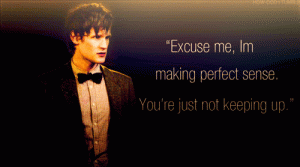
DoctorWho

Anyway, what I’m trying to say is that writers create magic, but editors help contain it. And for that, we need our own set of spells.

10. For the Love of All Things Books

When it really comes down to it, there’s only one true reason someone decides to pursue editing: a genuine, deep-rooted for all things books. The reasons listed above are great, but if I lost all of them tomorrow, I know I’d still have a love for books. Because nothing beats the ability to escape into a million other lives and worlds. It’s even been scientifically proven that reading enhances our ability to empathize. It’s a fundamental human gift, storytelling, and it’s one I will always cherish.

And that, my friends, is why I adore being an editor. Why I strive to look past the gritty, harsh truth of an editing life. I love storytelling. Plain and simple. And I love editing because it lets me pursue that love of storytelling. I enjoy the process, as painful as it may be sometimes, because I love the challenge, and I love helping others achieve their literary dreams. And best of all, I love that I get to spend my days surrounded with all things books.

I can’t sum up this last point any better than with this quote:
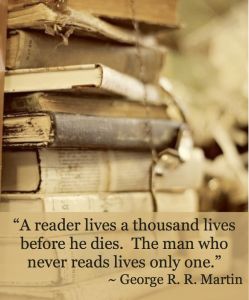
7afa052705168d8936aadee57b7a5f3a

Happy reading!

From the Editor’s Desk: Sachael Dreams by Melody Winter

Who noticed that I recently revamped the page I store these reviews on? Anyone? No? Well, I did. You can check it out later if you’re curious. 😉

In the process of said revamp-age, it came to my attention that I’d been remiss on posting my thoughts for a few of the titles I had the privilege of working on. To those authors, I’m sincerely sorry, and I will be fixing that shortly.

First up on that roster is a lovely romantic fantasy, whose sequel just so happens to be dropping in a few short months. But first, the obligatory disclaimer/explanation:

As an editor (both freelance and under REUTS Publications), I have the wonderful opportunity to see amazing novels during their production phase. And I wanted to find a way to share them with all of you as they became available. (I also wanted to find a way to help support the authors who trusted me with their manuscripts.) So think of these as my own personal book recommendations, straight from the editor’s desk.

Okay, now we can get to the review.

Sachael Dreams

by Melody Winter

Sachael Dreams by Melody Winter

Twenty-two-year-old Estelle Bailey has had enough of busy city-life and her hot-tempered ex. She escapes to the seclusion and peace of her family’s clifftop home in Ravenscar, where the soothing solitude whispers to her soul as strongly as the sea itself does. But her newfound contentment is interrupted when a mysterious man — a Sachael, master of seduction — joins her midnight swim unexpectedly.

Estelle struggles against his charm and the overpowering attraction she feels for him. He offers her a life she never could have imagined, a life beneath the waves . . . but at what cost? Before she can decide, she’s captured, ensnared by the Sect, a secret enemy of the Sachaels, becoming a pawn in a war she knew nothing about.

Now, she’s left with a new choice — escape the clutches of the Sect and flee into the ocean, or side with her alluring, intimidating captor and destroy the Sachaels forever. Can she turn her back on the man she might love, or will the secret of her heritage change everything?

Set against a picturesque backdrop, Sachael Dreams is the first in a new series, exploring themes of romance, love, and identity, and the struggle that happens when all three collide.

The first thing I remember thinking about Sachael Dreams is: what a brilliant premise. Not unlike a wave crashing to shore, it landed on my desk and instantly captured my attention. The paranormal romance/romantic fantasy genres are heavily saturated with angels, demons, vampires, werewolves, and a plethora of other supernatural critters, but Winter managed to do the unexpected — she gave us a brand new creature altogether.

Estelle’s story is not a peaceful one; kidnapping, escape, fight scenes, and arguments litter her tale with splashes of suspense. But those moments of tense action and drama, while exciting, are perhaps not the most memorable elements. For me, the enchantment of the story lies in its tone, ambiance, mystery, and passion.

Lyrical and detailed, Winter’s prose transports us to the setting with a mastery that had me nearly smelling the ocean breeze on my home’s very non-ocean-oriented air. Realistic and gripping from the moment you start the Prologue (yes, there’s a prologue, and it’s handled with supreme efficiency), Sachael Dreams is like stepping into an ethereal world that’s maybe just a tad dark around the edges.

Even the romance, which is central to the book’s core, starts with an almost Phantom of the Opera-like vibe, and the sinister nature behind the mysterious Sachaels lends a tinge of danger to the relationship unfolding between the lead characters. Add to that Estelle’s personal history (alluded to for much of the book and revealed fully toward the end) and a villain bent on revenge, no matter the cost, and you start to see why the story’s tone is heavier than your standard romance.

Winter makes sure to give readers plenty of swoon-worthy, romantic moments though; don’t worry. But my favorite scenes were actually those where the sheer raw emotion — often of the darker variety — really bubbled to the surface: the arguments between Estelle and Azariah, the heartbreaking moments of loss and grief, even the tortured rage of the villain. All of them were handled with a grace and poignancy that is nothing short of impressive.

Darkly beautiful and intriguing, Sachael Dreams is the beginning of what is arguably a refreshing, original take on mythology from a promising new author. Fans of romantic suspense, dark fantasy, and paranormal romance would be wise to check this one out. I, for one, am definitely looking forward to watching this world, and author, bloom into their full power.

Book Links: Amazon | Barnes & Noble | Goodreads

Hear Ye, Hear Ye! $20 Full Manuscript Critique Offer

I know, I’m posting a day early. But if you were on social media earlier, you already know that I’ve stepped off the deep end into a pool of utter (and awesome) madness. Hence the need to post a day earlier than normal this week.

See, one of my best friends — the brilliant and fabulous Cait Spivey — is trying something ambitious for the release of her debut full-length novel, From Under the Mountain. She’s putting together a high fantasy fashion show for her launch party. It’s a unique, fantastic way to bring readers into the world of her novel right from the get-go, and I’m always one to applaud innovation. (As does REUTS Publications, who — to the surprise of no one, I’m sure — is behind the book’s publication.)

The thing is, she can’t do it alone. She needs help to make this ambitious dream a reality. And, with the aid of IndieGoGo, she’s created a way for you to be involved, offering a variety of bonuses and extra perks in exchange for a small-to-generous donation to the cause. (Which, in case you’re curious, funds only the event’s production and not the book’s.) From custom art to autographed copies and exclusive bonus content, there’s a lot to choose from.

But I have one more to add to the pile:

Anyone who donates $20 – $50 to the campaign between 9/3/15 and 10/1/15 will receive a FULL MANUSCRIPT CRITIQUE from me.

Check my Freelance Editing Page, that’s worth $200-$500 dollars all on its own, without the added value of the perks Cait is offering too. That’s a crazy good deal, right? You know you want it. 😉

Here’s how it works:

Between now and the end of the campaign on 10/1, Cait and I will keep track of the eligible donations. I’ll add them to a special two-week schedule on a first come, first serve basis. So the sooner you donate, the higher up on the list you’ll be.

Then, starting 10/2, I’ll contact everyone and work will begin. Due to the other constraints on my schedule, I will be working on them one at a time, so the closer to the top of the list you are, the faster the turnaround time will be.

(Side note: if you won something from me previously and have not received it yet, don’t worry. I have not forgotten you and will be working on those first. You’ll even receive a bonus for your patience and the inconvenience.)

All right, that’s pretty much all you need to know about the terms and conditions of my offer. As always, if you have questions, feel free to contact me directly or leave a comment below. I’ll be back next week with more book reviews, editing/writing advice, or whatever other randomness grabs my attention. But for now, what are you waiting for? GO DONATE!

About From Under the Mountain

ivy cropped

The novel follows Guerline, a young woman who ascends to the throne of the empire after her entire family dies in one fell swoop. Now Empress, Guerline must address the suspicion growing in her court toward the four witch clans that protect the empire’s borders. Among the seditionists is Guerline’s best friend and lover, Evadine.

Guerline’s political balancing act is upset when the palace is attacked by powerful magic, bringing all Evadine’s fears to bear—but magic saves them too. In the wake of the attack, with an even greater threat looming, Guerline must decide who to trust, and summon all her strength to meet the challenge.

From Under the Mountain is a high fantasy for the modern world, drawing on the foundations laid by great female fantasy writers of the past twenty years to tell the story of one young woman. Guerline’s journey to establish her place, protect what she loves, and do right by her people will resonate with readers across the board.

From the Editor’s Desk: Diverging Cadence by Katie Hamstead

Many of you also follow me on social media (I think), so it’s probably not a surprise that I’m posting a review for this. Anyone who saw my tweets about it knows that I swooned hard for this series. And since I already reviewed Deceptive Cadence, it wouldn’t be right to let the second one pass by unnoticed. Plus, I’m part of this here nifty blog tour:

Diverging Cadence Blog Tour Banner

But, because I was also part of the team that worked on it, I have to do the obligatory disclaimer first. So, for those of you who already know what that means, feel free to skip it! For everyone else, here’s the rundown:

As an editor (both freelance and under REUTS Publications), I have the wonderful opportunity to see amazing novels during their developmental/production phase. And I wanted to find a way to share them with all of you as they became available. (I also wanted to find a way to help support the authors who trusted me with their manuscripts.) So think of these posts as my own personal book recommendations, straight from the editor’s desk.

All right, on to the book review!

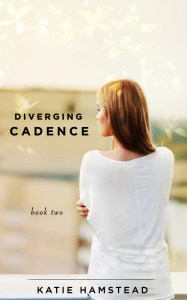
Diverging Cadence

By Katie Hamstead

Diverging Cadence Cover

When Cadence Anderson woke to find her husband and infant daughter had been killed, she thought her life was over. Instead, she was offered a second chance and sent back in time to do it all again.

She’s made the most of this opportunity, repairing her relationship with the best friend she lost the first time, avoiding the romantic mistakes she made originally, and even bringing her family closer together. But she’s also done something she wasn’t planning on — she’s fallen in love with someone other than her future husband.

Stepping onto a plane and flying across country to attend university is the hardest decision she’s had to make. But unless she follows through with it, her future with Austin might never happen. And what becomes of her beautiful baby if she stays with James, the man she was never supposed to love?

The only thing she knows for certain is that she has to see Austin again, and she’s intent on reliving that part of her previous life exactly like she did the first time. Even if that means she has to lie to James to do it. Because, deep down, she can’t quite bring herself to let him go.

Now, past and future are about to collide, and Cadence has to make her final choice — follow the uncertain path of a life with James, or the one she came back to save . . . with Austin.

In this emotional conclusion to the story that began in Deceptive Cadence, relationships will be tested, identities revealed, and the past will overshadow the future, putting the finishing touches on an unforgettable tale of courage, sacrifice, and, above all, love.

Diverging Cadence picks up where Deceptive Cadence leaves off, but not in typical sequel fashion, where you’re quickly brought up to speed even if you missed the first book. No, to truly experience the emotional roller coaster that is this series, you have to read both, and preferably back to back. Together, the duo create a traditional narrative arc, with Diverging Cadence being the latter, more appropriately tense, climatic portion. And trust me, the emotional pay-off of reading the series in its entirety is well worth the investment of time.

The second half of Cadence’s journey encompasses her adult life — attending college, finding independence, marriage — but is fraught with turmoil unique to her slightly supernatural circumstance. Namely, her decision between forging a new path and reclaiming the life she returned for. Unlike other love triangles, the relationship drama rings with more than a shred of truth, as Cadence wrestles between letting go of the comfortable (her relationship with James) and exploring the promise of her life with Austin. Hamstead expertly crafts a scenario that is heartbreaking, torturous, often maddening, and ultimately human. Cadence is allowed to make mistakes, to make the wrong choice, and the consequences of that speak volumes.

I won’t lie, there were many times that I felt uncomfortable with the choices Cadence made, and there were quite a lot of tears shed during the last third of the book, when we’re finally shown the horrific earthquake scene in real time, but the final resolution more than made up for all the heartbreak. It’s poignant, beautiful, and exactly what I wanted as a reader. Hamstead will rip your heart out before you get there, but that makes the ultimate satisfaction all the more powerful.

With beautifully simplistic prose, Hamstead captures a cast of characters who feel entirely real by the end. Flawed, human, and brilliant, Diverging Cadence wraps up all the threads left dangling at the end of Deceptive Cadence, providing a conclusion to a tale that will likely haunt me for years to come. If you’re looking for a light, upbeat story, this might not be for you, but if you want a thought-provoking tale that tugs on every element of your empathy, I cannot recommend this series enough. Seriously. Read it. Now.

Book Links: Amazon | Barnes & Noble | Goodreads

A Zebra in a Herd of Mustangs

Photo of zebra with horses

This past weekend, as many of you likely know, I attended the Willamette Writers Conference. It wasn’t my first time attending (I went last year under the guise of just being an attendee), but it was my first time attending as faculty. That, in and of itself, added a layer of terror and anxiety. But there was one thing in particular I found myself struggling with, not because of anyone at the conference (seriously, everyone I met and had the opportunity to interact with were friendly and awesome, and I highly recommend going if you have the chance), but because of a set of deeply entrenched scars that are the product of my battle with elitism in the arts.

This particular demon surfaced in the form of a tweet that some of you probably saw:

And obviously, it inspired the title of this post. But it’s not as negative as you might think. Instead, I’m going to show my fellow zebras exactly why it’s okay to be slightly left of center, why conformity is over-rated, and why there is value in every experience you bring to the table, whether it be literary or not.

The world of publishing is a strange, slightly archaic one, full of tradition and whispered secrets and closed doors. The Old Guard would have you believe that in order to be successful as an editor or agent or author, you have to follow the traditional path — earn a degree in creative writing or literature or publishing, put in your dues serving other literary people coffee (or publishing short story after short story) while living in a closet in New York, and eventually, maybe, you might actually get your foot in the door.

I don’t have a literary degree.

In fact, my path to a career in publishing is probably the most circuitous, winding thing ever. (You can read all about how I became an editor at that link there.) And I’ve noticed that I’m not the only one. Like the invasive species the Old Guard would paint us as, non-literary backgrounds are slowly infesting the halls of publishing and forcing an industry that’s fiercely protected its traditions for hundreds of years to do the very thing it fears most — change.

And I, for one, think that’s fantastic. However, those of us without literary degrees face something the rest of you don’t: a perceived judgment and condescension. Snobbery, if you will. (Note that I said “perceived.” Most of the time, the person with the literary degree isn’t actually judging or condescending; it’s our own insecurity demon and sense of inadequacy getting in the way.) What makes us worthy of competing with those who have the “proper” training? What could we possibly know about the business of writing and selling books without a certificate of accreditation from a prestigious university?

Turns out, quite a lot. In fact, I would hazard that some of us without literary degrees might even understand the business better than some who have them.

Now, before anyone gets all offended, I want to set the record straight. Following the traditional path to a career in publishing is perfectly fine. I have nothing against English degrees and actually loved everything about college (I often daydream about going back). And I’m certainly not saying that everyone who has a literary degree is a pretentious snob. What I’m commenting on is the internalized perception of snobbery many of us “non-literary” folks wrestle with. It may not be as insidious as some forms of prejudice, but it definitely hovers on the border.

Let’s veer away from that dark topic, though, and get to the point of today’s post: having a literary degree is not a requirement for success in publishing. In fact, if you look closely at your background, you just might find that every skill set you’ve learned, from formal education to working that crappy day job, has added something to your bag of tricks.

For example, here’s how my life stacks up:

  • Being home-schooled through grade school/high school/college gave me an ability to learn from my surroundings, to be resourceful in finding answers, and an understanding of deadlines and self-motivation.
  •  

  • Battling depression and anxiety has taught me empathy, self-awareness, and inner strength in the face of negativity and seemingly insurmountable odds.
  •  

  • A background in film (animation) has given me a different vocabulary with which to talk about story, POV, narrative tense, and other mechanics of literature normally obscured behind jargon.
  •  

  • Similarly, my experience in video games has given me a way to understand and impart things like non-linear storytelling, cause-and-effect in narration, and crafting the all-important stakes that drive a plot.
  •  

  • The Martial Arts instilled the concepts of humility, integrity, respect, dedication, perseverance, and the joy of giving back to a community.
  •  

  • Running a martial arts demo team taught me how to create a curriculum, how to manage a team, how to listen to others and address concerns without undermining the integrity of the whole, and how to teach.
  •  

  • Going up against the Old Guard in the martial arts world taught me to believe in myself, in my own innate talent and skills, even when I was repeatedly shut out and faced with a lack of validation or acknowledgment.
  •  

  • Working in sales has taught me how to network and how to understand the business side of production costs, profit margins, distribution, sales proposals/purchase orders and even marketing.

Yes, it’s an eclectic arsenal, but wrap it all together and it’s what makes me, well, me. One of my best friends called me a powerhouse the other day (which is seriously one of the best compliments ever!) and it started me thinking about myself differently, trying to see myself not through the lens of my own insecurity and fear of coming up short in the presence of my peers, but through her eyes. And you know what I realized? I may be a zebra among mustangs with my odd mixture of experiences and non-literary background, but I’m actually kind of proud of that. And when it comes down to it, I can keep pace with my non-striped cohorts.

So, to everyone who’s ever felt like they weren’t good enough to be where they are, that they were too different to fight for their dreams, that they’d never be accepted by the Old Guard, I say this: Wear your stripes proudly, my fellow zebras. Embrace what makes you different. Own what sets you apart. It’s not a weakness, and its just as beautiful. Believe in your stripes, slay that insecurity demon and feeling of inadequacy, and you just might find that the mustangs around you aren’t running away, but are instead running with you.