From the Editor’s Desk: The Works of Scott Hughey

Wow! It’s been ages since I’ve done one of these.  I’m slacking. Who here even remembers the premise of these posts? No? Let’s refresh our memories, shall we?

As an editor (both freelance and under REUTS Publications), I have the wonderful opportunity to see amazing novels during their developmental phase. And I wanted to find a way to share them with all of you as they became available. (I also wanted to find a way to help support the authors that trusted me with their manuscripts.) So think of these posts as my own personal book recommendations, straight from the editor’s desk.

Today’s edition brings you a dual entry from talented new author Scott Hughey. First up, his novella:

Already Seen by Scott Hughey

It isn’t every day your wife dies in a car accident, twice. For Nathan Summers, discovering he can reset time, and change the future by focusing on a moment in the past, is easily the best thing to happen to him . . . this week. Okay, ever.

He can’t wait to use his ability to get one-up on his perfect, cocky, and successful brother-in-law, Wade, who’s the kind of son his mother always wished she had. Only, Wade knows all about resetting time, and he warns Nathan that they aren’t the only ones who can do it.

Alice, is a mysterious woman who will do anything to gain power while eliminating the competition. She learns that Nathan shares her talent for twisting time. Now she’s kidnapped Nathan’s wife, and framed him for a horrendous crime.

With time for Nathan’s wife running out, Alice offers an exchange. Nathan’s wife for his reset point, and his life.

Already Seen is a fast-paced, brilliant thrill-ride with a side of snark. Containing one of the best opening lines — “The first time I killed my wife, I made a horrid spectacle of myself.” —  it combines humor, reminiscent of the TV show Chuck, with the multi-layered storytelling mechanic of Inception. I knew from the second I read its premise that I was going to love it, and Hughey didn’t disappoint.

Nathan is a normal guy with an average life. He’s married, works as a cell phone salesman, and has a complex about his perfect brother-in-law. But all that changes when he discovers he has the ability to morph time. Triggered by a car accident that results in his wife’s death, he suddenly finds he can jump back to a set point in the past, an ability that gives him unlimited do-overs.

But he’s not the only one who can manipulate the future, and he soon discovers that having this skill makes him a target. Wade, the always perfect brother-in-law, also has the ability, but for once, he’s on Nathan’s side. There’s an enemy greater than their petty rivalry, and she has Nathan in her sights. Determined to collect his reset point for her own, Alice kidnaps Nathan’s wife, setting him on a path that will take him as far out of his comfort zone as possible. But maybe, with Wade’s help, he just might be able to survive.

Loosely based on the idea of video game save points, Already Seen is a well-written, original take on the idea of time travel. With shades of superhero awesomeness, and infused with moments that are both heartfelt and poignantly human, this novella is easily one of the best things I’ve read so far this year. The prose is effortless and laced with Hughey’s signature wit. My only complaint was that it ended. That said, it is a self-contained novella, and the ending is definitely satisfactory.

I really can’t recommend this one enough. So, before we move on to his other work, here are the buy links for Already Seen:

Amazon | Barnes & Noble | Goodreads

And now, the second offering from Scott Hughey:
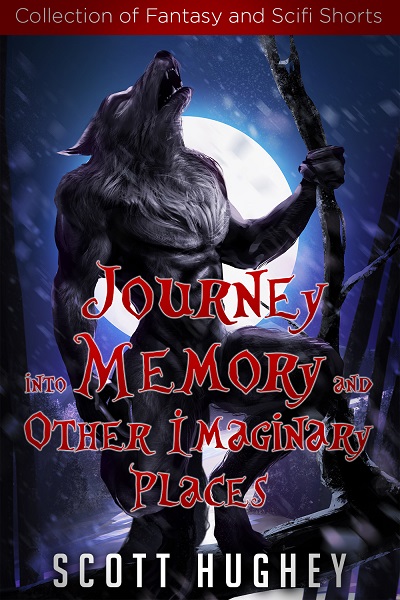
Journey into Memory and Other Imaginary Places by Scott Hughey


What happens when you can travel through feelings and memories like others can travel down the road? And what would happen if a werewolf, a vampire, and a zombie walked into a bar?

Enjoy this collection of fantasy and science fiction short stories, ranging from light-hearted comedy, to dark and poignant sci-fi drama. This collection contains two 100-word stories, for reading in a flash, two traditionally sized shorts, and end with a novelette sized story for a longer read.

This Is Not A Bar Joke- What happens when a vampire, a werewolf, and a zombie all walk into a bar at the same time?

Cheating Death- It’s Death’s first day on the job, and he’s already messed things up.

Don’t Feed the Fairies- A nine year old girl tries to manipulate the tooth fairy, and as a result has to confront her fear of wolves.

Bad News Bear- Ever wonder what really happened to Goldilocks? Surely three talking bears with (apparently) opposable thumbs wouldn’t let her get away so easily.

Journey Into Memory- Kris Lichnev had everything. A beautiful family, a new world to raise them on, and a dream job. In that world, money really could buy love, along with any other emotion, and Kris was one of the few people with the ability to sell. So why did he give up his luxurious life? More to the point, what made him suddenly willing to start digging through those memories again and sale them on the black market?

Journey Into Memory (I’m truncating the title for the remainder of this review) is an anthology containing works of several different lengths and tones. This is Not a Bar Joke is perhaps the most quintessential in terms of Hughey’s comic abilities, but my personal favorite is the longest of the collection — Journey Into Memory. As much as I enjoy Hughey’s sarcasm and often dark sense of humor, it’s his ability to craft intricate, complex narratives that really captivates me as a fan. And Journey Into Memory is nothing if not intricate.

Kris Lichnev is a broken man when we first meet him. He once had everything he wanted — a beautiful family, a dream job, all the things humanity strives for. But an accident ripped it all away, claiming his daughter’s life and his marriage in the process. Now, he wants it back, and he’s willing to do whatever it takes, including selling emotions on the black market.

The story itself is tragic and beautiful and will tug on your heart strings, but the idea of emotion mining, of sifting through memory and collecting the feelings contained within, is downright brilliant. The narrative is structured in such a way that you see both the past and present unfold simultaneously, creating a rich experience that rivals the depth of many longer works.

If you’re a fan of shorter fiction, or looking to discover a promising new writer, I recommend checking out everything by Scott Hughey. I suspect we’ve only scratched the surface in terms of what his talent has to offer, and I, for one, will be waiting not-so-patiently for him to release a full-length novel. In the meantime though, I will snatch up anything he chooses to publish, and highly recommend that you do the same.  Here are the buy links for Journey Into Memory, so you can do exactly that:

Amazon | Goodreads

The Challenges of Writing Historical Fiction

Happy Friday, everyone! I know some of you were expecting a different sort of announcement today — one revealing the winner of my epic holiday giveaway. But truthfully, you all made it so difficult to choose that I need a little more time. Which, as frustrating as it is, should be a testament to the talent pool I’m perusing. I promise not to leave you in suspense for much longer though, and will be posting the results by the end of next week.

In the meantime, I’ve invited Tammy Farrell, author of The Dia Chronicles and whose newest release I featured on Wednesday, to come talk about the challenges of writing historical fiction. As someone who writes historical fantasy, she’s intimately familiar with the struggles of accurately portraying history in fiction. So please give her a warm welcome, and be sure to check out her highly reviewed series!
 

The Challenges of Writing Historical Fiction

by Tammy Farrell

 
When I started writing the first book in The Dia Chronicles, I was fresh out of university and had spent the previous few years studying everything from Greek mystery religions, to the development of post-Roman Britain. At the time, I felt that I had a good understanding of the Middle Ages, but when the inspiration struck and I started to write a novel set in 6th century Britain, I realized there was still a lot I needed to learn.

RESEARCH

Researching the time period was my first order of business. I re-read my history textbooks, scholarly articles, library books, historical maps; I ordered books from Amazon, and I even read real medieval letters (particularly those between Peter Abelard and Heloise) to get a sense of the language. I did some Googling, and even looked at Wikipedia from time to time, but I made sure to source that info before I accepted it as fact.

As I quickly learned, simply reading a lot about a certain time period wasn’t enough to make me an expert. I had to research as I wrote. At first, I found that writing a scene was a slow process because I had to keep stopping to look things up. But this process actually helped cement facts in my mind. The further into the book I got, the more confident I was with the details of the world I was building. And while I still don’t consider myself an expert, I can now write a scene without stopping ten times to research. 🙂

LANGUAGE

Deciding how my characters would speak was no easy task. I’ve read historical fiction that uses modern language and lots of contractions, and I’ve also read historical fiction that uses formal language, old English, and no contractions at all.

What I found is that the best way is somewhere in between. The truth is, in the Middle Ages people used contractions all the time (i.e. ‘t is), and they often placed words in a different order than we do today.

It took some practice and playing around with dialogue, but I chose to give my characters both formal and informal voices, with some old English mixed in. If a character is speaking to someone of authority, or if the tone of the conversation is serious, they often speak more formally and with fewer contractions. When they are in a more casual situation, I give them a more relaxed dialogue with more contractions. If you pay close attention, you can almost always tell how one of my characters feels about a person by the way they are speaking.

WHEN TO MAKE THINGS UP

In The Dia Chronicles, I try to insert as much historical fact as possible, but there’s a lot of fiction involved in writing history. For the most part, I invented village names, people (with the exception of King Erbin and King Gerren), and some historical events. In The Embers of Light, one of the main settings is a mountain called Ayrith. I created Ayrith, but this fictional place is set on Snowdon in Snowdonia—a real set of mountains in Wales.

Sometimes inventing history is necessary, but I’ve found that as long as it’s believable, readers don’t mind.

FIND THE RIGHT EDITORS AND BETA-READERS

You can’t pick just any editor when it comes to historical fiction. I had to learn this lesson through experience. Unless your editors and beta-readers are somewhat familiar with historical fiction, you might find them trying to do things like: reword dialogue (e.g. “What of Malcolm?” vs. “What about Malcolm?”), question word choices (e.g. dais instead of platform, mantle instead of cloak), and question your characters actions and behaviors (such as the execution of justice, a woman’s place in society, the importance of land and titles). If an editor or beta-reader isn’t familiar with the basics of historical fiction, you’re wasting their time, and your own. I was really lucky to have Julie Hutchings work as a DE on The Embers of Light, and I feel like she understood the tone, the language, and the actions perfectly. Make sure your team can help improve your historical writing, not misunderstand it.

The Lesson — LEARN BY DOING

I think some writers avoid writing historical fiction because of the many challenges it presents. But the ONLY way to get past the obstacles is to write! Sit down and write as much as you can. No matter what genre you write in, you’ll always need a plot, you’ll need to know your characters, and you’ll need to know your setting. The best way to build the foundation for historical fiction is to write the story you need to tell, research as you go, and add in the details later. The more you research and the more you write, the more confident you’ll become and, one day, you’ll be the expert of your own world.

Book Feature: The Embers of Light by Tammy Farrell

The Embers of Light by Tammy Farrell


Since it’s only Wednesday, that means I either feature a cool book deserving of your attention, or I post a review of a cool book deserving of your attention. 😉

Today, it’s a book feature. And I want to wish a happy release day to author Tammy Farrell! The second installment in her historical fantasy series, The Dia Chronicles, is now available. This series has been on my radar for a while, and I’ve heard nothing but good things about it. Both books are currently in my TBR list, so I’ll be sure to post reviews of them once I’m done. But for now, check out the blurb for Book 2: The Embers of Light.

The descendants of the ancient gods think they’ve found peace, but the time has come when new magic and ancient powers will collide . . .

Stripped of his Dia powers and left to rot, Malcolm is a prisoner of Valenia—a sentence he finds worse than death. His thoughts of revenge are the only thing keeping him sane, but when he finally manages to escape, Malcolm discovers that living as a mortal is more dangerous than he ever imagined. After stealing from the wrong man, Malcolm becomes a captive once more, only this time his punishment is one that he won’t soon forget. His only hope of survival is Seren, an enigmatic young girl with golden eyes and a malevolence to match his own.

When he’s led to Mara and Corbin, the two responsible for his fall from grace, their new faction of Dia is in chaos, infiltrated by an ancient power thought to have been banished forever. This only fuels Malcolm’s ruthless ambitions, but he soon realizes that he too is under attack, a pawn in a centuries old game of power and greed. As new battle lines are drawn, Malcolm finds himself in uncharted waters, forced to choose between helping those he’s vowed to destroy or give in to his lingering desire to settle the score.

Debts will be paid, lives will be lost, and no Dia will ever be the same.

Who doesn’t love a good anti-hero and revenge-driven plot? I think it sounds amazing, if only because I tend to fall for the villains more often than the heroes. But maybe that’s just me. 😉

Be sure to add The Embers of Light, along with Book 1: The Darkness of Light to your reading list, and help Tammy celebrate her release. She’ll be joining us on Friday with a guest post about the challenges of writing historical fiction, so be sure to stop by and say hello.

About the Author:

TammTammy Farrelly Farrell grew up in Orangeville, Ontario Canada where she discovered her love of writing, and all things related to Edgar Allan Poe. She now lives with her husband and six fur babies in Greenville, South Carolina, where she attempts to learn French when she isn’t busy writing.

Learn more about The Dia Chronicles and Tammy Farrell’s other works at: www.TammyFarrell.com

And connect with her online: Goodreads | Facebook | Twitter

Book Feature: Fifteen by Jen Estes

Fifteen by Jen Estes


This week has been nothing short of hectic. Between work field-trips, frustrating encounters with mundane things, and a bout of dizziness that never seems to end, I failed at reading. But that doesn’t mean I can’t showcase another fantastic book you should all go check out. As part of the blog tour, I’m happy to bring your attention to yet another interesting, original offering from Curiosity Quills Press.

Similar to the last book I featured, this YA read contains a unique twist on the concept of time travel (I’m sensing a theme in my reading choices this year), and promises to be a multi-layered web of intrigue, criss-crossing timelines, and mystery. The part I have read is quite enjoyable, and I look forward to being able to share my full thoughts on it in the near future. But in the meantime, here’s the blurb:

Legend has it if you die in your dreams, you die in real life. Fifteen-year-old Ashling Campbell knows that’s not true because when she closes her eyes each night, she doesn’t dream about public nudity or Prom dates. Instead, she’s catapulted to the front row of her future self’s execution — fifteen years from now– where monsters have taken control of her hometown and she, or rather, her 30-year-old counterpart, is their public enemy number one.

For three months and counting, it’s been the same dream . . . until an encounter with an antique dreamcatcher. Ash falls asleep to discover she’s no longer a mere spectator in these dreams – now she’s astral-projecting into the body of her future self. Each night, she goes on the run with a ragtag group of rebels – who have no idea she’s really a high school sophomore and not their noble warrior. She has to make it through each night so that she can wake up and find a way to change the future. For every action she does in the present day, she falls asleep to discover it had an equal impact fifteen years later. It’s up to her to manage her two worlds and make sure she’s still got a place in both.

Intriguing, right? I’m a complete sucker for this kind of narrative (probably, at least in part, due to my own WIP). If you are as well, then this book should be right up your alley. Go add it to your TBR pile! 😉

About the Author:

Jen EstesBorn and raised in the Midwest, Jen had to choose between staring at corn or reading books. Corn husks just didn’t have the appeal of the Baby-Sitters Club, and so a bookworm was born. Reading later turned into writing and in 2011, Jen published her first novel with Camel Press. After releasing four books in the mystery genre, Jen finally gave in to the literary demands of her inner teenager with her YA debut, FIFTEEN (The Dreamwalker Diaries).

Jen is an active member of the National Writers Union. As an author, she has been featured in Penthouse Magazine, the State Journal-Register, Mystery Scene Magazine, and more. When she isn’t writing, Jen enjoys sci-fi in all its mediums, attempting yoga, using her passport, watching baseball, and reading a good book. She lives in Illinois with her husband Nathan under the tyranny of their three cats: Wrigley, Ivy and Captain Moo. To balance the feline:human ratio, they are expecting their first child this spring.

Find Jen Estes Online:

Website | Facebook | Twitter | Goodreads

A Writer’s Resolutions: 2015 Edition

Ah yes, resolution season. Normally, I’m among the first to catalog a new batch of ambitious goals, but this year, I’ve felt strangely impartial to the practice. Aside from the usual personal ones, like “Be Debt Free,” “Lose Like 100 lbs,” and “Stress Less, Have More Fun,” my resolution list has been sadly lacking. But, since it’s tradition to set some writing ones in stone by posting them here, I’m going to try and rustle some up by the end of this post.

First, a quick reminder of the ones from last year:

Writing Resolutions 2014

  • Finish the rough draft of Unmoving
  • Upload Chapters of Unmoving every two weeks to Wattpad & Authonomy
  • Revise and Re-publish The Bardach, Spinning & Confessions via Createspace/Amazon KDP
  • Compile brief synopses of all plot bunnies
  • Write, Edit & Publish one new short story

How did I stack up against those? Most of you already know. Unmoving still isn’t finished, but I did manage to write quite a bit more of it, thanks to the bi-weekly deadline. Though, I also wasn’t as consistent with that as I wanted to be, and I often had to postpone the chapters, missing the deadlines completely while I tried to finish other obligations. I didn’t upload anything to Wattpad or Authonomy, but I did start submitting the serialized chapters to Starter Serials. So we’ll count this one as a win. Yay me! A quick Amazon search will show that I completely failed at resolution three (The Bardach rewrite is only about a third of the way done), and I also didn’t complete four or five.

So, all total, I managed to maybe, kinda sorta achieve one on that list. But that’s still better than I did last year, so I suppose it’s progress, right?

2014 was actually a great year in other regards, though, aside from the last month, when it decided to go out with a crap-storm of awful. But before that, I attended my first writing conference, followed quickly by a second. I met a lot of fantastic new people and learned some cool new tricks. I helped twelve books come into the world, read a plethora of amazing manuscripts on submission, facilitated the Project REUTSway short story contest, and all around kind of flourished as an editor. So even though I didn’t make the specific goals listed above, I’d say it was a good eleven months. I’m not counting December. That month can suck it.

What does that leave me with for 2015? Well, on one side, it’s left me with a continuation of the suckage December shepherded into my life. But it also leaves me optimistic and full of ambition for my writing, editing, and art. Yes, art. The long-lost bastard child of my creativity. Which brings us to . . .

Writing Resolutions 2015

  • Finish Unmoving (It’s going to happen this year, damn it. I have other stories clamoring for attention too!)
  • Upload Chapters of Unmoving every two weeks to Wattpad & Authonomy (Since I didn’t technically accomplish this to the letter, I’m reusing it. Deal.)
  • Revise and Re-publish The Bardach, Spinning & Confessions via Createspace/Amazon KDP (Still something I really want to do. But I’ll settle for at least completing Kindred — aka The Bardach 2.0)
  • Compile brief synopses of all plot bunnies (Definitely becoming more and more necessary, since I can’t seem to remember s**t if it’s not written down anymore.)
  • Write, Edit & Publish one new short story (Still not sure why I haven’t managed to do this. It’s a short story! Get it together, self.)
  • Plan, Prep, and Unveil Secret Blog Project by the end of the year

You’ll notice there’s now a sixth resolution, and it’s particularly vague. I’m excited about it, but I don’t want to give too much away until I know for sure I’ll have the time and ability to pull it off. Let’s just say that if all goes to plan, it’ll involve quite a bit of free fiction for your reading enjoyment. 😉

Other things on the horizon that aren’t official resolutions — let’s call them “soft” resolutions:

  • Be more consistent with new content for the blog. You’ve all been super patient with my hectic schedule this past year, and I truly appreciate it. But I’m hoping to get back to a more regular posting schedule, full of new insights on writing, editing, publishing, or whatever the heck I feel like writing about. Sound good?
  • Maintain, consistently, the release schedule for the VIP subscription to Unmoving. (Not sure what that is? Look here.)
  • Start working on a more traditional (probably YA) novel. Now that my path to self-publishing is underway, I’d like to tackle the other half — traditional publishing. I’ve always said I wanted to do a hybrid publishing style, self-pubbing A Symphony of Synchronicity, and then pursuing traditional publishing for my dark fantasy stuff. Now seems like a good time to start working toward that goal.
  • Dust off my art training and put it to good use. I have a few artistic opportunities looming in my near future, so I think its high time I went back to actively cultivating this skill set. It may even help support that first “soft” resolution, yielding unexplored topics to write about. We’ll see.

I’m sure there are others I could list, but for now, that seems plenty ambitious, I think. So here’s to a new year, a clean slate, and accomplishing all those things we didn’t in 2014. Cheers!

P.S. I’d love to hear what some of your writing/publishing goals are for the year. Share them in the comments below! 🙂