What To Do WHILE Querying

A few months ago (okay, six months ago), I posted a surprisingly popular piece about what not to do when querying, detailing all the things authors should avoid, as well as some of the things they shouldn’t (I posted a reprise of it last week too, in case you were wondering). But that only covered the initial part of the process, the actual act of querying. Today, I want to talk about things you, as an author, can do while you wait oh-so-patiently (yes, that was sarcasm, people) for those elusive responses. And in keeping with the tone of the previous post, there will probably be at least a tiny bit of snark, so be ready.

What To Do WHILE Querying

(aka How to Avoid the Finger-Drumming Lure of Bad Decisions)

Let’s face it, waiting sucks. It has always sucked. And it will continue to suck, because it’s waiting. And waiting — say it with me now — SUCKS. Humans aren’t wired to be patient, and the age of the internet, with its instant gratification and its lightning fast access to information and entertainment, has done absolutely zip when it comes to instilling the virtue of patience.

Well, publishing isn’t the internet. At all. Publishing is a relic, a dinosaur founded on the very essence of patience. Yes, there have been advances that minimize the time it takes for an author to see their name in print, and yes, there will continue to be avenues and improvements that further move us toward that as yet unattainable moment when a decision is instantaneous. But today is not that day. Today, a querying author faces weeks, months, and possibly even years before they’ll finally hold their book-baby in their hands. Today, you wait.

I’m sure you can see how this scenario often leads to behaviors and decisions that can be problematic, many of which I listed in the previous post. No one likes waiting. No one likes that nail-chewing anxiety of having their fate in someone else’s hands. But how do you get around it?

The easiest way to avoid becoming the poster child for what not to do is to find some other way to distract yourself. Agonizing over the wait, refreshing your inbox every twenty seconds, is only going to drive you crazy. So here are some things to try instead.

1. Learn the Ins & Outs of the Industry

This is especially important for the newbies out there, which is why it’s going to be the biggest section. Debut authors are like fledgling birds, testing their wings for the first time. And that’s a special, unique place to be. But it’s also dangerous. Just like baby birds have no idea what waits for them as soon as they leave that cozy nest, debut authors often have little to no understanding of the industry beyond the steps required to query. It’s okay if this sounds like you. We were all there once. I promise.

One of the deadliest poisons to the author/publisher relationship is unrealistic expectations. Let me paint the picture for you: as a kid, you decided you wanted to become a writer. You loved reading and the act of putting words on paper, and stories just seemed to flow magically from your fingertips. You envisioned topping the New York Times Bestseller list, landing that triple figure book deal with a Big 5 publisher, instantaneous fame, book-signing tours, movie deals, and quitting your crappy day job with money to spare. Right? Don’t lie, we’ve all done it.

Enter reality.

The sad fact is that only the top 1% of the top 1% ever reach any of those things. The rest of us slum it out in the query trenches, find a nice home at a small to moderate-sized press or even forge our own paths and do the self-publishing thing. You will see more rejections than accolades. Sales will be slow because no one knows who you are yet. Marketing budgets, if offered at all, will be tiny and heavily reliant on the author’s own willingness to do the majority of the work. There are no book tours, probably no movie deals, and you’ll be stuck at that crappy day job for probably several more novels. If you’re lucky.

But as discouraging as all that is, you can combat it. Do your research. Learn the way the publishing industry actually  works. Set aside those shiny expectations that will label you a diva author and figure out how to attain success within the system that already exists. Read blogs by industry professionals, attend writing conferences, research publishers and agents and contracts and marketing and every other tidbit you can get your hands on. A firm understanding of the way the industry operates will prepare you for what’s to come when you land that offer of a contract and will help you avoid becoming prey to the cats waiting below your nest.

2. Befriend Agents & Editors

Social media is fantastic for this sort of thing. Find and follow agents and editors and even publishers to see first-hand what they’re looking for and get to know the people behind the “gate,” as it were. Because we are just people. People who love books just as much as you do.

When you’re on the outside, publishing seems like a big, scary world. But it’s actually not. Industry pros talk to each other as well as to authors, so if you can befriend a couple, guess what? Your chances of success just went up. You’re no longer just a name on the 800th query in the pile; you’re a person. They know you. They may even like you. And when that happens, you can guess what comes next: they dig your query out of that massive pile of submissions.

So don’t fall for the us vs. them mentality. Agents and editors are your friends. Just be careful you don’t abuse the privilege. You can read last week’s post for the cautionary note on that. 😉

3. Read Widely, Both Inside and Outside Your Target Genre

By now, you should be sensing a theme. Research, research, research. All of these are great ways to bide your time during the painstaking months of waiting. If you’re a writer, you really should be doing this anyway. But we all know how few those reading hours become when you’re wrapped in the thrall of writing. Which is why it’s perfect to spend some time catching up on the latest releases while your query works its way through the pipeline.

Why is this necessary? Well, for starters, it will give you a chance to see what the current trends in your genre are, or rather, were. Remember, the books releasing now are a few years old, because unlike the internet, publishing operates at a pace not unlike a sloth on Valium, which is to say, it’s slow. So by the time they’re on the shelf, those trends are pretty much dead. Which means that if your book fits in that trend, you can already guess it’s going to be a hard sell.

But the other reason is that you grow as a writer by reading the work of your peers. You’ll learn new styles, new approaches to storytelling, and possibly even new ways to combine genres. It will also come in extremely handy when an agent or editor asks you for comp titles (comparative books that appeal to the readership you’re targeting) for your work.

4. Start Something New

This is the last piece of advice I have, not because it’s less important, but because it should be the most obvious. Writers write. It what you do. Yes, you poured your heart and soul into that manuscript you just sent out into the world, but there’s nothing more you can do for it. It’s time to turn your attention to the next one. Because it may be years before your first-born novel sees the light at the end of the publishing tunnel, if it does at all. Many writers don’t succeed with their first, or second, or even third novel. Sometimes it’s the sixth or seventh that lands them their first book deal. And that’s perfectly normal. Those first attempts aren’t wasted effort. You learned and developed and grew, and now, now you have a back-list.

Back-lists and archives of “new” content are an author’s secret weapon. Because guess what? Readers are impatient too. Just like you don’t like waiting for agents and editors to respond, readers don’t like waiting for a new installment from their new favorite author. Which is why the best thing you can do while querying is to continue working. Continue honing your craft, be it on novels, short stories, or novellas. Continue generating new content, be it blog posts, contest entries, or platform-building endeavors. Just continue working. Because at the very least, it’ll keep you from drumming your fingers on the desk and falling prey to all the bad choices I mentioned last week. And you never know, one of those other projects could be the very thing that gets you noticed.

All right, those are my top suggestions for ways to make the waiting less agonizing, but they’re certainly not the only ways. I’d like to hear some of yours. So, authors and other editors, what do you do or recommend to keep the query-trench madness at bay? Sound off in the comments below! 🙂

Featured From the Archives: What Not to Do When Querying

It’s #WritePit over on Twitter today (for those who don’t know, that means authors are pitching to editors and agents via that hashtag all day long), and in honor of that, I thought I’d re-post what is arguably one of my more popular pieces to date: What Not to Do When Querying.

I originally posted it in January of this year, so it’s not as old as some of the ones I dredge up from the archives, but it is relevant, if not appropriate even, today — ESPECIALLY today, as hundreds of writers flood the query trenches under the banner of a Twitter pitch party. I have a companion piece to this that I’ll be posting next week, but until then, here’s a sarcasm-laced tutorial on everything to avoid while pursuing a book deal. 😉

***

As Acquisitions & Editorial Director for REUTS Publications, I’ve been privy to first-hand knowledge of publishing’s “mysterious” acquisitions process.  And over the past two years, I’ve witnessed innumerable querying blunders that hurt the author’s chances rather than helping them. I’m not the first to offer up this kind of advice-oriented post, but armed with personal insight and pet-peeves, I thought I’d add my own thoughts into the mix.

So, with only a modicum of tongue-in-cheek snark (okay, make that a lot of snark), I give you:

What Not to Do When Querying

(aka How to Piss Off an Acquisitions Editor)

By Kisa Whipkey

Originally Posted on 1/23/15

There are plenty of posts out there that explain what you’re supposed to do when querying, the steps that are supposed to lead to that coveted moment when someone offers you representation. There are also posts that tell you what to avoid. But I don’t know that I’ve seen anyone really say the following, in all its blunt glory. Because the truth of the matter is this: there are definitely things you can do as a writer to increase your chances of a book deal, but there are also plenty of ways to blow it. (Also, it should be noted that this information applies to agents as well, not just acquisitions editors.)

So let’s break down some of the worst publishing faux pas you can make, yes?

DO:

Submit to publishing houses and agencies that interest you.

DON’T:

Submit to them blindly, and then ask a bunch of questions about how they operate. That’s something that needs to come first and is a dangerous game to play. Vet the places you’re planning to query before you hand them your work. Not after. That wastes everyone’s time, and there’s nothing agents and editors hate more than wasting time. We have precious little of it as it is. Be courteous and ask your questions up front, please. Most of us are more than willing to answer.

DO:

Query agents and small presses.

DON’T:

Query them both simultaneously, and definitely, definitely don’t use a small press as leverage for attaining an agent’s interest.

This one’s two-fold, so let’s start with the first half: don’t query agents and editors simultaneously. Small presses are fantastic. So are agents. But they lead to two completely different publication paths. And there’s nothing we despise more than falling in love with something, only to discover that the author wasn’t serious about working with us after all. It breaks our literary-loving hearts. So please, know where each publication path leads and which one is right for both you and your project.

Which brings us to the second half. This is a serious faux pas, and one I hope none of you ever commit. Never ever use a small press for the sole intent of gaining interest from an agent. Leveraging an offer of publication from a small press to get an agent’s representation (or even a bigger publisher) is like dangling a wedding proposal from someone you pretended to like in front of the mate you really want. It’s mean, and cruel, and makes you a horrible person. It’s also a sure-fire way to end up on a publishing house’s Black List. Yes, we have those. And publishing is a small world; we talk. So be careful which bridges you burn. Treat all parties involved with respect and professionalism. If you want an agent, don’t query small press editors. If you receive an offer from somewhere else, tell us. There’s a perceived divide in publishing, the us vs them mentality, but we’re all just people. And we all just want a little consideration. Is that too much to ask?

DO:

Research the various agents and editors you’re querying. Find out what they like, personalize your query, follow their submission guidelines, and all that other stuff you’ve seen touted a million times. It’s good advice. We appreciate that.

DON’T:

Spam your submission to everyone at the agency/publishing house. And definitely don’t resubmit the same query, after receiving a rejection, to someone else within the company. Publishing houses are like families. We all know everyone else, and we know what they like. So if we see a submission cross our desk that isn’t a fit for us, but would be for one of our colleagues, we’ll tell you. Better yet, we’ll tell them. (Or, alternatively, acquisitions can be a team effort, as it is at REUTS, and everyone who has a say has already read your work prior to the decision being issued.) Talking about books is one of the reasons we got into publishing, so you can bet our water-cooler conversations revolve around that too. If you receive a rejection, accept it gracefully and move on.

DO:

Keep track of your submissions and the response times associated with each.

DON’T:

Incessantly hound an agent or editor for a decision. Wait until the listed response time has passed and then politely — key word there: politely — nudge for a response. Submission in-boxes are the first to brim over with a plethora of time-consuming tasks. And as I said above, editors and agents are incredibly busy people. Reading actually falls low on our priority scale, as our days are usually spent dealing with the various tasks associated with producing the projects we’ve already signed. So reading the new queries that rain down like, well, rain, is a luxury we don’t have on a daily basis.

We know you’re excited for your work, and that you can’t wait for that glorious day when someone from our side of the fence is equally excited for it, but constantly yapping at our heels like a chihuahua does nothing but annoy us. We don’t appreciate being backed into corners, and if you push too hard, guess what the answer is: NO. That’s not the relationship you want to have with your potential publishing allies, is it? You want someone to appreciate those words you slaved over, to savor the story you carefully crafted, and to join you in screaming its brilliance from the rooftops. Rushing a decision allows for none of those things. The most you’ll get is a half-assed read-through and a reluctant yes. Patience really is a virtue here, people. As much as it sucks, it will benefit you in the long run.

DO:

Follow agents, editors, and publishing houses on social media and interact with them. Forming networking connections is a fabulous way to form relationships that further your career. But be careful. There’s a fine line between creating useful contacts and this . . .

DON’T:

Abuse the accessibility social media gives you. We’re there because we genuinely want to meet the authors behind our next favorite read. We want to support the writing community and foster a kinship that bridges the gap between publisher and author. And we want friends who like what we like. We’re human. It happens.

We’re not there so you can harass our every waking moment with status requests, update requirements, or attempts to pressure us into taking your work by leveraging the opinions of others who have read it. That’s not the best impression to make, so just don’t do it, okay? There are a lot of factors that go into an acquisitions decision, but endorsements from random Twitter buddies isn’t one of them. Now, maybe if your random Twitter buddy is Stephen King or JK Rowling, that might be different. But still, save that for the query letter, or better yet, get them to blurb your book after it’s signed.

DO:

Create an online persona, platform, and all that good stuff.

DON’T:

Parade things you don’t want the world to see. One of the biggest factors in an acquisitions decision is actually whether or not the team involved would want to work with the author. So, in that sense, submitting a query is on par with a job interview. And guess what? We do our research. We may love your talent, falling all over your manuscript with gushing adoration, but if we discover that you’re the world’s biggest Prima Donna on social media, guess what? Your appeal just went down. Don’t get me wrong, opinions are great. Everyone has them, along with a certain piece of anatomy that usually accompanies that phrase. But think about how your opinions may be perceived by someone on the outside.

Shaming other authors, railing against other publishers, responding horribly to a rejection, and whining like an attention-starved kitten are not appealing things in a potential partner. Would you date someone who checked those boxes? Probably not. So can you blame us if we don’t want to work with that person either? Publishing is a long-term relationship, taking months or years to come to fruition, and you can be darn sure we’re not going to want to work with someone who will make that time an ulcer-inducing, grey-hair-creating pain-fest. You could have the most brilliant masterpiece, but if you yourself are a piece of work online, I’m pretty sure you can guess what the verdict will be. So the moral here is this: think about your online persona. Craft one that will be appealing to both your audience and your potential publisher. And generally try to avoid things that would fall under the heading “authors behaving badly.”

The take-away from this candid look at the publishing process is simple, really. It all comes down to common courtesy. Editors and agents are people. As in human. As in we have lives and obligations and families too. And just like you want us to shower you with glowing praise and go to the ends of the earth to champion your project, we want you to understand that your manuscript is not God’s gift to publishing. We may think it’s brilliant, it may be among our favorite reads of all time, but it’s definitely not the only one we’re working on. Show respect of that fact, handle your interactions with poise and professionalism, and you’ll manage to avoid every single one of the querying faux pas I just listed. Sound like a plan? 😉

The 10 Best Things About Being an Editor

There have been a lot of articles floating around the interwebs lately detailing the uglier side of editing, the harsh reality and bitter truth that publishing generally prefers to keep hidden. And I’d guess a lot of you are wondering why anyone would sign up for a job that clearly comes with a large side of misery. Or, if you’re a fledgling editor, you’re probably thinking it won’t happen to you, that those of us “griping” are just jaded old farts yelling “GET OFF MY LAWN!” at anyone who comes near. But trust me, you’re wrong. It will happen to you. I said I’d never fall prey to it either, and now look. I struggle daily to hold on to the passion and enthusiasm I started out with, to avoid turning into that hateful, jaded editor I said I’d never become. Because, you see, being an editor is a lot like being a statue in a sandstorm. Each stressful project wears down a little more of that initial optimism and joy, replacing it with marble-lined walls nothing can get through.

But it’s not all bad. And this isn’t going to be one of those bare-all-the-skeletons-in-the-closet type of articles (in case you didn’t glean that from the title above). No, to counter-act the very valid, albeit depressing, truth behind the editing life, I’m going to show you the good, the reasons we battle our way through the ugly, day after day after day. The reasons, when asked, we’ll still tell you we love it and it’s the best job on Earth.

I give you, the ten best things about being an editor, in no particular order and with just a touch of snark. 😉
 

1. Nerdery Welcome

If you’re an editor, you’re an avid reader. You have to be. It’s literally job requirement #1. Okay, proficiency in grammar is probably job requirement #1, but you know what I mean. You are a self-professed book nerd and you wear that label proudly.

But growing up, you were likely teased for it. A lot. While others spent their afternoons playing video games, sports, or lusting after the opposite sex, you were Belle from Beauty and the Beast, walking around with your nose stuck in a book. Admit it, this was you:

20120817-084704

Well, one of the best things about being an editor is that your unabashed love of all things books is returned and fed by others who also unabashedly love books. All those things that riddled your childhood with taunts are no longer a weak point. The fact that you’re a book nerd is par for the course, and in fact, nerdery in all forms is highly encouraged. They say that nothing beats finding your people, your tribe. Well, book nerds, the land of editing bears its nerd flag proudly, and if you have the skills, you’re more than welcome to add your sigil to our banner.
 

2. Buying Books Becomes a Business Expense

This is legit. Seriously. Part of an editor’s job (especially an acquisitions editor) is knowing the ins and outs of the book-buying market. And how do you accomplish this? By buying books. No joke. Therefore, those extensive receipts from Barnes & Noble, Amazon, and whatever other book haven you haunt, become what is known as “market research” and according to my tax professional, that is a deduction. **Note: I’m not a tax professional and make no claims to be. Make sure you talk to someone who is before taking my word for it.

As if we needed another reason to buy books, right?

excited-baby
 

3. Hoarding Books No Longer = Mental Disorder

Ah, yes. This is probably one of my favorites. I am a book hoarder. There, I admitted it. My apartment is crammed to the gills with books, to the point that one of the first comments any visitor says when they walk inside is, “Man, that’s a lot of books!” The second is always “Cool weapons,” but that’s a story for another time.

The point is, I like books. No, scratch that, I LOVE them. I love their smell, their feel, their beautifully linear sqaureness (Don’t ask. It’s been noted before that I have a touch of OCD). And someday, I will own that library from Beauty and the Beast. I will!

Anyway, this habit to collect books in droves has long been considered strange, obsessive, and cause for concern for any who have to help me move. But guess what? No one bats an eye now that I’m an editor. All that judgment I used to have to fend off gets checked at the door. It’s considered normal and, apparently, is completely understandable now that I live my life surrounded by words and literature and the soothing smell of printed paper. Now my only problem is my lack of shelf space. (Thank God for Kindle!)

Books
 

4. You Become a Mystical Rainbow Unicorn with Super Powers

No, not really. But it will feel that way sometimes. I believe I wrote before about how I considered “Editor” to be an unattainable, near-mythical job title when I was younger. Well, apparently, I’m not alone in that. People seriously look at us like we’re some shimmery Fae creature that can’t possibly exist in real life. And I’m not talking about writers, whose reaction is usually more akin to the fangirl/fanboy response of a super-fan at a rock concert angling to get backstage. No, I’m talking about everyday people who have no affiliation to the publishing industry whatsoever. There’s an impressed awe that tends to come across someone’s face when I mention what I do for a living (no, not the Day Job of Doom part). And honestly, who doesn’t want to feel like a rock star, even the literary kind?

magic-unicorn-meme-generator-i-am-splendiferous-watch-me-sparkle-ae7515
 

5. Books! Books! Books!

read-all-the-books-meme

I think that’s self-explanatory, don’t you? Moving on . . .
 

6. It’s Intellectually Challenging

Now we’re starting to get into the more serious reasons editors become (and stay) editors. So I’ll try to hold the sarcasm in check.

This one in particular is probably one of the main things I find appealing. Editing is like Crossfit for your brain. It’s often mentally taxing and can leave you feeling like you’re seconds away from having your eyeballs abandon ship, but that’s also part of why it’s fun. Not the mutinous eyeballs part. The mental gymnastics.

The best editing projects are like a massive puzzle, requiring you to shift and move and tweak and tune things until, like a camera lens, the focus snaps into place and the picture becomes perfectly clear. I love that feeling, and for me, it is a visceral feeling. I know the rules and regulations, but honestly, I edit primarily by instinct. I’m lucky to have been born with an innate sense of storytelling (and yes, I have had people tell me its a super-power) and I can actually feel in my bones when a narrative clicks into place. That sensation alone makes all the hard work, all the sweat and blood and tears (because editors expend those just as much as the authors do in this process) worth it.

puma
 

7. Proud Teacher Moments

If the last point wasn’t enough to convince you that being an editor is awesome, this one should. Yes, I just said that feeling a story find its groove makes it all worth it. And it does, but this is the icing on the cake. Completing a project definitely feels good, I’m not going to lie. But there’s one thing that feels even better:

Watching your author step into the much-deserved spotlight, their polished, perfect new book-baby clutched in their hands.

I call it the Proud Teacher Moment, because that’s the only way I could think to describe it. I imagine it’s very similar to the swell of pride and emotion teachers feel when they watch their students graduate. It’s sort of a bittersweet sensation — one part love, one part pride, one part sadness. Most people don’t realize how invested editors become in the projects they work on. Yes, the author wrote the thing, but we helped train it, helped shape it into the perfect piece of literary brilliance flourishing out in the world. And that creates a special bond. We may be relegated to the shadowy corners of Hell writers call the Editing Cave, but we watch from those shadows, cheering our authors on with proud tears glittering in our eyes.

Make Good Choices
 

8. Discovering Hidden Gems of Awesome

Okay, now that we had our little moment of seriousness, back to the fun. This one is a perk that most people automatically know — we get to read (and find) awesome books before they’re published. Boom. Go ahead and be jealous. You know that’s totally awesome.

Bejealous
 

9. Creating Magic

Writing is a magical process. I mean, come on, authors paint fully-realized worlds, characters, and plots that elicit emotions in readers with words. Letters on a page. That’s pretty magical, if you ask me.

Editing may not seem all that magical — it’s more like polishing a car than say, painting one — but it has its own kind of magic. Especially in the developmental phase. Editors are like spirit guides, helping authors find their way when they get lost in a forest of words. The best ones can actually step into an author’s voice, mimicking their syntax, their style, with the efficiency of a Pooka. Which, come to think of it, may be the perfect analogy for editors in general, given the oft touted love/hate relationship writers have with us.

DoctorWho

Anyway, what I’m trying to say is that writers create magic, but editors help contain it. And for that, we need our set of spells.
 

10. For the Love of All Things Books

When it really comes down to it, there’s only one true reason someone decides to pursue editing: a genuine, deep-rooted for all things books. The reasons listed above are great, but if I lost all of them tomorrow, I know I’d still have a love for books. Because nothing beats the ability to escape into a million other lives and worlds. It’s even been scientifically proven that reading enhances our ability to empathize. It’s a fundamental human gift, storytelling, and it’s one I will always cherish.

And that, my friends, is why I adore being an editor. Why I strive to look past the gritty, harsh truth of an editing life. I love storytelling. Plain and simple. And I love editing because it lets me pursue that love of storytelling. I enjoy the process, as painful as it may be sometimes, because I love the challenge, and I love helping others achieve their literary dreams. And best of all, I love that I get to spend my days surrounded with all things books.

I can’t sum up this last point any better than with this quote:

7afa052705168d8936aadee57b7a5f3a

Happy reading!

The Editing Life Laid Bare: A Brutal Look at the Statistics

This is a post I’ve been wanting to write for weeks now, but true to The Editing Life, I simply haven’t been able to find the time. Or the brain cells, for that matter. But today, I’m finally going to do it. I’m going to show you exactly what it looks like to be an editor, not with words, which would perhaps be the obvious choice, but with numbers. Why numbers? Well, nothing puts things into perspective quite like seeing the break-down of exactly what goes into something. Or so I’ve heard.

Now, I’ll be the first to claim that numbers are not my friend, so these “statistics” I’m about to lay down are only about as accurate as my math. And sometimes, that’s not terribly accurate at all. But even though it’s not going to be an exact science, it should still give you a snapshot of what my life as an editor truly looks like. The key words there are “snapshot” and “my,” meaning that this is in no way a comprehensive look at all the various things I work on as an editor, nor is it all inclusive for every editor. Others will be different. But based on experiences I’ve heard recounted from fellow editor friends, this is pretty close to what it looks like more often than not.

Let’s get to it, shall we?

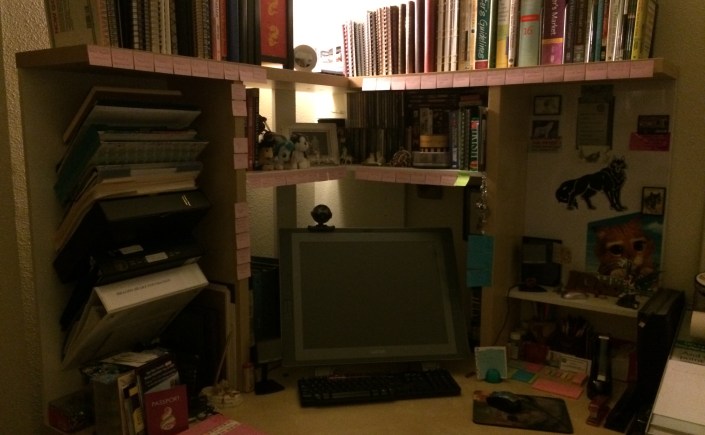
How many of you have heard us (us = editors) say that we work on multiple projects at once? Most, if not all, right? It’s a pretty common fact. But what does “multiple” truly mean? Well, cast your eyes over that photo at the top of the post. That’s my actual desk. No comments on the content/mess, please. 😉

See the lines of pink around the edges? Those are post-it notes. And yes, I realize it looks like an exercise in insanity, but trust me, it’s actually a very efficient method. Now, count them. How many did you get? Here’s the thing, each one of those post-its represents a project in various stages of completion. Not the stages, the project. I purposely kept it distant so you can’t see the names, but yeah, that’s what it means when editors say they’re working on multiple projects at once. Daunting, isn’t it?

On top of constantly being buried up to our eyeballs in work, we’re also generally underpaid. I’ve featured an article on this before, written by the lovely Cait Spivey, which can be found here. But let’s actually turn the microscope on it and dissect what that means in terms of my life.

On average, a manuscript clocks in somewhere around 75,000 words. Some will be more, some less, but that’s a good solid representative of a standard novel. Every editor has a different way they figure out what to charge. Common methods are by page, by hour, or by word. If you’ve looked at my freelance editing page, you know I charge by the word. So a full edit on that 75,000 word manuscript runs $1500. Ouch, right? That’s a hard number to stomach for most authors, and I get it. It seems really expensive. Until you break it down to see what you’re actually paying me for.

75,000 words is roughly 300 pages (according to the age-old school-paper formula of 250 words = a page). Most editors I know that are worth their salt average a pace of about 6-7 pages an hour for line edits. (I’ll cover why it takes this long in a future post.) So 300 pages equates 50 hours of work. If we take that $1500 fee from above and divide it by 50 hours, you get about $30 an hour. That seems like good money, doesn’t it? And in fact, that’s considered average for a professional freelance editor according to the Freelance Editor’s Association.

But we’re not done yet.

That 50 hours is solely what I spend during one round of line edits. There are things that happen before and after that stage. Remember, I said that $1500 rate was for a full edit, which consists of structural edits, line edits, and proofreading. So let’s factor in those things.

Structural editing is the process of reading a manuscript, analyzing it, and then diagnosing and finding solutions to any problems that are weakening the overall story. Tell me, does that sound like an especially fast process to you? It shouldn’t. If an editor is actually qualified and trained to do this (and not all of them are), it looks like this: reading — not just speed-reading, but really truly reading and seeing every letter and space and punctuation mark on the page — and analyzing 300 pages takes me approximately 2-3 full days, so, at 8 hours per day, that’s 24 hours of reading time, give or take. Figuring out what, exactly, is affecting the manuscript and how to deal with it will vary, but let’s say another 3-ish hours is spent on the mental gymnastics of curing an ailing story, and then another 2-3 are spent compiling all my notes and thoughts into an edit letter explaining all that to the author. These are super rough, ball-parky type figures because I don’t think I’ve ever truly tracked this part of the process. Anyway, when it’s all said and done, that’s about 30 hours invested into just the structural edits. And that’s without any follow-up discussion or brainstorming with the author, things that often occur after I hand them the aforementioned edit letter.

Proofreading is the last step and is probably the fastest portion of the process for me. Most projects, I can average 10-15 pages per hour. So if the manuscript is in good condition, that’s only about 20 more hours of work. However, that’s for a base proofread. If I have to do an editorial proofread (which is somewhere between a line edit and a proofread) the pace drops dramatically.

So, where are we at with our project overall? We have 30 hours for structural edits, 50 hours for line edits, and 20 for proofreading. That’s 100 hours of effort from start to finish, bare minimum. Suddenly, that $1500 flat fee isn’t looking so grand, is it? That’s only $15 an hour. Minimum wage in many larger cities.

I should also point out that most projects take at least two rounds of line edits to truly shine, which, if you’re lucky, is only an additional 30 hours of labor, and there are probably easily 20 hours of time invested in various discussions and emails and hand-holding with the author. Making the total time expended on any full project easily 150 hours. Honest to God. What does that make my hourly wage? $10 an hour. You can flip burgers in some states for more than that.

Now, maybe that doesn’t seem so bad to you. $10 an hour is a livable wage, barely. Until you realize this: normal people work 40 hours a week. Even doctors and lawyers (who make a hell of a lot more money than editors) will only clock 70-80. So how many projects do you think we can realistically fit into a month? The answer is one. From start to finish, with no other obligations, family or social life, etc. an editor can comfortably complete one project in a month’s time. But we don’t live in a perfect world, do we? And we rarely get the luxury of only working on that one project and nothing else. (Photo of project management via post-it being exhibit A.) We also don’t get paid everything up front. So, if we only schedule that one project in a month, because 150 hours equals 3.75 weeks of normal human work-time, that’s a grand income of $750. For the month. I’ll let you do that math. Is that a living wage in your book? Because that barely covers my car payment.

Are you completely depressed now? Because I am. But the point of this post was not to whine, or complain, or guilt-trip anyone. I simply wanted to show you exactly what life as an editor looks like. It’s not sitting around and reading all day. It’s arduous, mentally-taxing, long hours for very little pay and often even less appreciation. It’s not a life that will lead to riches, or fame, or maybe even a full-time income. Which begs the question, why would anyone do it?

The answer is easy — love. Editors truly love what they do. But the sad truth is that editors also have one of the highest burn-out rates of any career. The average life-span of an editor is only 2 years, and now you see why. In an industry that refuses to pay a living wage (freelance editors who charge less than $500 for a full edit and indie presses that offer $350 for two rounds of full edits, I’m looking at you), we’re required to go to super-human levels in order to stay afloat. We take on burdens that would make Atlas tired, and we do it all for you guys, the authors. Because we truly want to help you produce fantastic, beautiful pieces of art. We’d just kind of like not to starve while doing it.

So, there you have it. That’s what the editing life looks like in all it’s stress-filled, brutal glory. I hope it’s been enlightening and that you take away three key things:

1. If you’re looking to hire an editor, please consider what their rate actually means. As in every industry, you get what you pay for.

2. If you’re already working with an editor, try to remember that they may have a desk covered in post-its too, and that your project is not the only one on their plate.

3. If you are an editor, set your rates appropriately. When you charge less than $500, you harm not just yourself, but the rest of the industry. You deserve to eat. You deserve to have a roof over your head.

That is all. Thanks for reading! 🙂


Book Review Wednesday: The Ties Eternal by Cait Spivey

Despite the fact that this four-day work week has left me nothing if not continually confused about what day it is and stressed about being a full day behind (three-day weekends are awesome, aren’t they? Until you have to start your week on Tues . . . then, not so awesome), I did manage to meet the Wednesday deadline for the final installment in my review series for Cait Spivey’s Web novellas. So let’s get to it, shall we?

The Ties Eternal

by Cait Spivey

The Ties Eternal by Cait Spivey

My Rating: 5/5 Stars

Seventeen-year-old Miranda Wolford was born Deaf, though it took her years to realize it. She thought everyone could hear the cacophony of voices that surrounded her—but those voices belong to the dead, and they are the only things Miranda can hear.

When a ghost leads Miranda to a missing child and his murderer, she tries to enlist the police; but between the communication barrier and the insane story, she can’t make them understand.

The murderer is on the loose. To stop them, Miranda will have to take matters into her own hands.

The Ties Eternal is the third Web novella, and unlike the first two, it does not feature the Fletcher siblings at all. Instead, it introduces us to Miranda Wolford, a young Latina who was born Deaf but has the intriguing ability to see and communicate with the dead. We’re not talking Ghost Whisperer style, either. No, Miranda sees the dead in all their gruesome glory and is surrounded by their cries for her help. One in particular becomes more incessant than the others, and Miranda soon discovers that hearing the dead isn’t the only ability she possesses.

This was definitely my favorite of the series, for two very distinct reasons. The first is how beautifully written Miranda is. Spivey has masterfully captured what it would be like to live in a world you can’t hear, but without making the story solely about Miranda’s Deafness. Instead, it’s simply part of her identity, and we are given a glimpse into everyday, subtle things, like the worry over injury to her hands, which would affect her ability to sign, her frustration when her cousin resorts to words Miranda can’t hear in order to yell at her, her isolation when surrounded by a room full of boisterous family that isn’t translating anything into sign language. All of these things held the essence of truth and painted an eye-opening picture for those of us who otherwise have no way to understand. That’s always been the brilliance of Spivey’s writing, to me, and this novella showcases that phenomenally.

The second thing that really elevated this installment above the others was the opportunity to see how events overlap. I can’t reveal much without giving away spoilers, but there is definite cross-over between this novella and certain scenes in both of the previous ones. The resulting effect is impressive realism. These characters feel real; the world they live in feels real. Lives intersect all the time without those involved realizing, and Spivey mimics that perfectly.

We still aren’t given resolution in the traditional sense, and none of the questions from the previous installments are answered in this one, but that’s okay. Because somehow, Spivey manages to continually build on these origin stories, moving us ever closer to a fully realized, highly intricate world. I did find this one to be the most satisfying in terms of overall plot arc, but Miranda’s story is clearly just getting started. I can’t wait to see where the series goes from here.

Next up will be the forthcoming fourth novella, From This Calligraphy, and from there, I’ve heard rumor there will be novels. For those who don’t know, Cait has recruited me for the fourth installment, so I obviously won’t be reviewing that one. But I hope you’ve all enjoyed these reviews and that you have or will be checking the series out for yourself. I highly recommend it! And not just because I’m assisting with the last one. 😉