
Blog Tour Feature: Night of Pan by Gail Strickland

Blog Tour Banner Graphic


As you read this, I’ll be on my way to attend the Pubcamp Writer’s Conference in Seattle, WA. Which means, finally (FINALLY) you can expect to see some more posts about the craft of writing, and not just about my book recommendations. But before that happens (and because it’s awfully hard to write while also driving), I have another such recommendation for you, courtesy of the blog tour mentioned above. So let’s jump right into, shall we?

Night of Pan

by Gail Strickland
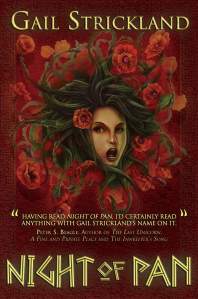
 

cover1000


My Rating: 4/5 Stars

The slaughter of the Spartan Three Hundred at Thermopylae, Greece 480 BCE—when King Leonidas tried to stop the Persian army with only his elite guard—is well known. But just what did King Xerxes do after he defeated the Greeks?

Fifteen-year-old Thaleia is haunted by visions: roofs dripping blood, Athens burning. She tries to convince her best friend and all the villagers that she’s not crazy. The gods do speak to her.

And the gods have plans for this girl.

When Xerxes’ army of a million Persians marches straight to the mountain village Delphi to claim the Temple of Apollo’s treasures and sacred power, Thaleia’s gift may be her people’s last line of defense.

Her destiny may be to save Greece…
…but is one girl strong enough to stop an entire army?

I’ve always had a soft spot for books based in mythology, and this one definitely doesn’t disappoint on that front. The story starts with fifteen-year-old Thaleia’s wedding day. A strong, independent heroine, though, she has other plans for her future, plans that don’t involve marrying a man she’s been betrothed to since age five. She escapes and starts to flee, but is stopped by Pan and a prophecy — the Persian army is on its way to Delphi, and she’s the only one who can save her people.

This is an interesting coming-of-age story about how the Oracle of Delphi comes to be. Strickland has clearly done a ton of research into the culture of the region, from the well-known pantheon of gods, to the day-to-day customs and warfare practices of the time. And from that standpoint, it’s phenomenally written. But I did find myself struggling with some of the other aspects. Namely, that the character development felt shallow. I would expect a coming-of-age story to be largely character-driven, but this fell flat on that for me, reading instead like more of a plot-driven action-adventure. I didn’t connect with Thaleia emotionally (nor with any of the supporting cast), and often struggled with her voice. She seemed to be both too mature and too young for fifteen, and some of the modern turns of phrase were jarring against the historical backdrop. While I do feel that she’s a good role model for young girls, she almost borders on a cliche’ed example of the “strong, independent woman” stereotype. I would have liked to see her be a littler more fully developed and multi-faceted as a character.

That said, I do think the prose itself is beautifully written. Lyrical and smooth, Strickland’s style is effortless, and I could appreciate her voice as an author (not to be confused with Thaleia’s voice, as mentioned above.) The additional material included in the book makes this a well-rounded choice for younger readers interested in mythology. It is a YA, and I think it targets it’s market effectively. However, unlike some YA, it doesn’t translate quite as well outside of that target readership. I would definitely recommend it for the 12 + age range it’s intended for, though. And I will probably finish the trilogy, if only to see more of the richly developed, detailed world.

**Disclosure Statement: I received a copy from the publisher in exchange for an honest review. **

About the Author:

Gail Strickland — classicist, poet and musician — was recognized by The Baltimore Review & Writers’ Digest and published by the Oxford University Journal New Satyrica. While studying the classics in college, Gail translated much of Homer’s Iliad and Odyssey. Always passionate about music and bringing the richness of Homer’s language and culture to today’s youth, Gail mentored young poets and novelists and introduced thousands of youngsters to piano and Greek mythology.

Gail was born in Brooklyn, New York and grew up in northern California. She raised her children, read French philosophers in French and played in an eclectic country band called the Prairie Dogs whose claim to fame was being the only band to play Candlestick Park between the Beatles and the Rolling Stones.

Her first book, NIGHT OF PAN … a mythic journey of a young Oracle in ancient Greece, was published by Curiosity Quills Press November 7, 2014. NIGHT OF PAN is book one of THE ORACLE OF DELPHI TRILOGY.

Gail Strickland Author Photo

Website | Facebook | Twitter | Goodreads

Featured From the Archives: Story vs. Concept; A Demo Team Showdown

Tonight, I’ll be teaching my annual class on demo teams. I know I haven’t posted about the martial arts recently, and that the majority of you out there reading this are writers, rather than martial artists, but this particular post holds helpful tips for both. And since this is what I’ll be discussing over the next two days with the students of Dragon Heart Tang Soo Do, I thought it would be appropriate. However, for the writers out there, I’ll provide annotated notes, indicating the literary terms that correspond with my demo team lingo. So even if you aren’t a martial artist and you have absolutely no desire to learn about demo teams, give it a read. I think you’ll be surprised to see just how much the two worlds intersect.
 

Story vs. Concept; A Demo Team Showdown

by Kisa Whipkey

Originally Posted on 5/10/13

 
Recently, I found myself on the wrong side of an angry, pitch-fork touting mob after I eloquently shoved my foot in my mouth. (Turns out, there’s a fine line between snarky and jackass. Especially when it falls on the wrong ears.) And as I was being schooled by a student who naively believed I was a demo team idiot, I was amazed at how often the terms “concept” and “story” were used interchangeably, as if they were the same thing. I’m not sure if this is a common misconception, but since I was due for a demo team post, I figured why not take a moment to clarify the definitions and try to make something good out of my embarrassing mistake. And what better way to do that than to pit story against concept in an epic battle of demo team terminology. Sounds fun, no?

So, here we go! Contestants to your places, aaaaaaand . . . fight!

Round One: Concept

(2014 Annotation: Writers, this is the same for you. Everything said below applies to the same definition we use in literature.)

Concept does not, in fact, equal story. If it was synonymous with any word, it would be theme. And what is theme? The point of your project. It’s the message or idea that you want to convey to your audience. Let’s check out some examples.

(These are some of the more common demo themes/concepts I’ve seen over the years.)

  • Video Games such as Mortal Kombat, Street Fighter, Etc. (I’m guessing there’s a secret sect of Comic-Con Cosplayer geekhood within the martial arts.)
  • Medieval Asian Warlords (Yes, the Asian part is particularly important. How else can you create something as awesome as a D-grade Kung Fu movie brought to life?)
  • The Korean and/or Association Flag (Especially prevalent in the WTSDA. Apparently, we have a lot of association pride. And unoriginality.)
  • Badass little kids taking over the world (Cute factor combined with awesomeness. Who doesn’t love that?)
  • The Matrix movie franchise (Does this really need further explanation? The Matrix was just, like, the most epic movie ever!)
  • Pretty much any popular movie franchise (Further proof of my statement on example one. Maybe we’re all nerds at heart?)
  • Women’s self-defense (The only thing better than badass kids is watching a bunch of girls pummel a bunch of dudes, right?)
  • Peace, Love and Unity, man (Otherwise known as the undefinable, “high” concepts.)
  • The Elements (Because there can never be too many interpretations of wind, fire and water.)

(I hope, by now, you’re laughing with recognition.)

But despite my mockery, these are all perfectly acceptable examples of concept. I’ve used some of them myself. (There may or may not be multiple versions of Mortal Kombat costumes lurking in Dragon Heart’s demo team archives. 😉 ) The problem comes when that’s all there is to your demo (2014 Annotation: same is true for writing). The concept should be the foundational element, the first spark of creativity. Not the entire focus. Here’s why: concepts are simple. They contain absolutely no allusions to the story they might evolve into, making them a two dimensional, cardboard cut-out experience guaranteed to bore the life out of your audience. Don’t believe me? Let me show you. A concept’s inception typically looks something like this:

Student One: “Dude, let’s do a demo about the Korean flag!”

Student Two: “Like, oh my god! That would be totally awesome!”

Ok, maybe that’s a little facetious, but it’s not that far off the mark. A concept is that first burst of enthusiastic direction, not the ultimate goal. Don’t get me wrong, concept is very much an important part of any demo. Not only does it provide the inspiration, it has influence over decisions like costuming (aka genre, if you’re a writer), set/prop design (setting), characters, and overall presentation (POV/Voice/etc.) as well. But it’s focus remains purely on technique, and will rarely impart any lasting impression or emotion on the audience. For that, you need story.

Round Two: Story

(2014 Annotation: This is more commonly known as “premise” in the written world. But same basic idea.)

If concept is the idea, then story (aka premise) is the way you impart said idea to the audience. It builds on the foundation concept provides to create something with a far richer experience for everyone. However, story is often misconstrued to mean flash. As in, an overly theatrical fluff-fest that’s trying to compensate for a lack of technique. That, my friends, is sadly mistaken. And probably the reason story is given so little respect in the creativity division. (2014 Annotation: “flash” in literature can take on many forms, but most commonly it’s seen as an over-indulgence in world building, or an over-wrought, heavy-handed style that gets in the way of the story.)

All those components that instantly scream flash – costuming, props, etc – are not actually controlled by story. They reside within concept’s domain. (Cheeky bugger, fooling everyone by pointing the finger at story.) The only thing story controls is choreography (aka plot, for writers). Why? Because choreography is how you tell a narrative in a demo (See? Plot). The rest is bonus to help ensure the audience understands. But you don’t actually need anything beyond choreography.

Story is defined in the literary world as conflict. Meaning, there has to be something happening. A journey from Point A to Point B. I’ve written about this topic at length in my previous post, Storytelling for Demo Teams, so rather than repeat myself, I’ll provide an example of how story elevates concept. And how it doesn’t necessarily have to be complicated to be effective. (There’s only so much you can cram into a 5 minute span, after all.)

I’m going to use one of my own demos for this exercise – The Dream Sequence – which I have featured before.

The concept for this demo actually came from the music itself. (As do all my ideas, which many of you know by now.) I wanted to show a dreamy, ethereal world that matched the tone of the music. But since that isn’t enough for a competition-grade demo in my opinion, I needed a story that would deliver that message to the audience. So I created one about a little boy who falls asleep and finds the dolls he was playing with have come to life around him. When he wakes up, the dolls disappear. Literary genius, isn’t it? But that’s my point. No one said you had to be a master storyteller; you just have to tell something.

So, to recap:

Concept = dreamy, ethereal imagination.

Story = slightly creepy dolls coming to life inside a child’s dream.

(2014 Annotation: This same equation applies in literature, and is quite handy for figuring out things like queries. 😉 )

See how neither of these statements is really that complicated or involved? And how, when combined, you end up with an idea that’s far more powerful and interesting than the concept alone? That’s the beauty of story. (If you haven’t seen the demo I’m referencing, take a moment to go watch it. I’ll wait. 😉 )

And the Winner is . . . ?

Neither.

That’s right, our epic showdown actually ends in a draw. Anti-climatic, I know. But that’s because one isn’t better than the other. They work in tandem, not competition. The ideal demo (or novel) is a balance of both, pulling from the strengths of each to create a wonderful masterpiece people remember for years. But, because the two terms are separate elements, it is possible to create award-winning demos using only one of them. You can have a traditional demo that focuses primarily on technique, with no storyline, just concept. And you can create a moving, story-driven demo featuring absolutely no costumes, props, or flash. (Technically, though, if you have a story, you have a concept, regardless of the addition of flashy elements. Concept can live without story, but story needs concept to survive.) The trick is knowing your ultimate goal and utilizing your team’s talents to their fullest. (I’ve given out a lot of helpful tips about how to do this.)

And remember, if you find yourself having to explain what your demo is about, you failed. (Harsh, but true.) Whether your aim is traditional/concept-driven, or theatrical narrative, your audience should always receive your message clearly. That is, after all, the entire point of demos (and storytelling in general), is it not?

Featured From the Archives: What is “Flow”?

Next week, I’ll be participating in a panel discussion on editing and “voice.”  (It’ll be at the NW Bookfest Conference, if you happen to be attending.) “Voice” is one of those oft-touted, rarely-defined writing terms, and as I work on compiling my thoughts on it, I figured we’d revisit another tenuously defined term — “flow.” I’ll post notes from the panel (well, mostly the material I present) for those of you who won’t be joining us there, but for now, let’s start the discussion off with . . .
 

What is “Flow”?

by Kisa Whipkey

Originally Posted on 10/19/12

 
Stop the snickering and dirty jokes, I’m not talking about that type of flow. 😉

I stumbled on an interesting and rather heated discussion this week (as most conversations involving the dissection of writing tend to be), about the use of “flow” as a literary term. The forum seemed pretty evenly divided between writers that absolutely despised it and felt it should never be used in a critique (an argument that instantly smacked of stereotypical writer pretentiousness), and those that felt it was a valid descriptor (instantly hailed as amateurs by the snobby residents of the Anti-Flow brigade). And it got me thinking. What exactly is literary flow?

Technically, “flow” isn’t recognized as a legitimate literary term — go ahead, Google it. I did. You’ll find it’s omitted from nearly every list of valid literary terms. Yet it’s probably one of the most frequently used words when discussing someone’s work. I know I’m guilty of using it — you can find it’s offensive four letters listed among the things I look for when freelance editing. So how did it become such a firm presence in our literary vernacular if it doesn’t technically exist? And why is using it tantamount to dropping another four letter word starting with “F”?

My theory is that it’s because no one really knows what it means. Is it referring to the structure of the piece as a whole, the “flow” of the words themselves, the pacing, what? It’s this vagueness that makes feedback including it seem awfully similar to:

“I loved it!”

“This sucks. I hated it.”

While those are, I suppose, acceptable reader responses, they fail to tell the writer anything useful, namely — why? In order for any critique to actually help the author, it has to explain why the reader felt the way they did, and what they would have liked to see different or not. Telling us that our work is lame, that you think it’s utter crap, or on the flip-side, that it’s the most amazing thing you’ve ever read ever, really doesn’t help us improve or repeat the success. Telling us why you hated it, or loved it, is like feeding a starving man — it’s what we really care about. Nothing will get your opinions ignored faster than failing to quantify your experience as a reader. I believe this is why “flow” causes such a divide among writers — it gets thrown around like it’s a brilliant little gem of insight when really it’s just unhelpfully frustrating.

I don’t agree that it’s a bane to literary terms, though. Actually, I think it’s a perfectly valid starting point for a critique, as long as the reviewer goes on to define it. The definition is crucial, because “flow” is one of those terms that can mean about a million different things to different people.

For me, “flow” is synonymous with “smooth.” When something flows, it should have an effortless feel that allows me to forget the words and really immerse myself in the story. It’s a visceral sensation of rightness that you only really notice when it’s disrupted. I tend to imagine storyline as a thread running through the center of a piece. Ideally, that thread should be smooth and straight, holding everything tightly in place. When that happens, the story “flows.” But if the thread gets crinkled up in a tangent, veering away into a knotted section of confusion, or frays into several disjointed, broken paths, the story’s flow feels off. Much like the way a river flows toward the sea, everything in the story should flow toward the final goal. This is part of why you need an editor, or critique partner, or random-person-off-the-street to read your work. Authors are usually too close to the story to be able to catch these flaws in the thread. But your readers sure will. They may not know exactly how to define it, but they’ll feel it.

I use “flow” to start a conversation about the structural integrity of a piece, but I can think of at least two other ways in which it could be defined. Let’s put that to the test, shall we? In the comments below, tell us what “flow” means to you. And please refrain from derailing this into the gutter. This is a serious, (ok, semi-serious), literary discussion, and I do have the power to decline your comments (Mwahaha!). So family-friendly only, please. 😉

Featured From the Archives: The Anatomy of a Successful Short Story

Reuts Publications announced the impending return of their Nano-inspired writing contest — Project REUTSway — this week. Which means that (hopefully) there is a horde of eager writers rubbing their hands together in anticipation. (If you’re not sure what I’m talking about, be sure to click above and sign up for the VIP notification list.) It also means that those same writers will be sharpening their proverbial pencils to craft — in rapid-fire succession, no less — four brand new short stories. So what better time than now to dredge this post up from the archives?

Anyone planning on entering PRW (as the REUTS team affectionately calls it), listen up. Here are three things you’ll want to keep in mind as you strive to impress the judges (*ahem* me *ahem*). Let me hand you the key to success on a silver platter; you’ll thank me later. 😉
 

The Anatomy of a Successful Short Story

by Kisa Whipkey

Originally Posted on 12/13/13

 
Short stories. Some people love them, others can’t stand them. But no one can deny they’re an entirely different creature from novels.

This week, I’ve been judging entries for the ProjectREUTSway competition held during the month of November. Buried amid 144 short stories, I started to think about what exactly makes one “successful.” I think most of you know by now that I, myself, published three, so this is a topic that hits very close to home. It’s also one I’ve never really stopped to think about. Until now. Because, let’s face it, short stories are strange. Similar to novels and yet completely dissimilar, they require a certain — almost magic — recipe to really shine. I don’t believe in the undefinable though (at least not when it comes to writing), so let’s see if we can’t identify the exact ingredients that make short stories such a unique form of storytelling.

Short stories are often considered a novelist’s training wheels, the idea being that someone can learn the basics of storytelling through short stories and then graduate into novels. But that’s not exactly what happens. Because, in reality, they require two different skill sets to pull off well. A short story is not a truncated novel, nor is a novel an elongated, rambling short story. Rarely can the concept for one be turned successfully into the other. And yet people still try. Why? Because short stories have been given a bad rap. Novels take all the glory, leaving short stories to rot in creative writing jail like fiction offenders. They’re looked down on as an inferior form of narrative, an eighth grade diploma to the novel’s PHD. After all, the only difference between them is length, right?

Wrong.

There are three things a successful short story must have: brevity, focus, and telling. Yes, you heard me, telling. But before you get your knickers in a bunch, let me explain further.
 

1. Brevity

 
Novelists are taught the value of brevity. But even the most refined novels still sprawl, meandering through details and settings and other things short story authors simply can’t afford. Literally every word matters in a short story. No detail is extraneous. If we mention the light blue collar on a random cat, you can bet that collar is important somehow.

The same holds true for the words themselves. Novelists are allowed to write sentences like this:

She paused, grabbing the handle of the stainless steel refrigerator and pulling it open with a subtle flick of her wrist.

(Hey, no comments on the quality. Clearly, I know that sentence is atrocious. I’m proving a point. 😉 )

That’s 21 words to say this:

She opened the refrigerator door.

Yes, that may be a bit exaggerated, but you see what I mean, I hope. When you only have maybe 5000 words of space, every letter has to serve a purpose. Successful short stories know this, and the language/storytelling is as finely honed as a scalpel. If it doesn’t somehow move the plot along, impart valuable information, or absolutely have to exist, it doesn’t.
 

2. Focus

 
I’m a firm believer that every story should have a message, a reason for existing. But maybe that’s because I started out as a short story author. Whenever I come up with an idea, I identify the core message first, before the setting, characters, or even plot. For example, The Bardach is a story about identity, Spinning is about fate, and Confessions is about losing faith. Even Unmoving has a focal point. At its core, its about compassion. This type of focused narrative is one of the more notable differences between a short story and a novel.

Short stories are single-minded. Like a starving man spotting food, they keep their eyes on the prize. None of this wandering off into detours, flashbacks, subplots or other shenanigans that novels get away with. Nope, they have one message, one plot, one climatic moment that everything points to. And, interestingly enough, short stories are typically driven by an event, rather than a character. The focus is on the action, not the person doing it.

How does this translate into our recipe for success? Well, you’ll be able to feel the underlying drive in a really good short story. You’ll walk away from it remembering the message, not necessarily the characters. So make darn sure you know what you’re saying, both literally and subtextually.
 

3. Telling

 
All right. I know this is the one you were waiting for. After all the times “show, don’t tell” has been beaten into your head, you simply can’t believe I’d actually stand here and advocate telling, can you? Well, I’m not really.

See, the thing is, showing is still 100% better than telling. But, telling is allowed in a short story. Due to the limited amount of time you have to impart your narrative, there’s really no way around it. You don’t have the luxury of wasting thousands of words, or even hundreds, showing us the back-story. Nor can you illustrate anything directly outside the timeline of the main event, regardless how important it may be. So that only leaves one option — telling. You should still avoid the dreaded info-dump if you can, but slipping in the occasional line of summary, or a paragraph of back-story, won’t automatically earn you peer derision. Well, most of the time, anyway.

Successful short story authors are masters of knowing when to tell and when to show. (Which, by the way, I am not. Just wanted to clarify that in case anyone thought I was going to be cocky and throw myself on that list.) They give you just enough information — typically in the form of telling — to make their worlds/characters feel as fleshed out as a novel’s, but not so much that you really notice. They cover a lot of ground in a really short amount of time, making this the hardest skill on the list. It actually requires mastery of the other two to pull off, which is why I listed it last.

And there you have it; the anatomy of a successful short story. Learn how to control these three elements and your short fiction will stand out in a pile like little beacons. And let’s all try to stop viewing short stories as the lesser form of fiction. They’re not inferior. Just different.

Featured From the Archives: Inspiration is a Fickle Wench

Ah yes, my post about inspiration, or rather, the lack thereof. As I stared blankly at the titles in my drafts folder this week, waiting for something (anything!) to spark an idea, I realized that this post would be oddly fitting. It’s also fairly old, so there’s a good chance it will be new to a lot of you. Given my complete lack of inspiration this week (I’m serious, I think my muse died, or decided to flit off to her beach with the cabana boy again), it’s safe to say this is better than anything I could have managed to drag, kicking and screaming, from the depths of my brain. It’s at least somewhat humorous, and I bet a few of you out there will be able to relate. Enjoy!
 

Inspiration is a Fickle Wench

by Kisa Whipkey

Originally Posted on 8/10/12

 
Have you ever had those days where you suffer from a complete lack of inspiration? Where you feel like a creative well that’s run dry? Yeah, me too. In fact, it happens more than I’d like to admit. For someone plagued by the never-ending breeding of plot bunnies, I have a remarkably hard time finding the motivation to actually write. Oddly, the most sure-fire way I have to motivate myself is to declare to the world that I’m not writing. (Sorry, writing group buddies. Sometimes I have to cancel just so the muses in my head will freak out, screaming, “No! You can’t write absolutely nothing this week!” and finally show me the path to the next scene they were greedily withholding.)

But inspiration doesn’t just apply to writing. We need it for all things creative. It plays just as much of a role in creating a masterpiece of art, or choreographing a moving sequence for demo team. And some days, it’ll simply refuse to come when you call it.

I find the idea of inspiration a fascinating thing. Where does it come from? Is it an invisible lightning bolt that shocks our imagination to life the way a defibrillator brings our hearts back from death? Is it a gift from some higher power, sending waves of creative energy coursing through us like sunlight? Is it the whispered voice of a muse dressed like the women of Greek mythology? Or is it just some random combination of neurons firing that creates a delusional escape from reality? Honestly, I don’t know. I’m not sure anyone does. But I do find it intriguing that when a writer talks about hearing “voices,” they’re considered brilliantly touched by inspiration. When anyone else says it, they’re considered mentally ill.  What separates inspiration from insanity? The final product? Who’s to say that people with schizophrenia or brain tumors warping their neurological pathways aren’t the most in tune with that magical force we call inspiration. Or that those of us who claim to rely on it for our careers aren’t actually suffering a slight mental meltdown. Interesting stuff, isn’t it?

All I know about inspiration is that it rarely shows up when I want it to. Case in point, I’m now suffering through week 2 of the current inspirational drought. This wasn’t even the blog post I had scheduled for today, but I was too uninspired to finish the original one. Which made this the perfect week to muse about the elusive nature of the muse, so to speak.

I’ve mentioned a few times that I find inspiration through music, going into rather lengthy, and probably creepy, detail about it here. I’m not sure why that’s my avenue of choice, but it’s always been that way. Maybe I’m mooching off the creative brilliance imbued by the composer/songwriter. Maybe I’m gifted with a finely tuned sense of musicality, and I can find stories through the nuances and layers of musical instruments the way others can through dreams or spoken words. Maybe I’m just nuts. But regardless of the reason, that reliable source of  melodic inspiration only seems to cover the initial conceptual phase. It gives me the base-line, the foundation on which I have to build, and more plot bunnies than I could ever write, even if I was lucky enough to be a writer that could finish a novel in a few months. When it comes to the actual creation part, the nitty-gritty work part, I’m left to suffer the whims of inspiration like everyone else.

Every writing website, advice article, author/artist blog out there will tell you that creator’s block is a myth. That it’s just an excuse for being lazy, for procrastinating, for giving in to your fear of failure, or for a plethora of other reasons. They’ll all tell you that you just have to power through those days when you’re lacking inspiration. That you have to discipline yourself to create every day. That you can’t wait for the muse to come to you, for the weather to align perfectly, for the fourteen cups of caffeinated beverage to kick in, or for whatever that magic combo is that ignites the fires of inspiration for you. And they’re probably right.

I, however, can’t force it. When I’m not feeling inspired, I end up with this:

“Blah, Blah, more Blah, Blaaaaaaaaaaaaaaaaaaaaahhhhhhhhhhh! Stuff and things. Blarg. Grrrrrrrrrrrrrrrrrrrr. Oh, and more Blah.”

How would you like to read an entire novel of that? I know I wouldn’t. So I ignore all those lovely professional people out there smarter than me, because their perfectly valid advice doesn’t help me. And I wait, sometimes days, sometimes weeks, sometimes even months for the return of inspiration. Does that make me a lazy, procrastinating, fear-frozen artist/writer/choreographer? Maybe. It definitely makes me slow. But one thing I’ve learned over the years chasing down my dream of making a living at something creative, is that you have to be true to yourself. You can read as many books, blogs, advice columns as you want; take a million classes to hone your skills; talk to everyone you admire who have been lucky enough to make a living doing what they love, but in the end, it’s all about figuring out your own creative style, the strategies that work for you, and the confidence to believe that just because your process may be a little different, doesn’t make it wrong.

And mostly, that inspiration is a fickle wench you can control about as much as you can control the weather.