
Blog Tour Feature: Night of Pan by Gail Strickland

Blog Tour Banner Graphic


As you read this, I’ll be on my way to attend the Pubcamp Writer’s Conference in Seattle, WA. Which means, finally (FINALLY) you can expect to see some more posts about the craft of writing, and not just about my book recommendations. But before that happens (and because it’s awfully hard to write while also driving), I have another such recommendation for you, courtesy of the blog tour mentioned above. So let’s jump right into, shall we?

Night of Pan

by Gail Strickland
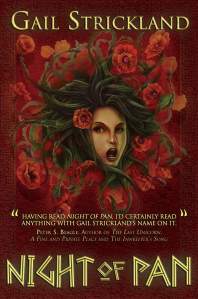
 

cover1000


My Rating: 4/5 Stars

The slaughter of the Spartan Three Hundred at Thermopylae, Greece 480 BCE—when King Leonidas tried to stop the Persian army with only his elite guard—is well known. But just what did King Xerxes do after he defeated the Greeks?

Fifteen-year-old Thaleia is haunted by visions: roofs dripping blood, Athens burning. She tries to convince her best friend and all the villagers that she’s not crazy. The gods do speak to her.

And the gods have plans for this girl.

When Xerxes’ army of a million Persians marches straight to the mountain village Delphi to claim the Temple of Apollo’s treasures and sacred power, Thaleia’s gift may be her people’s last line of defense.

Her destiny may be to save Greece…
…but is one girl strong enough to stop an entire army?

I’ve always had a soft spot for books based in mythology, and this one definitely doesn’t disappoint on that front. The story starts with fifteen-year-old Thaleia’s wedding day. A strong, independent heroine, though, she has other plans for her future, plans that don’t involve marrying a man she’s been betrothed to since age five. She escapes and starts to flee, but is stopped by Pan and a prophecy — the Persian army is on its way to Delphi, and she’s the only one who can save her people.

This is an interesting coming-of-age story about how the Oracle of Delphi comes to be. Strickland has clearly done a ton of research into the culture of the region, from the well-known pantheon of gods, to the day-to-day customs and warfare practices of the time. And from that standpoint, it’s phenomenally written. But I did find myself struggling with some of the other aspects. Namely, that the character development felt shallow. I would expect a coming-of-age story to be largely character-driven, but this fell flat on that for me, reading instead like more of a plot-driven action-adventure. I didn’t connect with Thaleia emotionally (nor with any of the supporting cast), and often struggled with her voice. She seemed to be both too mature and too young for fifteen, and some of the modern turns of phrase were jarring against the historical backdrop. While I do feel that she’s a good role model for young girls, she almost borders on a cliche’ed example of the “strong, independent woman” stereotype. I would have liked to see her be a littler more fully developed and multi-faceted as a character.

That said, I do think the prose itself is beautifully written. Lyrical and smooth, Strickland’s style is effortless, and I could appreciate her voice as an author (not to be confused with Thaleia’s voice, as mentioned above.) The additional material included in the book makes this a well-rounded choice for younger readers interested in mythology. It is a YA, and I think it targets it’s market effectively. However, unlike some YA, it doesn’t translate quite as well outside of that target readership. I would definitely recommend it for the 12 + age range it’s intended for, though. And I will probably finish the trilogy, if only to see more of the richly developed, detailed world.

**Disclosure Statement: I received a copy from the publisher in exchange for an honest review. **

About the Author:

Gail Strickland — classicist, poet and musician — was recognized by The Baltimore Review & Writers’ Digest and published by the Oxford University Journal New Satyrica. While studying the classics in college, Gail translated much of Homer’s Iliad and Odyssey. Always passionate about music and bringing the richness of Homer’s language and culture to today’s youth, Gail mentored young poets and novelists and introduced thousands of youngsters to piano and Greek mythology.

Gail was born in Brooklyn, New York and grew up in northern California. She raised her children, read French philosophers in French and played in an eclectic country band called the Prairie Dogs whose claim to fame was being the only band to play Candlestick Park between the Beatles and the Rolling Stones.

Her first book, NIGHT OF PAN … a mythic journey of a young Oracle in ancient Greece, was published by Curiosity Quills Press November 7, 2014. NIGHT OF PAN is book one of THE ORACLE OF DELPHI TRILOGY.

Gail Strickland Author Photo

Website | Facebook | Twitter | Goodreads
Featured Image: “Sweetheart Ronin” Illustration

Happy Halloween! Originally, I was intending to post my thoughts on literary voice this week, but given that it’s a holiday (and the fact the conference I was supposed to speak at was cancelled), I’ve decided to showcase something a little more spooktacular (yes, horrible pun intended) instead. Some of you may be familiar with the Project REUTSway competition Reuts Publications hosted last year, challenging writers everywhere to pen new and twisted versions of your favorite fairy tales. No? You don’t remember that? Well, you’re in luck then, because it just so happens to have released today. That’s right, FAIRLY TWISTED TALES FOR A HORRIBLY EVER AFTER is available in eBook now! And will be available in a special hardcover edition in a couple weeks. I highly suggest you all check it out; it’s amazing!

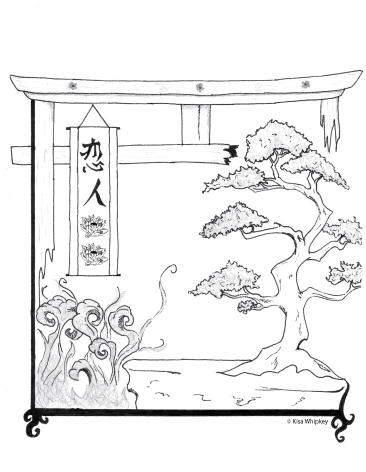
But that’s not the point of today’s post (okay, not the whole point). I’m actually going to do a rare art feature. See, I was lucky enough not only to be involved with the selection of the gruesomely fantastic tales in the anthology, but also to create one of the many illustrations included within its pages. And trust me, there are some truly beautiful works of art in this thing. Want a taste? Well then, let me present my illustration for a story called “Sweetheart Ronin” by the talented Suzanne Morgen:

"Sweetheart Ronin" Illustration by Kisa Whipkey


Created to evoke the style of the setting (Japan, in case you’re wondering), this piece is a combination of traditional drawing with pencil and Sharpie (yes, Sharpie. Who knew, right?) and digital vector graphic created in Adobe Illustrator. In order to understand the significance of the elements, you’ll have to read the story, which can be located here. Buy it. Seriously.

And for those of you curious about Project REUTSway, click here. The 2014 competition, featuring challenges rooted in world mythology, kicks off tomorrow and runs all November long. So if you’re looking to flex those writing muscles, but NaNoWriMo is too daunting/impossible, head on over and check it out. Who knows? Maybe I’ll end up drawing an illustration for you in next year’s anthology. 😉

Book Review Wednesday: Wicked Path by Eliza Tilton

Okay, so this isn’t so much a review as a release announcement. Apologies for the misnomer. Some of you may remember my review for book one in The Daath Chronicles, so when I saw book two was becoming available, I jumped at the chance to continue the story. I haven’t had time to read it yet, so unfortunately, my review is still pending. But here’s some more info about it, just to pique your interest. 😉

Wicked Path by Eliza Tilton

In Wicked Path: Book Two of the Daath Chronicles brother and sister are forced to opposite sides of Tarrtainya on a fast-paced adventure where the wildlife isn’t the only thing trying to kill them.

Three months have passed since Avikar defeated the Reptilian Prince, and he still can’t remember his battle with Lucino. On the hunt for answers, he returns to the scene of the fight and discovers a strange connection between his family’s dagger and the mysterious kingdom of Daath, and it seems only his distant father can reveal the truth behind it all.

Before Avikar can travel back home, Lucy assaults him in the market and forces him to flee to Nod Mountains—a place few dare to enter, and even less return from. With Raven and her childhood friend by his side, they must survive the treacherous journey through the pass with a vengeful Lucy hunting them. If they don’t, they’ll never see home again.

Jeslyn’s new life in Luna Harbor is the perfect remedy for her confused and broken heart. But when a group of mercenaries kidnap her beloved Grandfather, interrupting her daily routine as his jewelry apprentice, she’s forced to join forces with the one person from her past she tried to forget.

And his assistance comes with a price.


About the Author:

Eliza Tilton

Eliza graduated from Dowling College with a BS in Visual Communications. When she’s not arguing with excel at her day job, or playing Dragon Age 2, again, she’s writing. Her stories hold a bit of the fantastical and there’s always a romance. She resides on Long Island with her husband, two kids and one very snuggly pit bull.


AUTHOR LINKS:

Twitter / Tumblr / Website / Pinterest / Facebook / Instagram

BUY LINKS:

Amazon / Goodreads /

Featured From the Archives: Inspiration is a Fickle Wench

Ah yes, my post about inspiration, or rather, the lack thereof. As I stared blankly at the titles in my drafts folder this week, waiting for something (anything!) to spark an idea, I realized that this post would be oddly fitting. It’s also fairly old, so there’s a good chance it will be new to a lot of you. Given my complete lack of inspiration this week (I’m serious, I think my muse died, or decided to flit off to her beach with the cabana boy again), it’s safe to say this is better than anything I could have managed to drag, kicking and screaming, from the depths of my brain. It’s at least somewhat humorous, and I bet a few of you out there will be able to relate. Enjoy!
 

Inspiration is a Fickle Wench

by Kisa Whipkey

Originally Posted on 8/10/12

 
Have you ever had those days where you suffer from a complete lack of inspiration? Where you feel like a creative well that’s run dry? Yeah, me too. In fact, it happens more than I’d like to admit. For someone plagued by the never-ending breeding of plot bunnies, I have a remarkably hard time finding the motivation to actually write. Oddly, the most sure-fire way I have to motivate myself is to declare to the world that I’m not writing. (Sorry, writing group buddies. Sometimes I have to cancel just so the muses in my head will freak out, screaming, “No! You can’t write absolutely nothing this week!” and finally show me the path to the next scene they were greedily withholding.)

But inspiration doesn’t just apply to writing. We need it for all things creative. It plays just as much of a role in creating a masterpiece of art, or choreographing a moving sequence for demo team. And some days, it’ll simply refuse to come when you call it.

I find the idea of inspiration a fascinating thing. Where does it come from? Is it an invisible lightning bolt that shocks our imagination to life the way a defibrillator brings our hearts back from death? Is it a gift from some higher power, sending waves of creative energy coursing through us like sunlight? Is it the whispered voice of a muse dressed like the women of Greek mythology? Or is it just some random combination of neurons firing that creates a delusional escape from reality? Honestly, I don’t know. I’m not sure anyone does. But I do find it intriguing that when a writer talks about hearing “voices,” they’re considered brilliantly touched by inspiration. When anyone else says it, they’re considered mentally ill.  What separates inspiration from insanity? The final product? Who’s to say that people with schizophrenia or brain tumors warping their neurological pathways aren’t the most in tune with that magical force we call inspiration. Or that those of us who claim to rely on it for our careers aren’t actually suffering a slight mental meltdown. Interesting stuff, isn’t it?

All I know about inspiration is that it rarely shows up when I want it to. Case in point, I’m now suffering through week 2 of the current inspirational drought. This wasn’t even the blog post I had scheduled for today, but I was too uninspired to finish the original one. Which made this the perfect week to muse about the elusive nature of the muse, so to speak.

I’ve mentioned a few times that I find inspiration through music, going into rather lengthy, and probably creepy, detail about it here. I’m not sure why that’s my avenue of choice, but it’s always been that way. Maybe I’m mooching off the creative brilliance imbued by the composer/songwriter. Maybe I’m gifted with a finely tuned sense of musicality, and I can find stories through the nuances and layers of musical instruments the way others can through dreams or spoken words. Maybe I’m just nuts. But regardless of the reason, that reliable source of  melodic inspiration only seems to cover the initial conceptual phase. It gives me the base-line, the foundation on which I have to build, and more plot bunnies than I could ever write, even if I was lucky enough to be a writer that could finish a novel in a few months. When it comes to the actual creation part, the nitty-gritty work part, I’m left to suffer the whims of inspiration like everyone else.

Every writing website, advice article, author/artist blog out there will tell you that creator’s block is a myth. That it’s just an excuse for being lazy, for procrastinating, for giving in to your fear of failure, or for a plethora of other reasons. They’ll all tell you that you just have to power through those days when you’re lacking inspiration. That you have to discipline yourself to create every day. That you can’t wait for the muse to come to you, for the weather to align perfectly, for the fourteen cups of caffeinated beverage to kick in, or for whatever that magic combo is that ignites the fires of inspiration for you. And they’re probably right.

I, however, can’t force it. When I’m not feeling inspired, I end up with this:

“Blah, Blah, more Blah, Blaaaaaaaaaaaaaaaaaaaaahhhhhhhhhhh! Stuff and things. Blarg. Grrrrrrrrrrrrrrrrrrrr. Oh, and more Blah.”

How would you like to read an entire novel of that? I know I wouldn’t. So I ignore all those lovely professional people out there smarter than me, because their perfectly valid advice doesn’t help me. And I wait, sometimes days, sometimes weeks, sometimes even months for the return of inspiration. Does that make me a lazy, procrastinating, fear-frozen artist/writer/choreographer? Maybe. It definitely makes me slow. But one thing I’ve learned over the years chasing down my dream of making a living at something creative, is that you have to be true to yourself. You can read as many books, blogs, advice columns as you want; take a million classes to hone your skills; talk to everyone you admire who have been lucky enough to make a living doing what they love, but in the end, it’s all about figuring out your own creative style, the strategies that work for you, and the confidence to believe that just because your process may be a little different, doesn’t make it wrong.

And mostly, that inspiration is a fickle wench you can control about as much as you can control the weather.

Featured From the Archives: The Curse of Being a Slow Writer

Apologies for having to go archive-diving again this week. Let’s just say, it’s not been a great one for me and leave it at that. I wanted to find a post that could do what I couldn’t — bring some humor to my otherwise bleak mood — and this one seemed like the perfect fit. Snarky, but still inspiring, it’s a good reminder for anyone struggling to find time to write. Even if it doesn’t apply to you, I hope it will at least bring a smile to your face. After all, laughter is the best medicine, or so they say. 😉
 

The Curse of Being a Slow Writer

by Kisa Whipkey

(Originally Posted on 5/31/13)


I don’t think it’s news to anybody that I am the equivalent of a sloth when it comes to writing fiction. At least, it shouldn’t be. I’ve said it quite a few times. But usually, I try to put a positive spin on that fact, embracing my molasses-covered words and declaring it proudly, like it’s some kind of statement of quality. But the truth is, it sucks. It is the single most frustrating thing in my writing career. So today, I’m going to indulge in a moment of venting negativity. Today, I’m not going to try to convince you that it’s okay to be slow; that it’s all right to procrastinate with research, or editing, or any of the other excuses I’ve told myself are justifications for slackerhood. Because it isn’t. If you want to make it in this industry, you have to be prolific. That’s just a fact.

We had a saying at Dragon Heart Tang Soo Do: “If you can’t be a good example, then you’ll have to be a horrible warning.” So let me be your horrible warning. Being a slow writer isn’t a blessing, it’s a curse. Here are the top 5 reasons you don’t want to be me.
 

#1: Limited Productivity Potential

 
At my current rate, I’ll be lucky to finish a novel a decade. And since I also conveniently dragged my feet in deciding to take my writing career seriously, that means I’m joining the party late. So that puts my productivity level at direct odds with the amount of life I have left. If (fingers crossed) nothing horrific happens, I could potentially be looking at a long and happy life. But how much of that will I realistically spend writing? I’m going to say that probably by my 70’s, I’ll be running out of oomph, and likely, Carpal Tunnel will get me before then. So, given my late admittance that I really wanted to be a writer after all, that optimistically gives me a productivity potential of 4 books. (4?! That’s pathetic. This is why I dislike math; it never pans out in my favor!)

Now, say you were smarter than me and realized early on that you were destined to write for a living. I’m not so ancient that you’d have that much of a head start. Most people figure out their life’s passion during their twenties, and a lucky few know by their late teens. So at best, you’re a book and a half ahead of me. That’s still not a rosy picture of successful writerdom. I suppose there is a chance that you don’t see yourself being prolific. That you only have one or two titles in you and then plan to call it good. But I think the majority of us choose to be writers because we’re bursting with ideas waiting to find their way to the page. Am I wrong?

Which leads us to reason #2 why you don’t want to be me.
 

#2: Royally Pissed Off Plot Bunnies

 
The thing about plot bunnies is they breed like, well, bunnies. I have yet to go longer than a month without finding another cute and fluffy little detour hopping innocently across my path. (Innocently? Yeah, right. Those little buggers know my muse can’t resist them. They’re about as innocent as creepy children in a horror film.) So when I compare my maximum potential output (the measly 4 books) to the avalanche of rabbit fur weighing me down, you can guess what happens.

Personally, I don’t want face the legions of plot bunnies running around in my head when they realize that only 4 will ever get their moment in the spotlight. They’ll probably start a riot. They might even turn carnivorous. I don’t know. But I do know that they’ll be royally pissed off, and that can’t be good for my muse. Or anyone, really.

So unless you’re one of those rare writers content to write only a couple books, I’m guessing you’ll be facing the same predicament. And in case the thought of angry, carniverous plot bunnies hasn’t scared you away from my path of slackerness, let’s move on to reason #3.
 

#3: Getting Lost in the Discoverability Jungle

 
It’s a well-known fact that the fastest way to gain momentum in a writing career is to continually publish new content. Whether you’re self-publishing (especially if you’re self-publishing) or traditionally published, name recognition is everything. In an ever-growing jungle of titles, being prolific enough to constantly have your work in front of readers is the only way to survive. No problem, right? I just established that, like me, you have a plethora of ideas to choose from. “Prolific” will be easy!

Hear that screeching of the brakes? Yeah, you forgot about one key element — reason #1. When you’re as slow as I am, your chances of consistently staying on your readers’ minds goes out the window. I’ll survive in the Amazon jungle about as long as a fruit fly with that level of productivity. There’s no amount of marketing in the world that can save me from sinking into the mire of oblivion.

Pretty convincing case for not being me, no? But, just for kicks, let’s say the issues of discoverability aren’t really that bad. That I’m being over dramatic in my snarkiness. (I did warn you I would be venting negativity.)

Welcome to reason #4.
 

#4: Being Stuck in a Permanent Day Job

 
Every writer dreams of waking up every day and spending the entire time writing. But the reality is that most of us still have to work day jobs. The fridge doesn’t fill itself, unfortunately, and the bill collectors don’t look kindly on IOU’s. So chances are, unless you’re secretly a billionaire, married to a billionaire, or homeless, you need some source of income. Where do you get it? The dreaded day job.

Now, some of you may be lucky enough to actually have a career you enjoy. But the rest of us punch the time clock like we’re signing in for a prison sentence. The only thing that gets us through the day is that shiny dream of someday getting to say “F you!” to the boss and walking away with certain fingers held high.

But what happens to that shiny dream when you write like a snail? It shrivels up and disappears. Yep, that’s right, your shiny dream is now a rotting, wrinkled hunk that looks like a dried apricot. Why? Because you’re too slow to be considered prolific. And since you’re not prolific, no one knows who you are. And because no one knows who you are, your books don’t sell. And when your books don’t sell, you get to offer that chicken-scratched IOU to the bank and pray they let you keep your house.

Such a pretty picture isn’t it? I think I’m rather gifted at casting the most depressing slant ever on the situation. But in case you missed the lesson in that dreary portrayal, let me reiterate it. If you don’t want to be stuck permanently in that day job you hate, don’t be me!
 

#5: The Burden of Emotional Turmoil

 
By now, I hope you’re seeing the downfall of succumbing to the slow-writing curse. If not, (man, you’re a hard cookie to convince!) here’s one final reason.

I’ve already covered the practical, tangible reasons it sucks to be a slow writer. But there’s also an emotional aspect. When you move with the agility of a tortoise, you tend to find yourself battling things like frustration, irritation, depression, anger, all the lovely turmoil that goes with swimming in the negative side of life. That self-doubt all writers experience? Yeah, quadruple it about a gazillion times. That lure of perfectionism? You’ll be chasing after it like a siren’s song. The regret over letting your dream slowly starve to death and die? You’ll carry it around until you start to look like Atlas, carrying the world on his back.

My point is, eventually, you’ll find yourself so immersed in the quicksand of negative emotions that you’ll end up writing a blog post just like this. 😉

So, there you have it. The top 5 reasons why you shouldn’t be me; why you shouldn’t succumb to the curse and let your writing career languish on the back burner. If you already find yourself hovering dangerously close to joining my sinking ship, don’t despair. There’s still hope. All you have to do is kick your lazy booty into gear. Figure out where you have the time to write and commit to it, even if it means sacrificing sleep, weekends, and watching Celebrity Game Night. (Seriously, though, that last one’s not a sacrifice. Whoever decided that sitting around watching celebrities play board games was quality television needs to be fired. Immediately.) You can do it. I have faith in you. In fact, how about we make a pact? Let’s take all the negativity and turn it on it’s head. Let’s laugh in the face of frustration and prove to everybody, including ourselves, that we do have what it takes to be writers, and we can be prolific. Let’s break the curse together. Deal?