The Editing Life Laid Bare: A Brutal Look at the Statistics

This is a post I’ve been wanting to write for weeks now, but true to The Editing Life, I simply haven’t been able to find the time. Or the brain cells, for that matter. But today, I’m finally going to do it. I’m going to show you exactly what it looks like to be an editor, not with words, which would perhaps be the obvious choice, but with numbers. Why numbers? Well, nothing puts things into perspective quite like seeing the break-down of exactly what goes into something. Or so I’ve heard.

Now, I’ll be the first to claim that numbers are not my friend, so these “statistics” I’m about to lay down are only about as accurate as my math. And sometimes, that’s not terribly accurate at all. But even though it’s not going to be an exact science, it should still give you a snapshot of what my life as an editor truly looks like. The key words there are “snapshot” and “my,” meaning that this is in no way a comprehensive look at all the various things I work on as an editor, nor is it all inclusive for every editor. Others will be different. But based on experiences I’ve heard recounted from fellow editor friends, this is pretty close to what it looks like more often than not.

Let’s get to it, shall we?

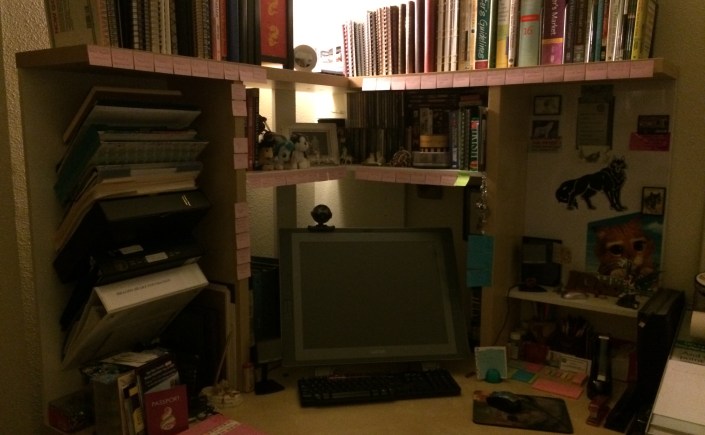
How many of you have heard us (us = editors) say that we work on multiple projects at once? Most, if not all, right? It’s a pretty common fact. But what does “multiple” truly mean? Well, cast your eyes over that photo at the top of the post. That’s my actual desk. No comments on the content/mess, please. 😉

See the lines of pink around the edges? Those are post-it notes. And yes, I realize it looks like an exercise in insanity, but trust me, it’s actually a very efficient method. Now, count them. How many did you get? Here’s the thing, each one of those post-its represents a project in various stages of completion. Not the stages, the project. I purposely kept it distant so you can’t see the names, but yeah, that’s what it means when editors say they’re working on multiple projects at once. Daunting, isn’t it?

On top of constantly being buried up to our eyeballs in work, we’re also generally underpaid. I’ve featured an article on this before, written by the lovely Cait Spivey, which can be found here. But let’s actually turn the microscope on it and dissect what that means in terms of my life.

On average, a manuscript clocks in somewhere around 75,000 words. Some will be more, some less, but that’s a good solid representative of a standard novel. Every editor has a different way they figure out what to charge. Common methods are by page, by hour, or by word. If you’ve looked at my freelance editing page, you know I charge by the word. So a full edit on that 75,000 word manuscript runs $1500. Ouch, right? That’s a hard number to stomach for most authors, and I get it. It seems really expensive. Until you break it down to see what you’re actually paying me for.

75,000 words is roughly 300 pages (according to the age-old school-paper formula of 250 words = a page). Most editors I know that are worth their salt average a pace of about 6-7 pages an hour for line edits. (I’ll cover why it takes this long in a future post.) So 300 pages equates 50 hours of work. If we take that $1500 fee from above and divide it by 50 hours, you get about $30 an hour. That seems like good money, doesn’t it? And in fact, that’s considered average for a professional freelance editor according to the Freelance Editor’s Association.

But we’re not done yet.

That 50 hours is solely what I spend during one round of line edits. There are things that happen before and after that stage. Remember, I said that $1500 rate was for a full edit, which consists of structural edits, line edits, and proofreading. So let’s factor in those things.

Structural editing is the process of reading a manuscript, analyzing it, and then diagnosing and finding solutions to any problems that are weakening the overall story. Tell me, does that sound like an especially fast process to you? It shouldn’t. If an editor is actually qualified and trained to do this (and not all of them are), it looks like this: reading — not just speed-reading, but really truly reading and seeing every letter and space and punctuation mark on the page — and analyzing 300 pages takes me approximately 2-3 full days, so, at 8 hours per day, that’s 24 hours of reading time, give or take. Figuring out what, exactly, is affecting the manuscript and how to deal with it will vary, but let’s say another 3-ish hours is spent on the mental gymnastics of curing an ailing story, and then another 2-3 are spent compiling all my notes and thoughts into an edit letter explaining all that to the author. These are super rough, ball-parky type figures because I don’t think I’ve ever truly tracked this part of the process. Anyway, when it’s all said and done, that’s about 30 hours invested into just the structural edits. And that’s without any follow-up discussion or brainstorming with the author, things that often occur after I hand them the aforementioned edit letter.

Proofreading is the last step and is probably the fastest portion of the process for me. Most projects, I can average 10-15 pages per hour. So if the manuscript is in good condition, that’s only about 20 more hours of work. However, that’s for a base proofread. If I have to do an editorial proofread (which is somewhere between a line edit and a proofread) the pace drops dramatically.

So, where are we at with our project overall? We have 30 hours for structural edits, 50 hours for line edits, and 20 for proofreading. That’s 100 hours of effort from start to finish, bare minimum. Suddenly, that $1500 flat fee isn’t looking so grand, is it? That’s only $15 an hour. Minimum wage in many larger cities.

I should also point out that most projects take at least two rounds of line edits to truly shine, which, if you’re lucky, is only an additional 30 hours of labor, and there are probably easily 20 hours of time invested in various discussions and emails and hand-holding with the author. Making the total time expended on any full project easily 150 hours. Honest to God. What does that make my hourly wage? $10 an hour. You can flip burgers in some states for more than that.

Now, maybe that doesn’t seem so bad to you. $10 an hour is a livable wage, barely. Until you realize this: normal people work 40 hours a week. Even doctors and lawyers (who make a hell of a lot more money than editors) will only clock 70-80. So how many projects do you think we can realistically fit into a month? The answer is one. From start to finish, with no other obligations, family or social life, etc. an editor can comfortably complete one project in a month’s time. But we don’t live in a perfect world, do we? And we rarely get the luxury of only working on that one project and nothing else. (Photo of project management via post-it being exhibit A.) We also don’t get paid everything up front. So, if we only schedule that one project in a month, because 150 hours equals 3.75 weeks of normal human work-time, that’s a grand income of $750. For the month. I’ll let you do that math. Is that a living wage in your book? Because that barely covers my car payment.

Are you completely depressed now? Because I am. But the point of this post was not to whine, or complain, or guilt-trip anyone. I simply wanted to show you exactly what life as an editor looks like. It’s not sitting around and reading all day. It’s arduous, mentally-taxing, long hours for very little pay and often even less appreciation. It’s not a life that will lead to riches, or fame, or maybe even a full-time income. Which begs the question, why would anyone do it?

The answer is easy — love. Editors truly love what they do. But the sad truth is that editors also have one of the highest burn-out rates of any career. The average life-span of an editor is only 2 years, and now you see why. In an industry that refuses to pay a living wage (freelance editors who charge less than $500 for a full edit and indie presses that offer $350 for two rounds of full edits, I’m looking at you), we’re required to go to super-human levels in order to stay afloat. We take on burdens that would make Atlas tired, and we do it all for you guys, the authors. Because we truly want to help you produce fantastic, beautiful pieces of art. We’d just kind of like not to starve while doing it.

So, there you have it. That’s what the editing life looks like in all it’s stress-filled, brutal glory. I hope it’s been enlightening and that you take away three key things:

1. If you’re looking to hire an editor, please consider what their rate actually means. As in every industry, you get what you pay for.

2. If you’re already working with an editor, try to remember that they may have a desk covered in post-its too, and that your project is not the only one on their plate.

3. If you are an editor, set your rates appropriately. When you charge less than $500, you harm not just yourself, but the rest of the industry. You deserve to eat. You deserve to have a roof over your head.

That is all. Thanks for reading! 🙂


Featured From the Archives: My Average Day as an Editor (in GIFs)

As you read this, I may or may not be buried neck-deep in projects for the Day Job of Doom and daydreaming of a huge shot of Fireball Whisky later tonight. But, since I have never missed posting something for your entertainment, I managed to find a few moments to schedule this post. You’ll have to forgive the archive-diving — again. But given the week I’ve had, and the overwhelming response to my giveaway question requesting more editing/publishing insights, this one is definitely appropriate. And everyone loves GIFs, right? So, without further ado, your encore performance of . . .

My Average Day as an Editor (in GIFs)

by Kisa Whipkey

Originally Posted on 4/18/14

There have been a lot of GIF posts about what the publishing or writing process is like, but I’ve never seen one for what it’s like on the other side of the fence. Until now. This week, I’m breaking the unspoken rule that writers are never allowed behind the publishing curtain and illustrating what my average day as an editor looks like. And, because I had a request for a post with GIFs, I’m going to use everyone’s favorite sarcastic medium (which means that any of you reading this via an email/mobile device may have to click through to the actual site to see them). Before we dive in, I do want to say that this is solely what my average day looks like — other editors will be slightly different. The moral of this story, though, is that editors need cheerleaders too. You’ll understand by the time we get to the end. Don’t worry. 😉

My Average Day as an Editor

The alarm goes off at 6:15 am and I’m all like:


and . . .


Okay, maybe that’s a lie. It’s actually a lot more like this:


bill-murray-beating-alarm-clock


But anyway, I’m up. I’m ready for the day. I’ve got all the things I need to do circling through my head, and I’m ready to tackle them all. Until . . .


louie


I remember that I have to go to work. Not editing work — work work. Because, you know, editing doesn’t pay as well as everyone thinks, and I still have to eat.

So, for the next eight hours, I go punch the clock at the dreaded day job and secretly think to myself . . .

idiots


while outwardly doing this . . .


katy-nod-dance


Meanwhile, my inbox is filling up. By the time I actually get to start my day as an editor, I have 64 new emails (that’s a light day). Of those, approximately 1/3 will be submissions, 1/3 will be about the various tasks I assist with at REUTS, and some days, as many as 1/3 are authors freaking out over something. Those days, I tend to open my inbox and immediately think . . .

rudd-sucks

See, contrary to popular belief, editors work on a lot of projects at once. And writers (yes, you) are a high maintenance bunch, prone to neurotic freak-outs and requiring constant reassurance.

cat

That’s okay, though. We (as editors) understand, and we love you guys. Really, we do. But some days, you make us do this . . .

too-much


Anyway, I’m getting off topic. On those days where my inbox is full of people freaking out, I spend the next several hours holding their hands and providing reassurance. (See, the take-away here, writers, is that every time you send one of those freak-out emails, the person on the other side loses valuable time they could have spent actually working on your project.)

**Note, I do not consider status requests and legitimate questions freak-out emails. Those are always welcomed and definitely allowed. 😉 **

By the time that’s done, it’s dinner time. But, before then, I’ll read through a couple of the submissions, which looks something like this:


umno

Or . . .

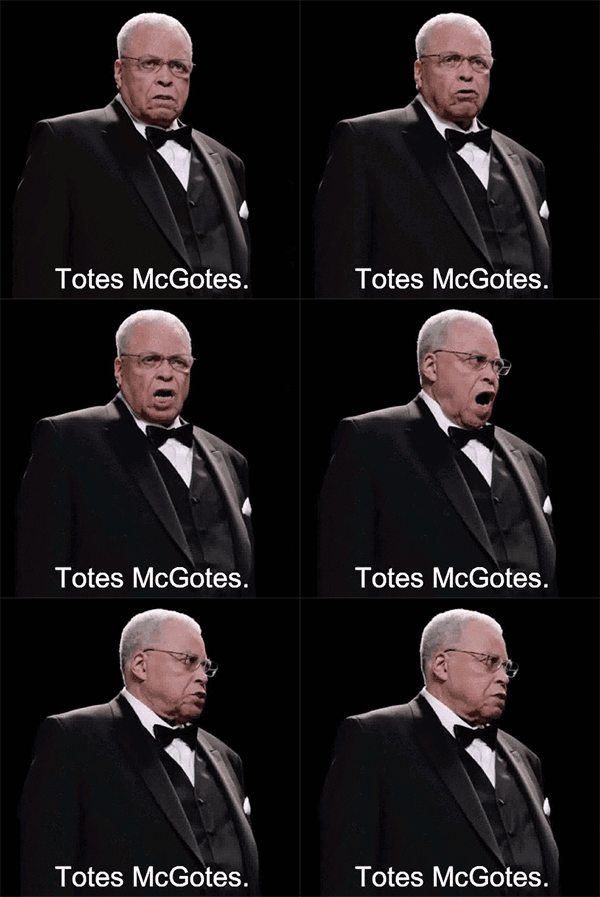
James-Earl-Jones-Totes-McGotes2

Or sometimes even . . .

jon-fan

FattyGenius


And occasionally this (if I’m the odd man out on the voting) . . .

not_having_it

Then it’s dinner time, and I step away from the computer for the first time all day.

By the time I get back, there’s at least one more freak-out email waiting not-so-patiently for me.

wut


frustrated

So, I deal with that one too (because I don’t like to leave anyone with more anxiety on their plate than necessary) and then finally, FINALLY, I get to edit. You know, that thing everyone thinks editors spend their days doing, but that we actually only get a few hours with. It’s a victorious moment when I finally get to this part of the day. Like . . .

fsa


Then, after investing several more solid hours into the thing I enjoy most, this happens . . .

tired

So I . . .

give-up

and . . .

exhausted

and the whole thing starts over.

And there you have it, my average day as an editor. Sounds like fun, right?

thumbs-up-matt-leblanc

The point of this (besides getting to have way too much fun with GIFs) is to show you just how hectic an editor’s life can be. We’re not robots who sit and do nothing but edit 24/7. We’re people, with lives and jobs, families, and human needs. So cut your editor some slack if they don’t get back to you immediately, or if it’s taking longer than you expected to edit your manuscript. We’re not purposely doing these things to hurt you. Editing is a time intensive job, and to do it right, you have to invest that time. The argument I always tell myself when stress threatens to overwhelm me, or someone’s pushing me to meet deadlines that aren’t possible without giving up things like sleeping and eating, is this — would you rather it be done right? Or be done fast? It’s not a perfect world, and those two can’t coexist. Anyone who claims otherwise is lying. Trust me.

**A big thanks to www.reactiongifs.com for supplying all the GIFtastic fun. Be sure to check them out! Their database is phenomenal. :)**

Featured From the Archives: Writing . . . With a Twist

All right, everyone. The moment has come; it’s time to announce the winners of my 3rd Blogiversary Giveaway. Before I do, I want to sincerely thank everyone who supported and entered the contest. You were all so overwhelmingly enthusiastic, that, true to my nature, I’ve decided to throw in a surprise bonus. What might that be? Well, let me preface this by saying that I’m either crazy, or generous (or crazy generous?), because I’ve decided to give away not one, but SIX full edits. Yes, see, crazy.

Without further ado, the lucky winners of said Full Edit Packages are . . .

Susan Nystoriak

Ann Marjoy K

Tiffany Rose

Shantele Summa

Emma Adams

C.C. Dowling

But, that’s not all. I also said I’d be giving away winner’s choice of three print editions from the REUTS Publications library. Those lucky people are . . .

Rachel Oestrich

Alexandra Perchanidou

Ashley Hudson

I will be contacting the winners regarding their prize over the course of this next week. To everyone who didn’t win this time, I’m sorry. I tend to do these kinds of giveaways a couple times a year though, so please come back and try again in the future. 🙂

And, because today is supposed to feature an actual article and not just an announcement, I’ve pulled one of my more humorous bits of writing advice from the archives (at least, I think it’s humorous). Enjoy!

Writing . . . With a Twist

By Kisa Whipkey

Originally Posted on 8/3/12

This week’s topic comes courtesy of an interesting forum thread I haunted about what makes a plot twist good or bad. And since I’ve decided to break one of writing’s cardinal rules by courting a twist largely hailed as cliche, over-done, and impossible to pull off, I decided that maybe I’d take a moment to dissect what makes a plot twist successful. Publicly, of course. Because what fun would it be if I kept my musings to myself?

Every consumer of entertainment is familiar with the plot twist, be their media of choice literature, film, or video games. It’s a staple of the storytelling arsenal, and it’s a device everyone tries and most fail at. I’m no exception. I would like to say that I haven’t included such horrifically cheesy plot twists as pivotal characters actually being long-lost family members, vague prophecies that come to fruition in a way that surprises no one, bringing a character back from the dead after spending several long scenes grieving their loss, the dramatic love confession everyone saw coming the moment the characters met, the betrayal by a character close to the protagonist, etc, etc. But I would be lying, because the truth is, I have done all of those. And I’m rather embarrassed about it. Oh, and did I mention they were all in the same story? Yeah, needless to say, that one needs a massive overhaul before it ever faces the publishing gauntlet.

The only thing I can draw comfort from is that every writer suffers this same affliction during the beginning stages of their career. And eventually, they all outgrow it. Mostly. That doesn’t mean they graduate from relying on the plot twist to infuse their stories with suspense and  mystery, it just means that they stop suffering from CPT, a.k.a. Cheesy Plot-Twistitis. Symptoms of CPT include the heavy-handed attempt to create a twist no one has seen before, but in reality, everyone has seen before; the desperate need to earn intellectual points by creating an intricate, and completely obvious, web of twists and turns that wouldn’t fool a four-year-old; the delusional belief that you’re actually smarter than your readers, resulting in the condescending reveal of something we all figured out on page 2; and the urge to cram so many twists into your plot that it starts to look like a fraying pretzel, and even you can’t keep your ideas straight anymore. If this sounds like you, don’t worry, CPT isn’t terminal. To send it into remission, though, we need to figure out what makes a plot twist good.

I believe a successful plot twist consists of three things:

  • Subtlety
  • Total integration with the plot-line
  • Complete alteration of the reader’s perception of prior events

This powerhouse combination relies on all three parts working seamlessly to produce a recipe for success. Just knowing the ingredients isn’t enough, you have to know how to apply them. It would be like trying to cook with no directions. What order do you add them? What happens when they combine? How much of each one do you need? These answers are just as important as the ingredients themselves, so let’s break down our list of plot twist ingredients a bit further.

Subtlety: This is the foundation of a successful plot twist, and perhaps the most crucial element of the three. How often have you watched the first three minutes of a movie or television show and instantly known how it would end? Or within the first two pages of a mystery novel, figured out who the villain was and why they did what they did? Some of you may just be geniuses, but more often, the reason it was so easy to figure out is because the twists were predictable and obvious and something you’ve seen a billion times before.

Audiences tend to remember twists that make large impacts on them and look for them to be repeated. It’s kind of the “fool me once, shame on you; fool me twice, shame on me” phenomenon.  We only partially like being made to feel foolish, so we remember those moments vividly. For example, everyone who’s ever seen The Sixth Sense remembers that moment when you realized nothing was what you thought it was. (I don’t believe in spoilers, so on the off-hand chance you haven’t seen that movie, I left it vague for your benefit. And if you haven’t seen it, shame on you! Go rent it. Right now!) Fans of Inception will forever be analyzing every aspect of future movies, looking for the threads tying them together. And people (like myself) who watch far too many police/courtroom dramas will likely be trying to figure out who the criminal is within the first five minutes, and often succeeding.

So how do you manage to fool an audience who’s keeping a keen eye out for plot twists? Through subtlety. A good plot twist is one written with a delicate hand. It’s hidden until the moment of it’s reveal through the clever use of decoys and hints that carefully and slowly build toward the twist. Play into your jaded audience’s expectations and let them think they’ve got it figured out before springing the reality on them. If you’ve done it well, they never see it coming and will begrudgingly offer a tip of the hat in appreciation afterward. Your audience wants to be challenged, so never underestimate them.

Total integration with the plot-line: For a plot twist to work, it can’t be out of the blue. There needs to be a lead-in, a build-up of tension before the final reveal. And you do this through those subtle hints I just mentioned above. Failing to sprinkle enough clues into the narrative will result in a twist that feels like it’s sole purpose is to get you out of a narrative corner you didn’t expect to be in. Readers hate hand-waving devices (things that dismiss everything they just read in order to change the story’s direction). It makes them feel like they’ve wasted their time investing in your book. And I don’t blame them. Any writer that uses devices like this is cheating, looking for the easy way out of a sticky situation. That character wasn’t supposed to die yet? Fine, bring them back and have everyone ignore the fact they died. Don’t like where your narrative is heading? Make everything a dream, and then you can take off in a whole new direction without having to revise your entire manuscript. You can see why it’s something readers find irritating, and why it should be avoided. Your twist has to feel like a natural — albeit surprising — turn of events, not a miraculous and random thing that doesn’t fit the rest of the story at all.

Which brings us to the final element . . .

Complete alteration of the reader’s perception of prior events: While you don’t want your twist to feel out of place with the rest of the narrative, you do want it to surprise the reader. Ideally, the final reveal is a twist so shocking that it changes the way your audience thinks about everything prior to it. I’m going to use The Sixth Sense again, because, even though it’s old now, it’s still one of the best examples of this element in action.

When viewers got to the end of the movie and the massive twist was revealed, there was a resounding “WTF?!” reaction, and suddenly everything the audience thought they understood about the film was painted in a completely different light. During the subsequent flashback explanation, we realized that the clues had been there all along, we just hadn’t seen them. This is exactly the reaction you want to create. When you reveal your big twist, you want your readers to immediately rethink everything they just read, and hopefully, because you’ve subtly integrated the build-up so well, they’ll realize that all the arrows were pointing to this moment, and it’s not really that shocking at all. In this way, you create an experience that’s both surprising and completely in sync with the rest of your piece.

Master all of the above, and voilà! Successful plot-twist soup, instant cure for CPT.

Now that we’ve dissected what it takes to make a plot twist successful, let’s take a brief look at what makes one bad. Personally, I don’t think there are such things as bad plot twists, just poorly executed ones. Just like no story is ever truly original, no plot twist is either. It’s all about the presentation. That said, there are a few notorious twists that are generally frowned upon by readers and writers alike, things seen so many times that it’s nearly impossible to spin them in a fresh way. Doesn’t mean you can’t try; just be prepared for a high rate of difficulty and the likelihood of potential failure.

The List of Plot Twist No-No’s:

  • Everything was just a dream
  • Villain & hero are actually related
  • Prophecies
  • Long-lost heir to the throne is actually the stable-boy/kitchen scullion/maid/soldier
  • The hidden love triangle/dramatic declaration of love
  • Betrayal by someone close to the protagonist
  • Bringing a character back from the dead after grieving their loss
  • Miraculous special powers that the hero discovers just in time to kill the villain
  • Gender reveal of villain/hero/general bad-ass character opposite of expectations
  • Anything which makes the prior storyline irrelevant
  • Anything that feels like the writer is simply trying to prove they’re smarter than their audience

Reading that list, I’m sure you can think of many examples where you’ve seen these very things done well. Which proves my point that there are no bad plot twists, just bad execution. Feel free to attempt the impossible and include any or all of them in your own writing. I, myself, will be attempting the all-hated “everything was just a dream” scenario. And it could very well blow up in my face. It could also be the very thing that makes my story successful. You never know until you try. But you can’t say I didn’t warn you if it doesn’t pan out the way you expected. 😉

Nightwolf’s Corner Turns 3! (Also, Celebratory Birthday Giveaway)

Image of Birthday Candles

“Birthday Celebration” by Cédric Boismain | Copyright 2013


Last week, I asked you to weigh in on what my birthday giveaway prize should be. The results are in, which means it’s time for the actual giveaway to kick off. First, thank you to everyone who voted. Your input definitely swayed my decision, as I always find those kinds of insights exceedingly fascinating.

So, what were the results? Well, some of you may have clicked on the little button at the bottom of the poll to find out, and therefore already know. But for those who didn’t, here’s the breakdown:

By and large, everyone went exactly for the prize I suspected — the full edit giveaway. I really wasn’t surprised by this, as I know a large portion of my audience is comprised of writers, and editing is one of the most expensive parts of the publishing process. Who wouldn’t jump at the chance to get that for free?

But, in a surprising turn of events, the reader’s choice of three print editions from the REUTS Publications library came in a close second. Okay, maybe not that close, but still. I wasn’t expecting readers to make up such a large portion of my audience. I mean, obviously, everyone loves free books too, but I was pretty sure the editorial service options would dominate. Consider me schooled. 😉

Okay, let’s get to the fun, shall we? Here are the prizes (yes multiple) I’m giving away this year, along with the rules/stipulations for each.

Prize #1: A Full Edit Package (Structural edits, line edits, & proofreading)

To the surprise of exactly no one, I took your resounding suggestion and am offering the prize most of you said you wanted. However, there are a few things you have to do to qualify for it.

  • You must have a completed manuscript, or one that will be completed by May 31st, 2015.
  • If you have previously won a read report or other prize from me, you are allowed to enter the same manuscript here. Should you win, that previous prize will be upgraded; if you don’t, no worries, you still have the prize from before.
  • While I will try my best to provide a reasonable turnaround time, this is a volunteer/pro bono gig, and as such, will be subject to the whims of my schedule. Which means that there may be times when I will not be able to work on your project, and you will need to be okay with that. If that’s not something you’re willing to do, then might I suggest opting for one of the other prizes instead. 😉

Prize #2: Winner’s Choice of 3 Print Edition REUTS Publications Titles

Since this one was almost as popular as the first choice, it seemed only fair that I include it as well. The difference being that two people will have a chance at scoring this one. But, just like above, there are some rules.

  • You are allowed to choose any three books from the REUTS Publications Library (including the hardcover anthology), but they have to have been released in print by the time the contest concludes.
  • The exception to the above rule is Off Book by Jessica Dall. It will be released in paperback shortly after the end of the contest, so it will be included as well, with the clarification that choosing this one may result in a slight delay.

And that’s pretty much all there is to it. Thank you again to all of you — for your votes, for your support, and for just being plain old awesome. The giveaway will end at midnight on 5/8/15 and the winner’s will be announced that day. Best of luck!

Click Here to Enter!

Reader’s Choice Poll: What Should I Giveaway?

Hello! Feels like I haven’t seen everyone in ages. Even though I’ve been posting things from the archives, it’s not quite the same as actually creating new content and spending time with you lovely folks. I’m definitely looking forward to getting back in the swing of things around here, and have plenty of new topics and ideas floating around to craft into insightful, probably snark-infused posts.

But first, I believe I mentioned a giveaway coming up . . . no? I didn’t? Hmm, weird. I was pretty sure I’d let that slip during our journey through the land of subgenres. Anyway, my three year blogiversary is fast approaching (May 2nd, in fact), and that means it’s time for one of my two annual giveaways (the other happens in December). Excited? Everyone loves free stuff. Don’t lie. You know it’s true.

The problem is that I’m not currently sure what I want to offer as the prize. I have some ideas, and I could copy what I’ve done before, but what’s the fun in that? So instead, I figured I’d give you, the readers who have loyally stuck with me while my schedule was blown to smithereens and then repaired, a chance to tell me what you want.

Below is a poll listing some of the options I’ve been toying around with. There’s also an “other” category, so if you have an idea I didn’t list, feel free to pitch it. The ultimate decision will be mine, but knowing what interests you guys will most definitely help me figure out the best prize for the job.

So, that’s it. For now. Vote away, and I’ll be back next week with something new. Promise. 😉