Announcing the 2014 Holiday Giveaway


Image by Ashley Ruggirello of Cardboard Monet

It’s no secret that Christmas is my favorite holiday, and those that have hung around here for awhile know that I tend to celebrate it by doing a giveaway every year. This year’s no exception, though I am starting it earlier than normal due to the fact it’s my birthday today, and I’m feeling especially generous. 😉

What do I have hidden up my sleeve this time? Something I think many of you will be super excited for. See, I’ve teamed up with the design genius behind the REUTS Publications book covers to bring you a self-published author’s dream — a full-fledged, FREE prize that will take your manuscript from draft to publication-ready. Yep, Cardboard Monet’s Ashley Ruggirello and I have combined our freelance prowess to offer one lucky person the following:

  • A comprehensive, top-to-bottom, full manuscript edit (including structural & line edits)
  • A polished, publish-ready eBook cover design
  • Assistance creating the all-important book blurb
  • A final proofread of the type-set, ready-for-print galley (typesetting/formatting itself is not included though)

It might not be all-inclusive, as you will still need to find a formatter and to create your own marketing materials, but I think you’ll agree that’s a pretty significant monetary value being offered up for free. Every author knows that the two most expensive aspects of self-publishing are the editing and the cover design, so why not take advantage of this rare chance to gain both in one fell swoop?

I’ve got your attention now, yes? 😉

Here’s what you have to do:

Round One:

Starting right now, you can enter to win via the Rafflecopter form. Simply fill out the various possibilities, and your name will be added to the hat. Enter as many times as you’d like until the form closes at midnight on January 2nd, 2015.  On January 3rd, I will select 100 names at random via Rafflecopter’s handy little service. Those lucky people will move on to round two. (And yes, they will be announced on the blog, so you’ll all know who to congratulate.)

Round Two:

This is where the competition gets a little fierce. The 100 winners will be required to submit a query, along with the first 5 pages of their manuscript, via email. (Specific instructions will be sent to the winners on the appropriate date.) I will review them all, and much like an acquisitions editor, I will select the final winner based both on potential and the quality of your pitch. I’ll be looking for the person I think will gain the most value from our help, so your manuscript definitely doesn’t have to be perfect yet, but it does need to be complete. Also, I will consider novellas, but not short stories.

My final decision will be made by January 30th, 2015, and the lucky winner will be announced. So sharpen those pitches, people. Make it so I absolutely have to pick you.

Good luck!

Video Games: The Future of Book Publishing?

There are whispers in the halls of publishing about how the future of books will slowly evolve into the business model seen in the video game industry. But no one seems to be able to define exactly how that will happen, or which facets will be adopted. And frankly, I just don’t see it. In fact, I’d even go so far as to posit that the people spreading these whispers have little to no understanding of how the video game world actually works. I realize that’s a potentially polarizing assertion to make, but here’s why I think this: see, I actually come from the video game industry. I have a degree (that I rarely talk about) in video game art and design, and I’ve been to the Game Developer’s Conference multiple times. So I know how the video game industry works. And publishing is already structured similarly; there’s nothing left to glean from the video game industry that hasn’t already been incorporated into publishing, or vice versa.

But, just for the sake of argument (and because no one else out there seems willing to break this prediction down and explain it), let’s do a little compare/contrast analysis.

From where I stand, there are only four possible areas where the business models of the video game industry and publishing coincide:

  • Distribution
  • Interactivity
  • Production
  • Content

So let’s explore each one and see if we can’t figure out exactly what these vague whispers and predictions are talking about.
 

Distribution

 
Since I’ve heard these claims from people who are largely on the indie side of the spectrum in publishing, this is my top contender for what they’re looking at. And largely why I suspect people haven’t done their research. There seems to be a misconception floating around about the distribution channels involved in producing a video game. The assumption is that games go direct from the developer to the audience. That’s not exactly true. Even for casual games (otherwise known as the time-killing awesomeness on your phone).

Games, just like books, have multiple parties involved in the making and publishing of a title. It starts with a developer, yes, but that developer then has to secure the interest of a publisher (sound familiar?), and then said publisher needs to find a distributor to actually disperse the thing into the world. So, to simplify, it looks like this:

Game Developer –> Publisher –> Distributor –> Audience

And, in comparison, this is what traditional publishing looks like:

Author –> Publisher –> Distributor –> Reader

There are varying steps that factor in to each that I’m not documenting, (such as agents in publishing, or outside investors in video games), but the basic formula, is, at its heart, very similar. Even if you look at the indie side of things in both industries, the model is the same, minus one step in the middle:

Game Developer/Author –> Distributor –> Reader/Audience

 Video games also struggle with the same divide between traditional publishing and indie, where the AAA titles (as they’re called) are the ones that are mass distributed to brick-and-mortar stores and garner media attention, acclaim, and the all-important exposure needed to succeed. While, on the other hand, the indie titles are left to duke it out for visibility in the digital jungle of the various app stores. Again, it all sounds very familiar, doesn’t it? So where is the innovation and industry-changing business model we’re supposed to be looking to? Not here, unless I’m missing something. So let’s move on.
 

Interactivity

 
This would be another possibility for what the self-proclaimed Seers of Publishing are predicting, and in some ways, I can see why they’d say it. But I still don’t think it will ultimately come to pass, and here’s why:

Video games are a very different form of entertainment from books. Both rely on the idea of escapism, of transporting the consumer to another world where they can step outside their own reality and immerse themselves in someone else’s. But the way they accomplish it is fundamentally different. Games are an active form of entertainment, requiring the user to literally interact with the game world. Books are passive, relying on the reader’s ability to visualize and imagine the words on the page as a real scenario. (Note that I’m basing this observation on a scale of  interactivity, and not on the level of imagination/brain involvement required.)

So, in theory, if books were to go this direction, we’d need to increase the level of interactivity to simulate the gaming experience, right? Well, then let me point you to these lovely things, which already happen to exist:

  • Choose your own adventure books: Immensely popular with young readers in the 80’s, these books required their audiences to put themselves in the character’s place, choosing how they would handle the scenario and seeing the immediate consequences of that action. Notice I said they were popular in the 80’s, though. Meaning they fell out of favor almost as quickly as they rose. They still exist, but they’re rare and outnumbered, by far, by the more traditional forms of reading material.
  •  

  • Enhanced books/eBooks: Yes, this is a thing. There are experimental authors and publishers out there who are trying to find ways to bridge the gap between traditional print and multimedia. Some examples include Booktracks (which pairs a soundtrack with your novel, using auditory cues and music to create a richer immersion for the reader), puzzles deciphered while reading, and enhanced books that are almost more like apps, featuring animations and sound effects. Cool ideas, yes, but again, not very popular with readers.
  •  

  • Supplemental Materials: These are almost more marketing related than anything, but I’ve seen authors create real-life scavenger hunts and multimedia apps that go along with their story and world, engaging their fans in new and immersive ways. Essentially, they quite literally marry the video game industry with publishing, but not in a way that truly enhances the reading experience. It’s additional to that basic action, rather than replacing/modifying it.

 
Which brings us to my point, the reason why I don’t see books becoming more like video games — books were never meant to be truly interactive. If anything, they compete with film for their audience’s attention, because film is another passive form of entertainment. Both of these mediums have always been about observing. Yes, they can affect us, making us feel emotions and form bonds with fictitious beings in ways that might have us wondering about our sanity, but their point is to detail observations, impart information, and deliver messages that transcend our day-to-day lives and make us empathize with, or understand, the world around us. Gaming is entirely different, more akin to physical activity in the way it engages the brain. You won’t often find gamers who spend hours mulling over the morality of murdering that NPC (non-player character) they saw appear on the screen for half a second. Because the act of gaming is about reflex, instinct, and less about deep philosophical thoughts and musings.

But that’s a conversation for a later day. Today’s point is that readers don’t necessarily want to interact with books. They simply want to read them. And until that changes, I don’t see interactivity becoming the hot trend publishing will steal from the gaming industry.
 

Production

 
Ah yes, production. This is where I most often see a lack of understanding about how games are made. There’s this underlying idea out there that games are easy to create, that the time invested in them is minimal in comparison to the profit. And just like the first point, distribution, that’s not entirely true.

The AAA titles — the big ones everyone hears about, the Halos and Dragon Ages and Skyrims of the world — take, on average, 3-5 years to produce. And that’s with teams of several hundred people. You have game designers, artists/animators, programmers, actors, PR/marketing/administrative staff, and sound engineers involved, and it’s as time intensive as creating a feature film. The reason these are considered AAA titles is because they have budgets that rival cinema blockbusters. It’s no small feat to release a game of this scale, and with the advances in technology, gamers are becoming more and more expectant of this level of quality. Anything that falls below this often earns derision and ridicule.

The casual games (think the ones on your phone that most people consider mindless wastes of time) are less intense, but still generally require at least a small team of people to invest months or even years of their life into their creation. There are a few really astounding individuals that have found success doing it all on their own, but those are the exception, not the rule.

All right, how much of what I just said sounded familiar to all you writers out there? I’m guessing all of it. Because again, it’s not dissimilar to the way the book industry already operates. You have the Big 5 publishers (with the equivalent of blockbuster budgets) publishing a select few, super prominent titles, and guess what? On average, it takes 2-3 years from the time they sign you to the time your book is in stores. And then we have the indies, where the timeline is much shorter, but you still have a team of experts (editors, cover designers, formatters, etc.) helping you put out a product that is largely under-respected by the world.

So what’s to be learned from the gaming industry here? They’re fighting the same equality battle that publishing is, and frankly, they’re not doing any better than we are on that front.
 

Content

 
This is the last possible area that could potentially be what the predictions are talking about. But they have it backwards. See, the divide between gaming and books isn’t being bridged because books are becoming more like games, it’s because games are becoming more like books. There’s a movement within the gaming industry to include stronger storytelling in games. Let’s face it, up until maybe five years ago, games were not hailed for their storytelling prowess. And that’s because 90% of games were written by game designers, people who focus more on what makes a game fun than anything else. They created the game mechanics (the rules) and built from there.

And then along came companies like Bioware and Bethesda and Square Enix, and suddenly storytelling started to become more important, leading to the employment of actual game writers. So now we have video games that actually include epic narratives with quality writing, bringing the worlds of literature and gaming one step closer together. But that’s not publishing noticing the strengths in the gaming industry and adjusting accordingly, that’s the gaming industry glomming onto the strength publishing already had — story.

Which brings us to the conclusion of our analysis. As you can see, for someone standing with a foot in both industries, this prediction of publishing turning into the gaming industry makes little sense. I simply don’t see the shiny new path these people are touting. But that doesn’t mean it doesn’t exist. If someone out there has a better understanding of exactly what this vague statement for publishing’s future means, I would love to be enlightened. Please share  your thoughts on this interesting topic in the comments. Do you see publishing moving toward video games, and if so, in what way? I’m sure I’m not the only one out there dying to know. 😉

Featured From the Archives: Story vs. Concept; A Demo Team Showdown

Tonight, I’ll be teaching my annual class on demo teams. I know I haven’t posted about the martial arts recently, and that the majority of you out there reading this are writers, rather than martial artists, but this particular post holds helpful tips for both. And since this is what I’ll be discussing over the next two days with the students of Dragon Heart Tang Soo Do, I thought it would be appropriate. However, for the writers out there, I’ll provide annotated notes, indicating the literary terms that correspond with my demo team lingo. So even if you aren’t a martial artist and you have absolutely no desire to learn about demo teams, give it a read. I think you’ll be surprised to see just how much the two worlds intersect.
 

Story vs. Concept; A Demo Team Showdown

by Kisa Whipkey

Originally Posted on 5/10/13

 
Recently, I found myself on the wrong side of an angry, pitch-fork touting mob after I eloquently shoved my foot in my mouth. (Turns out, there’s a fine line between snarky and jackass. Especially when it falls on the wrong ears.) And as I was being schooled by a student who naively believed I was a demo team idiot, I was amazed at how often the terms “concept” and “story” were used interchangeably, as if they were the same thing. I’m not sure if this is a common misconception, but since I was due for a demo team post, I figured why not take a moment to clarify the definitions and try to make something good out of my embarrassing mistake. And what better way to do that than to pit story against concept in an epic battle of demo team terminology. Sounds fun, no?

So, here we go! Contestants to your places, aaaaaaand . . . fight!

Round One: Concept

(2014 Annotation: Writers, this is the same for you. Everything said below applies to the same definition we use in literature.)

Concept does not, in fact, equal story. If it was synonymous with any word, it would be theme. And what is theme? The point of your project. It’s the message or idea that you want to convey to your audience. Let’s check out some examples.

(These are some of the more common demo themes/concepts I’ve seen over the years.)

  • Video Games such as Mortal Kombat, Street Fighter, Etc. (I’m guessing there’s a secret sect of Comic-Con Cosplayer geekhood within the martial arts.)
  • Medieval Asian Warlords (Yes, the Asian part is particularly important. How else can you create something as awesome as a D-grade Kung Fu movie brought to life?)
  • The Korean and/or Association Flag (Especially prevalent in the WTSDA. Apparently, we have a lot of association pride. And unoriginality.)
  • Badass little kids taking over the world (Cute factor combined with awesomeness. Who doesn’t love that?)
  • The Matrix movie franchise (Does this really need further explanation? The Matrix was just, like, the most epic movie ever!)
  • Pretty much any popular movie franchise (Further proof of my statement on example one. Maybe we’re all nerds at heart?)
  • Women’s self-defense (The only thing better than badass kids is watching a bunch of girls pummel a bunch of dudes, right?)
  • Peace, Love and Unity, man (Otherwise known as the undefinable, “high” concepts.)
  • The Elements (Because there can never be too many interpretations of wind, fire and water.)

(I hope, by now, you’re laughing with recognition.)

But despite my mockery, these are all perfectly acceptable examples of concept. I’ve used some of them myself. (There may or may not be multiple versions of Mortal Kombat costumes lurking in Dragon Heart’s demo team archives. 😉 ) The problem comes when that’s all there is to your demo (2014 Annotation: same is true for writing). The concept should be the foundational element, the first spark of creativity. Not the entire focus. Here’s why: concepts are simple. They contain absolutely no allusions to the story they might evolve into, making them a two dimensional, cardboard cut-out experience guaranteed to bore the life out of your audience. Don’t believe me? Let me show you. A concept’s inception typically looks something like this:

Student One: “Dude, let’s do a demo about the Korean flag!”

Student Two: “Like, oh my god! That would be totally awesome!”

Ok, maybe that’s a little facetious, but it’s not that far off the mark. A concept is that first burst of enthusiastic direction, not the ultimate goal. Don’t get me wrong, concept is very much an important part of any demo. Not only does it provide the inspiration, it has influence over decisions like costuming (aka genre, if you’re a writer), set/prop design (setting), characters, and overall presentation (POV/Voice/etc.) as well. But it’s focus remains purely on technique, and will rarely impart any lasting impression or emotion on the audience. For that, you need story.

Round Two: Story

(2014 Annotation: This is more commonly known as “premise” in the written world. But same basic idea.)

If concept is the idea, then story (aka premise) is the way you impart said idea to the audience. It builds on the foundation concept provides to create something with a far richer experience for everyone. However, story is often misconstrued to mean flash. As in, an overly theatrical fluff-fest that’s trying to compensate for a lack of technique. That, my friends, is sadly mistaken. And probably the reason story is given so little respect in the creativity division. (2014 Annotation: “flash” in literature can take on many forms, but most commonly it’s seen as an over-indulgence in world building, or an over-wrought, heavy-handed style that gets in the way of the story.)

All those components that instantly scream flash – costuming, props, etc – are not actually controlled by story. They reside within concept’s domain. (Cheeky bugger, fooling everyone by pointing the finger at story.) The only thing story controls is choreography (aka plot, for writers). Why? Because choreography is how you tell a narrative in a demo (See? Plot). The rest is bonus to help ensure the audience understands. But you don’t actually need anything beyond choreography.

Story is defined in the literary world as conflict. Meaning, there has to be something happening. A journey from Point A to Point B. I’ve written about this topic at length in my previous post, Storytelling for Demo Teams, so rather than repeat myself, I’ll provide an example of how story elevates concept. And how it doesn’t necessarily have to be complicated to be effective. (There’s only so much you can cram into a 5 minute span, after all.)

I’m going to use one of my own demos for this exercise – The Dream Sequence – which I have featured before.

The concept for this demo actually came from the music itself. (As do all my ideas, which many of you know by now.) I wanted to show a dreamy, ethereal world that matched the tone of the music. But since that isn’t enough for a competition-grade demo in my opinion, I needed a story that would deliver that message to the audience. So I created one about a little boy who falls asleep and finds the dolls he was playing with have come to life around him. When he wakes up, the dolls disappear. Literary genius, isn’t it? But that’s my point. No one said you had to be a master storyteller; you just have to tell something.

So, to recap:

Concept = dreamy, ethereal imagination.

Story = slightly creepy dolls coming to life inside a child’s dream.

(2014 Annotation: This same equation applies in literature, and is quite handy for figuring out things like queries. 😉 )

See how neither of these statements is really that complicated or involved? And how, when combined, you end up with an idea that’s far more powerful and interesting than the concept alone? That’s the beauty of story. (If you haven’t seen the demo I’m referencing, take a moment to go watch it. I’ll wait. 😉 )

And the Winner is . . . ?

Neither.

That’s right, our epic showdown actually ends in a draw. Anti-climatic, I know. But that’s because one isn’t better than the other. They work in tandem, not competition. The ideal demo (or novel) is a balance of both, pulling from the strengths of each to create a wonderful masterpiece people remember for years. But, because the two terms are separate elements, it is possible to create award-winning demos using only one of them. You can have a traditional demo that focuses primarily on technique, with no storyline, just concept. And you can create a moving, story-driven demo featuring absolutely no costumes, props, or flash. (Technically, though, if you have a story, you have a concept, regardless of the addition of flashy elements. Concept can live without story, but story needs concept to survive.) The trick is knowing your ultimate goal and utilizing your team’s talents to their fullest. (I’ve given out a lot of helpful tips about how to do this.)

And remember, if you find yourself having to explain what your demo is about, you failed. (Harsh, but true.) Whether your aim is traditional/concept-driven, or theatrical narrative, your audience should always receive your message clearly. That is, after all, the entire point of demos (and storytelling in general), is it not?

Featured Image: “Sweetheart Ronin” Illustration

Happy Halloween! Originally, I was intending to post my thoughts on literary voice this week, but given that it’s a holiday (and the fact the conference I was supposed to speak at was cancelled), I’ve decided to showcase something a little more spooktacular (yes, horrible pun intended) instead. Some of you may be familiar with the Project REUTSway competition Reuts Publications hosted last year, challenging writers everywhere to pen new and twisted versions of your favorite fairy tales. No? You don’t remember that? Well, you’re in luck then, because it just so happens to have released today. That’s right, FAIRLY TWISTED TALES FOR A HORRIBLY EVER AFTER is available in eBook now! And will be available in a special hardcover edition in a couple weeks. I highly suggest you all check it out; it’s amazing!

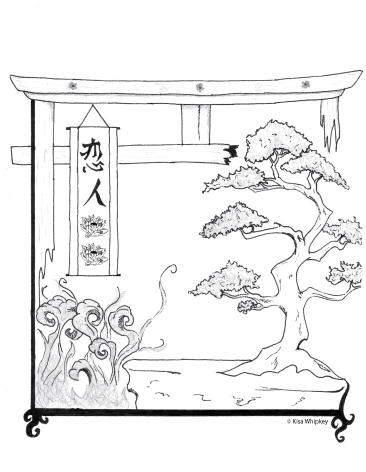
But that’s not the point of today’s post (okay, not the whole point). I’m actually going to do a rare art feature. See, I was lucky enough not only to be involved with the selection of the gruesomely fantastic tales in the anthology, but also to create one of the many illustrations included within its pages. And trust me, there are some truly beautiful works of art in this thing. Want a taste? Well then, let me present my illustration for a story called “Sweetheart Ronin” by the talented Suzanne Morgen:

"Sweetheart Ronin" Illustration by Kisa Whipkey


Created to evoke the style of the setting (Japan, in case you’re wondering), this piece is a combination of traditional drawing with pencil and Sharpie (yes, Sharpie. Who knew, right?) and digital vector graphic created in Adobe Illustrator. In order to understand the significance of the elements, you’ll have to read the story, which can be located here. Buy it. Seriously.

And for those of you curious about Project REUTSway, click here. The 2014 competition, featuring challenges rooted in world mythology, kicks off tomorrow and runs all November long. So if you’re looking to flex those writing muscles, but NaNoWriMo is too daunting/impossible, head on over and check it out. Who knows? Maybe I’ll end up drawing an illustration for you in next year’s anthology. 😉

Featured From the Archives: The Anatomy of a Successful Short Story

Reuts Publications announced the impending return of their Nano-inspired writing contest — Project REUTSway — this week. Which means that (hopefully) there is a horde of eager writers rubbing their hands together in anticipation. (If you’re not sure what I’m talking about, be sure to click above and sign up for the VIP notification list.) It also means that those same writers will be sharpening their proverbial pencils to craft — in rapid-fire succession, no less — four brand new short stories. So what better time than now to dredge this post up from the archives?

Anyone planning on entering PRW (as the REUTS team affectionately calls it), listen up. Here are three things you’ll want to keep in mind as you strive to impress the judges (*ahem* me *ahem*). Let me hand you the key to success on a silver platter; you’ll thank me later. 😉
 

The Anatomy of a Successful Short Story

by Kisa Whipkey

Originally Posted on 12/13/13

 
Short stories. Some people love them, others can’t stand them. But no one can deny they’re an entirely different creature from novels.

This week, I’ve been judging entries for the ProjectREUTSway competition held during the month of November. Buried amid 144 short stories, I started to think about what exactly makes one “successful.” I think most of you know by now that I, myself, published three, so this is a topic that hits very close to home. It’s also one I’ve never really stopped to think about. Until now. Because, let’s face it, short stories are strange. Similar to novels and yet completely dissimilar, they require a certain — almost magic — recipe to really shine. I don’t believe in the undefinable though (at least not when it comes to writing), so let’s see if we can’t identify the exact ingredients that make short stories such a unique form of storytelling.

Short stories are often considered a novelist’s training wheels, the idea being that someone can learn the basics of storytelling through short stories and then graduate into novels. But that’s not exactly what happens. Because, in reality, they require two different skill sets to pull off well. A short story is not a truncated novel, nor is a novel an elongated, rambling short story. Rarely can the concept for one be turned successfully into the other. And yet people still try. Why? Because short stories have been given a bad rap. Novels take all the glory, leaving short stories to rot in creative writing jail like fiction offenders. They’re looked down on as an inferior form of narrative, an eighth grade diploma to the novel’s PHD. After all, the only difference between them is length, right?

Wrong.

There are three things a successful short story must have: brevity, focus, and telling. Yes, you heard me, telling. But before you get your knickers in a bunch, let me explain further.
 

1. Brevity

 
Novelists are taught the value of brevity. But even the most refined novels still sprawl, meandering through details and settings and other things short story authors simply can’t afford. Literally every word matters in a short story. No detail is extraneous. If we mention the light blue collar on a random cat, you can bet that collar is important somehow.

The same holds true for the words themselves. Novelists are allowed to write sentences like this:

She paused, grabbing the handle of the stainless steel refrigerator and pulling it open with a subtle flick of her wrist.

(Hey, no comments on the quality. Clearly, I know that sentence is atrocious. I’m proving a point. 😉 )

That’s 21 words to say this:

She opened the refrigerator door.

Yes, that may be a bit exaggerated, but you see what I mean, I hope. When you only have maybe 5000 words of space, every letter has to serve a purpose. Successful short stories know this, and the language/storytelling is as finely honed as a scalpel. If it doesn’t somehow move the plot along, impart valuable information, or absolutely have to exist, it doesn’t.
 

2. Focus

 
I’m a firm believer that every story should have a message, a reason for existing. But maybe that’s because I started out as a short story author. Whenever I come up with an idea, I identify the core message first, before the setting, characters, or even plot. For example, The Bardach is a story about identity, Spinning is about fate, and Confessions is about losing faith. Even Unmoving has a focal point. At its core, its about compassion. This type of focused narrative is one of the more notable differences between a short story and a novel.

Short stories are single-minded. Like a starving man spotting food, they keep their eyes on the prize. None of this wandering off into detours, flashbacks, subplots or other shenanigans that novels get away with. Nope, they have one message, one plot, one climatic moment that everything points to. And, interestingly enough, short stories are typically driven by an event, rather than a character. The focus is on the action, not the person doing it.

How does this translate into our recipe for success? Well, you’ll be able to feel the underlying drive in a really good short story. You’ll walk away from it remembering the message, not necessarily the characters. So make darn sure you know what you’re saying, both literally and subtextually.
 

3. Telling

 
All right. I know this is the one you were waiting for. After all the times “show, don’t tell” has been beaten into your head, you simply can’t believe I’d actually stand here and advocate telling, can you? Well, I’m not really.

See, the thing is, showing is still 100% better than telling. But, telling is allowed in a short story. Due to the limited amount of time you have to impart your narrative, there’s really no way around it. You don’t have the luxury of wasting thousands of words, or even hundreds, showing us the back-story. Nor can you illustrate anything directly outside the timeline of the main event, regardless how important it may be. So that only leaves one option — telling. You should still avoid the dreaded info-dump if you can, but slipping in the occasional line of summary, or a paragraph of back-story, won’t automatically earn you peer derision. Well, most of the time, anyway.

Successful short story authors are masters of knowing when to tell and when to show. (Which, by the way, I am not. Just wanted to clarify that in case anyone thought I was going to be cocky and throw myself on that list.) They give you just enough information — typically in the form of telling — to make their worlds/characters feel as fleshed out as a novel’s, but not so much that you really notice. They cover a lot of ground in a really short amount of time, making this the hardest skill on the list. It actually requires mastery of the other two to pull off, which is why I listed it last.

And there you have it; the anatomy of a successful short story. Learn how to control these three elements and your short fiction will stand out in a pile like little beacons. And let’s all try to stop viewing short stories as the lesser form of fiction. They’re not inferior. Just different.