
Guest Post, Interviews, and Cool New Things

Today’s post is a bit different from the norm — a sort of compendium of things I’ve collected over the week that I wanted to share. Some are informative, some are about me (yay for self-promotion?), and some are just potentially cool. So let’s get right too it, shall we?

Interviews:

For those who may have missed it, I was interviewed earlier this week by S.M. Nystoriak about things like acquisitions and the publishing process in general. It was a lot of fun, and offers quite a bit of insight into what it’s like on my side of the fence. You should swing by, check it out, and thank her for putting it all together. Here’s the link.

There’s also another set of interviews you may want to wander past. REUTS Publications is the featured publisher of the month over on bestselling author Katie Hamstead’s blog. All month, she’s posting interviews with the staff (including me!) and authors, and there are some pretty significant giveaway prizes you can score simply by leaving a comment. (Hint: there may be some free editorial services and cover design up for grabs, and I know how much you all love those! 😉 )

Which sort of leads us into the next topic I want to bring to your attention (okay, not really, but kinda? It does have to do with interviews and questions and such . . .)

Cool New Things:

You all know you can ask me questions about editing, publishing, martial arts, or whatever, right? Well, now you can ask REUTS too! How many times have you wished you could just ask someone in the publishing industry for insight into the process, or advice, or even just get to know them. Here’s your chance. Part of the REUTS philosophy is transparency. We routinely pull back the velvet curtain and show you the messy innards that comprise the world of publishing. And now, we’re giving you the chance to tell us what you want to know. (Yes, I’m using the royal “we” here, because really, REUTS is as much as part of me as I am of it.)

So if you’ve got a publishing-related question burning a whole in your brain, head on over and submit it to our new Q & A blog series. Pretty cool, right?

And that brings us to the last item on the agenda — which is also somewhat related to that philosophy of transparency I just mentioned. Creative Director Ashley Ruggirello drafted a post about the delays in publishing, detailing some of the reasons why it takes so damn long for authors to receive responses. Similar to my post on queries, it’s a candid look at what those of us on the other side of the publishing fence see every day. And she’s graciously allowed me to syndicate it. So, without further ado, I give you:

“Hey, what’s taking so long?”

The Delays in Publishing

By Ashley Ruggirello

Originally Posted on the REUTS Publications Blog
Screen-Shot-2015-03-09-at-9.05.04-AM-1024x321

In the publishing world, there’s a lot going on behind-the-scenes even when it may not look like it. In fact, the bulk of a publisher’s (or agent’s or writer’s) efforts aren’t publicly broadcasted. When an announcement is made or a book is released, it comes on the heels of weeks, or even months, of behind-the-scenes teamwork. Because we like full transparency and providing an inside look into how we do what we do, I wanted to touch on delays; why they happen, and why they aren’t always a bad thing. So in a fashion similar to Editorial Dir. Kisa Whipkey’s What Not to Do When Querying article, here’s:

“Hey, what’s taking so long?”
The Delays in Publishing.

For organizational means, I’m going to break down “publishing” into the main phases an author and publisher go through. Please note this is specific to REUTS and how we move through these individual phases. Though other pubs may have similar processes, there isn’t a “one size fits all” method to publishing.


Submitting

Number one delay: Slush.

Now, don’t assume that’s bad. Slush is just a term to describe all the submissions we receive. Some are good, and some are not so good. Kind of like snow—you’ve got the pristine, fresh snow, and then the mucky, brown snow. Mix them together, and you have slush. Not bad, just how it goes. Every publisher or agency has slush, and everyone has their own method of trudging through it.

Delay’s happen here from an overwhelming number of submissions. If you have 100 submissions looming in the slush pile, and each includes a query/synopsis and the first ten pages of the manuscript, there’s quite a lot of reading involved at the very start of the process. And, in order to make the most informed decision on whether or not to request the full manuscript, we read them all. This causes a delay at REUTS because of the unique method we’ve adopted to handle submissions. Instead of submitting to one Acquisitions Editor who then decides yay or nay (and if yay, has to convince the rest of the team to feel the same way), we have a panel consisting of the four REUTS directors. Each of our directors reads through each submission, provides their thoughts, and submits a decision. It then comes down to a majority vote. Only after a majority vote has been decided can we respond to an author regarding their submission. And at REUTS we provide a unique response email to all of our submitting authors, regardless if it’s good news or bad news.

Only then can we move a manuscript out of the “submitting” phase, and into the “reviewing” phase.

Remember, requesting an update only delays us further, since the time it takes to look up your manuscript, track down the email with any discussion, and respond back takes precious time away from actually reading your submission. Here are REUTS we alwaysrespond to a submission made. No exceptions. So if you haven’t heard from us, that’s actually better than if you had and received a rejection.

Reviewing

Number one delay: Reading.

If a submission makes it to the “reviewing” phase that means we’ve requested a full manuscript for further . . . review. Makes sense! This is, without a doubt, the longest part on your journey toward receiving that beloved contract offer. In requesting manuscripts with a minimum word count of 50,000 (and many times a story is well over that), it means an acquisitions team has to read a full-length book before making a decision. Just like in the “submitting” phase, our panel of four REUTS directors are involved in reviewing the full manuscript. Each director reads the manuscript, and then there’s the discussion. Since people read at different speeds, with their own set of different delays (remember: our directors have responsibilities to already signed authors outside of their acquisitions duties) there’s no way to accurately gauge how long it will take all fourteam members to read a manuscript. Then there’s the discussion, which is absolutely necessary, as each of our directors brings a different perspective to the table. Editorial Director Kisa Whipkey weighs in on the amount of work involved in bringing a manuscript up to publication standards. Marketing Director Summer Wier weighs in on how marketable the title would be in the current—and future—marketplace trends. This method, along with many other factors, allows us to determine whether a title will work within our collection or whether it isn’t a good fit.

We take our job very seriously, as I’m sure all Acquisitions Editors do, and that means taking our time to make sure our accrual of a new title will benefit both REUTS and—most importantly—the author.

Production
(editing, cover design, marketing, etc…)

Number one delay: Life.

Your editor won’t be your cover artist. Your cover artist won’t be your marketer. That right there means there are at least four people working together to produce your novel. And, guess what, those four people all have lives independent of each other, independent of REUTS. Yes, you’re included in that four, too. We don’t expect an author to focus on their manuscript 24/7, just as we don’t expect our production team to focus solely on your manuscript 24/7. It’s a fact many tend to ignore: life gets in the way. Sometimes you can’t control it. Sickness, death, children, leisure . . . delays sometimes happen because of the things you can’t plan for. It doesn’t mean your editor/cover artist/etc . . . isn’t fully vested in your project. It doesn’t mean you’re not a priority in the eyes of the publisher. It just . . . happens. As much as we try to account for life-based delays, let’s face it, they’re unavoidable.

In addition, on top of those life delays each team member involved in the production of your title has at least a handful of other books they’re also working on, simultaneously, and trying to make sure all authors receive the same amount of attention, especially if one of the authors has a book release looming sooner than another.

Sometimes this means we miss the original publication date, and it has to be pushed back (trust me, this happens a lot in publishing, and not just to independent presses). Many times that means scrambling until the very last second before a release day, making sure everything is set and ready to go. But always this means we’re working our very hardest for you and your manuscript. A delay doesn’t mean otherwise.


So you see, there are a lot of pieces to the puzzle that come together, from start to finish, to produce a book. Delays aren’t necessarily a bad thing. We’d much rather delay any phase of the process in order to give your story the time of day it deserves. In the “Submitting” phase, that means actually reading through your submission, and determining if we’re the best fit as a publisher or not. In the “Reviewing” phase, that means reading every word of that 50,000+ word story, becoming emotionally invested in your characters/world/etc . . . and trying to find a place for it in our collection. And then finally, in “Production”, where if everything wasn’t done digitally, our blood, sweat, and tears would stain your pages because we want to put out the very best product possible.

Publishing is largely a waiting game. That should come as no surprise. But just remember what they say:

Patience is a virtue.

Featured From the Archives: Falling in Love With the Subgenres of Romance

This week, we’ll be continuing our refresher on the various subgenres of the prominent literary categories. This post, in particular, surfaces regularly in my stats feed, so it must contain something of value to those who write in this market-dominating genre. And since it’s already kind of long, I’ll cut right to the chase. (I’d also like to note that I’m using the very traditional definitions of these subgenres. In the past two years, though, there has been a push across all genres to include more diversity–a movement I wholeheartedly support. So if you write diverse fiction–first off, you’re awesome! I wish you lots of success–just swap out the pronouns used in these traditional definitions appropriately and you’ll be good to go. There’s certainly nothing wrong with turning a subgenre on its head; in fact, it’s highly encouraged.)

Falling in Love With the Subgenres of Romance

By Kisa Whipkey

Originally Posted on 8/15/13

After the popularity of my post on the various subgenres of Fantasy, I decided it was unfair to leave authors of the other common genres in the dark. Categorizing your work is one of the most difficult parts of the process, and it’s easy to see why authors struggle. So if I can help by providing a list of the various subgenres and their definitions, shouldn’t I? That’s exactly what I thought, too. So over the next few weeks, I’m going to do just that. Starting with Romance.

When I say “Romance,” I bet three-quarters of you instantly picture Harlequin and a beefy, shirtless dude who’s apparently never heard of a hair cut fawning over a buxom girl who tried to squeeze unsuccessfully into a corset three sizes too small for her chest. It’s okay. I did too. Because that’s the image we’ve been told embodies Romance. But as classic as that bodice-ripping image is, it’s not the whole picture.

Romance actually encompasses 10 separate subgenres, and as Romance fans can attest, each is distinctly different from the others. In fact, of all the popular genres of mainstream fiction, I’d hazard Romance is the only one where fans stubbornly refuse to read anything other than their favored subgenre. And that’s because of the dramatic difference between them. They’re almost so different as to not really belong under the same genre header. If it weren’t for the consistent narrative structure revolving around a love story with an emotionally satisfying end, these subgenres would have very little in common.

What are they? Let’s find out.

Contemporary Romance

Set after 1945, Contemporary Romance is the largest subgenre, cornering well over half of all Romance titles sold. It generally takes place in the time it was written and will reflect social behaviors of that time. For example, a Contemporary Romance set in 1950 would likely feature a heroine who’s primary goal is to get married, raise a family and be a good housewife, while one set in 2000 would probably feature a feistier, career-driven female with more progressive views on love. This subgenre shares a lot of similarities with Women’s Fiction (a subgenre of General Fiction), but a Contemporary Romance always focuses on the romance while Women’s Fiction can focus on any life change relevant to women.

Historical Romance

This is the only subgenre to have subgenres of its own. The only stipulation is that it be set prior to 1945 and, of course, the plot must be centered on romance. Other than that, it can fall into any of these subcategories:

  • Viking: Obviously features Vikings in the Dark or Middle Ages.
  • Medieval: Your typical Knight and Damsel in Distress situation.
  • Tudor: Set in the English time period of the same name — 1485 to 1558.
  • Elizabethan: Yep, more England. This time between the dates of 1558 and 1603, when the first Elizabeth ruled.
  • Georgian: Hey, look! More England! These take place between 1714 and 1810, during the historical period of the same name.
  • Regency: A super short time period in English history (yep, still England) — 1810 to 1820.
  • Victorian: Yet another moment in English history (Man! This subgenre really should be called English History Romance!) — 1832 to 1901.
  • Pirate: (Did anyone else just laugh over the fact this is considered its own thing?) I think the name speaks for itself, don’t you? Think Johnny Depp and Pirates of the Caribbean and you’re golden.
  • Colonial United States: Ah yes, now we get to the American-centric portion of history. This takes place between 1630 and 1798. So if Elizabethan or Georgian England isn’t your thing, cross the ocean and explore America instead.
  • Civil War: Typically, these are set on the Confederacy side (since everyone knows the Confederate South was a sexy place to be), but they don’t have to be. They just have to be set during the Civil War.
  • Western: I’m sure all of us just pictured cowboys. But those cowboys actually can be American, Canadian, or Australian. These books actually focus on the experiences of the female though, rather than the male-centric version found in the Western genre itself.
  • Native American: These books explore Native American cultures as much as they tell a love story. They also usually contain some element of fighting against prejudice and paint a picture of cultural acceptance.
  • Americana: A simple subcategory, Americana takes place between 1880 and 1920 in Small Town USA.
  • Celtic: This is apparently not recognized as a thing, but I’m including it because I’ve personally read at least a hundred Romance books featuring Scottish or Irish backdrops, cultures, and beliefs. That qualifies as a subcategory in my book.


Romantic Suspense:

Combining elements of the Mystery genre with Romance, this subgenre is a hybrid. It still features a relationship at the heart of the story, but is more plot-driven than its character-driven subgenre brethren.

The most common set-up is a woman who’s become a victim falling for a man who’s in a position of authority/protection — police officer, FBI agent, Firefighter, Navy SEAL etc. Solving the mystery around the crime brings them closer together and helps them fall in love.  The elements of suspense — mystery, thriller, etc. — become integral to the storyline, affecting the decisions the characters make and driving the plot forward. At the same time, the romance remains the focus, so those same suspenseful elements have a direct impact on the way the love story unfolds. All in all, this is one of the more complicated Romance subgenres to write, but it’s also one of the more fun to read.

Paranormal Romance:

Another hybrid, Paranormal Romance draws heavily from Fantasy. In fact, it’s considered a subgenre of Fantasy as well.

“Paranormal” simply means anything not normal, so the staple of this subgenre is weaving fantastical elements into contemporary settings. Vampires, Werewolves, Witches, Demons, Psychics — all are fair game in this subgenre. The most common settings pull from Urban Fantasy or Dark Fantasy, but there are even some Historical settings out there. Sometimes, the larger culture is aware of the paranormal happenings in their midst (à la Charlaine Harris’s Sookie Stackhouse novels) and other times, they’re not (à la Stephenie Meyer’s Twilight Saga). But almost always, a Paranormal Romance blooms between a human and something not-quite-human.

Science Fiction Romance:

Science Fiction Romance is to Science Fiction what Paranormal Romance is to Fantasy. Meaning it pulls heavily from the Science Fiction genre, weaving in futuristic, alien, or technological elements. The only difference between a regular Science Fiction tale and a Science Fiction Romance is the focus of the plot. Just like all Romance, the heart of a Science Fiction Romance is the blossoming love between two main characters. Now, whether those are both human characters on some outer-space road trip, or a human and an alien on some exotic, distant planet is up to you.

Time Travel Romance:

I’m honestly not quite sure why this gets its own dedicated subgenre. Depending on the set-up of the time travel, whether it’s magical or scientific, it could easily fall within the requirements of either Paranormal Romance or Science Fiction Romance.  But, apparently I’m wrong, because this is listed on multiple sources as a Romance subgenre.

A Time Travel Romance obviously has to contain an element of time travel. Whether you have a character traveling back in time to find their soul mate or have someone travel forward in time for the same thing doesn’t really matter. What does matter is that while you create the usual romantic plotline, you also pay attention to the clash of cultures. Time Travel Romances offer a unique way to filter viewpoints on current and past society through the lens of a character outside of it. In that sense, they can also contain aspects of morality or satire.

Inspirational Romance:

Inspirational Romance is a subgenre aimed at a specific niche of readers. It combines strong Christian elements with the more traditional aspects of Romance. However, because it does conform to the Christian belief system, it typically doesn’t include things like gratuitous violence or swearing, and sex, if it’s shown, only happens after marriage. The entire thing has a chaste, traditional courtship feel that appeals to readers wanting the warm and fuzzy experience of true love conquering all without the grit or vulgarity.

Erotic Romance:

I think there may be something intrinsically wrong with listing this directly under Inspirational Romance, but oh well. Just like Inspirational Romance targets a specific group of readers, so does Erotic Romance. And they’re at complete opposite ends of the spectrum! Where Inspirational is clean and innocent, Erotic Romance is dirty and explicit. It contains strong sexual content and frank language. But despite the heavier emphasis on sex and frequency of the sexual scenes, Erotic Romance stills contains developed characters and plots that could stand on their own without the steamier bits.  Technically, I would say E.L. James’s 50 Shades of Grey is an Erotic Romance. If you strip out the many sex scenes, you’re actually left with a semi-decent story of two people learning to love.

One thing to note: Erotic Romance is not the same as Erotica, which is its own genre. In Erotica, the sex scenes are all that matter, taking up three-quarters of the book at the expense of well developed characters or story.

YA (Young Adult) Romance:

This is a newer subgenre, and may not even be fully recognized as such yet. But I’m choosing to list it as its own thing because it has a distinct set of requirements just like the others do.

YA Romance targets readers between the ages of 15 and 18. It deals with things like first loves, first kisses, and losing one’s virginity — themes appropriate for the target audience. The romances are passionate in the way that only teenagers can pull off, and the prose is typically kept at a PG-13 rating. So while there are some steamy parts, they’re not as explicit as those contained in books intended for adults. Why is this worthy of a subgenre designation? Because more and more titles are being released that would fit; titles where the primary plot focuses on the romantic relationship between the characters and not something more external and grand, like saving the world. They can fall within any of the previous subgenres, but due to the specific age range of the target audience, I feel they should be set apart.

NA (New Adult) Romance:

The newest subgenre on the block, New Adult is quickly gaining popularity. Like Young Adult, it targets a specific age range — 18 to 25 — and deals with themes like discovering one’s self, leaving home for the first time, finding a career, etc. It also incorporates things like overcoming that first heartbreak, committing to a serious relationship, starting a family, and other things that resonate with readers in that stage of life. It lifts the PG-13 rating of YA, including more explicit sexual content and stronger language. How is it different from other adult romances? It’s not, really. Aside from the specific thematic elements and the target audience, it’s much the same as what you’d find in more mature titles. Why did I give it its own designation then? Because it’s the cool thing to do. Duh! Just kidding. It’s because it does have stipulations, requirements that dictate the path of the story. That’s what defines all the other subgenres, so why shouldn’t it come into play here?

And there you have it. As you can see, these subgenres vary widely, crossing over into the other mainstream fiction genres and back again. The main thing to remember is that while romantic subplots can and are included in nearly all genres of fiction, only plots where romance is the driving force can be considered true Romance. Regardless of which subgenre they are, they all must boil down to one simple thing — a story of two people falling in love who eventually end up together. If that sums up the core of your story, congratulations! You’re a Romance writer. And with Romance remaining among the most popular genres, there’s definitely no shame in that.

Next week, we’ll continue our exploration of subgenres by meandering through the intimidating number Science Fiction sports. In the meantime, if you feel I’ve miscategorized, misrepresented, or just plain missed a Romance subgenre, feel free to add/correct in the comments below. As always, thanks for reading! 🙂

Featured From the Archives: Dark and Urban and Contemporary, Oh My! (Defining Fantasy Subgenres)

To say this past week was exhausting would be an understatement of epic proportions. So would saying that I have more than two brain cells left firing at the moment. I’m sure it’s no surprise then, given my publicly proclaimed zombie status (I seriously almost cried over the lack of egg salad at the deli the other night, I was so tired. It wasn’t pretty, people) that I have nothing to offer by way of brilliant new blog content. But, that doesn’t mean I have nothing to offer you at all. There are always my trusty archives, there to fill the void when ingenuity doesn’t. And since we’re heading into what I’m affectionately dubbing Twitter Pitch-Party Season, this series of posts may be quite helpful to those of you getting ready to brave the query trenches. (It will also give me a much needed break so I can actually create some decent — new — content for you.) So, without further ado, and before I face-plant on my keyboard and walk away bearing the letters like a horrible face tattoo, I give you your refresher course on the various genres and subgenres in literature. Do with it what you will.

Dark and Urban and Contemporary, Oh My!

(Defining Fantasy Subgenres)

By Kisa Whipkey

Originally Posted on 5/24/13

I remember, back in the day, (nothing makes you feel old like starting a sentence with “back in the day”) fantasy and sci-fi were commonly known by only two genre names — fantasy and sci-fi. Okay, maybe that’s not 100% accurate. There were probably a few subgenres, but those only really mattered if you were inside the publishing industry. Readers didn’t care about the distinction. Maybe they still don’t. I don’t know. But bookstores do, agents and editors do, and the Mighty Zon’s recommendation algorithms definitely do. Classifying your book with the correct genre headers can mean the difference between actually finding readers and getting lost in a sea of other titles like a piece of driftwood. But with a plethora of subgenres to choose from, how is a writer supposed to figure out where their book fits?

Fantasy alone has 31 recognized subcategories. 31! So it’s no surprise that the distinctions between them can begin to blur. I know. I’m guilty of doing it myself. On any given occasion, I’ll declare Unmoving either Urban Fantasy, Contemporary Fantasy, or some combination of the two. Because the truth is, I didn’t really understand the difference. In my mind, they were virtually the same thing. (And, in the years since I first wrote this post, I’ve learned that neither actually apply to Unmoving. It is, in fact, Magic Realism. So you see why this post is necessary. Even I got it wrong!)

Further research proved that although Urban and Contemporary are indeed very similar, they also have distinct differences that set them apart. Curious what those distinctions are? I thought you might be. Which is why I’m going to use my newfound knowledge to give you a breakdown of the more common fantasy subgenres. That way you can declare your work a Comic/Arthurian/Steampunk masterpiece with confidence. Or, you know, whatever combination of subgenres it happens to be. 😉

Alternate History Fantasy

This type of fantasy takes real world events and creates an alternate outcome, resulting in a fictitious world that may still resemble ours. For example, Alternate History asks questions like, “What if we had lost World War 1 or 2?” The resulting progression of history from that deviating point would be the goal of the story, allowing the author to play with imaginary elements (including the light use of magic) while keeping the believability of the timeline.

Arthurian Fantasy

Just like the name implies, this includes any story inspired by the King Arthur legends. Whether it’s a literal retelling or simply based within that world, this subgenre is fairly straight-forward. Probably one of the most well-known examples of this is The Mists of Avalon by Marion Zimmer Bradley.

Comic Fantasy

This is the spoof category, where you’ll find over-the-top situations featuring fantasy elements. Whether humorous or satirical, this subgenre is meant to amuse. Common examples include the Xanth novels by Piers Anthony, Monty Python (I know, not a book), and to some extent, The Princess Bride by William Goldman.

Contemporary/Modern Fantasy

Contemporary Fantasy simply means it’s fantasy set in modern times. Magic and magical creatures mix with the everyday world we all know. The important thing that distinguishes this from Urban Fantasy is the location. Unlike Urban Fantasy, Contemporary can take place in any setting, as long as the time period is current. It also tends to be lighter in tone than its Urban counterpart.

Cross-Over Fantasy

When I first saw this, I thought it was referring to the blending of fantasy with other non-fantasy genres. But actually, it refers to stories where the characters can cross between realms and/or time periods. The only example I can think of that fits would be the Magic Kingdom of Landover series by Terry Brooks.

Dark Fantasy

Ah, my favorite subgenre and the one that most of my work falls into. Dark Fantasy contains elements of horror, so you’ll see a lot of the darker supernatural creatures appear here. But it also refers to the overall tone of a piece. Dark Fantasy is grittier than it’s more traditional brethren, dealing with the nastier bits of humanity’s psyche. There can be (and often is) a significant amount of violence and gore, and it usually contains themes meant to make a reader slightly uncomfortable. So even if there are no vampires, werewolves, demons, etc, a novel can still be classed Dark, simply by it’s voice and subtext.

Epic/High Fantasy

Otherwise known as your stereotypical idea of fantasy. This is the bread-and-butter of the genre, and the one I expected to write in when I first started out. (It wasn’t until I was much older that I realized I found the intricacies of personality and psychology far more fascinating than the intricacies of politics and fictitious cultures.) Hallmarks of this subgenre include immense, sprawling worlds with rich histories and more detail than most readers would ever care to know. Expect to see hand-drawn maps and be introduced to intricately crafted cultures, magic, and political maneuvering. Think Tolkien’s Lord of the Rings. Enough said, right?

Fairy Tales/Mythology

What would fantasy be without Fairy Tales and Mythology? Although many of the original Fairy Tales have been watered down for modern sensibilities, the original stories were often violent, dark, and twisted, meant to terrify children into learning a lesson. This is a subgenre rich in the history of storytelling, drawing on thousands of years of cultural traditions and is an endless well of inspiration for fantasy writers. Many of the books currently on the market can be boiled down to the retelling of a Fairy Tale or Myth, including my own WIP, which draws loosely from Sleeping Beauty.

Heroic Fantasy

Where Epic Fantasy focuses on the world and the overarching idea of good vs. evil, Heroic Fantasy focuses on the characters, primarily — you guessed it — the hero. Think of Epic Fantasy as a bird’s eye view and Heroic Fantasy as the close-up. Often, it will feel very similar to Epic/High Fantasy, with medieval settings, magical creatures, and good vs. evil. But it will stay closer to the hero’s personal journey and growth as a character, and often features a true damsel-in-distress.

Historical Fantasy

Historical Fantasy is the long-lost brother of Historical Fiction. It takes an actual time or event from history and blends in fantasy elements similar to the way Contemporary and Urban Fantasy do. Starting to get confused yet? Yeah, me too.

Low Fantasy

High Fantasy consists of large sweeping worlds, epic battles, and a ton of detail, right? So it’s safe to assume that Low Fantasy is the exact opposite. It usually contains little to no magic and more ordinary surroundings. This is a subgenre that is rarely used anymore, since it appears that writers who want this sort of thing tend to aim for the more contemporary variations — Modern or Urban or even Juvenile (strictly for kids). Kind of makes you wonder why it’s still considered a thing if no one uses it, huh?

Literary Fantasy

Literary Fantasy was created for all the snobby writers who didn’t want to be left out of the fun. (Just kidding.) This subgenre focuses on the actual writing rather than the other elements of storytelling. It uses things like format and style to deliver its message, often creating progressive narratives that don’t appeal to the mass market. Just like the Literary genre is aimed at a niche of highly intelligent readers, Literary Fantasy targets readers who like a little imagination in their pretension. 😉

Magic Realism

This refers to the type of magic included in a tale, and as such, is most often seen paired with another subgenre. Magic Realism means that magic is an accepted part of the story’s world and operates under a strict set of rules. There are no unexplained, miraculous saves by magic allowed in this subgenre and using magic is often followed by negative consequences. The need for implements and tools to channel magical abilities is also commonplace here, giving magic a requirement of skill and work rather than mere blessed luck.

New Weird/Slipstream

This is a sister subgenre to Literary in that it actively tries to break the conventions of fantasy. The landscapes and characters are often bizarre, and the language can be highly stylized or poetic.

Paranormal Fantasy

This subgenre has seen a massive boost over the past decade, thanks to the ever-popular variation of Paranormal Romance. By its most basic definition, Paranormal means anything not normal. (Well, no S*** Sherlock, you don’t say.) So the same cast of inhuman creatures that show up in Contemporary, Dark, and Urban Fantasy show up here. (Man, those vampires and werewolves really get around!) The most common plots seen in this subgenre are the romantic ones, which are often combined with a detective/police element. (Because only sexy cops can see the supernatural, apparently.) But you will also see the age-old battle of good vs evil and heroes trying to stop the nonhuman from taking over the world.

Romantic Fantasy

This subgenre combines Romance with fantasy in one powerhouse combination. How is that different from Paranormal Romance, you ask? Paranormal Romance is usually dark and gritty, and Romantic Fantasy doesn’t have to be. Romantic Fantasy focuses on the romance itself, relying on the question of “will they or won’t they” to drive the plot, while the love story can simply be an added bonus in Paranormal Romance.

Sword and Sorcery

This is another staple of the fantasy genre. Back in the early days, (Ack! There it is again! The reminder that I’m old) if you weren’t writing Epic Fantasy, you were considered Sword and Sorcery. This is an action-driven subgenre, with sword-wielding heroes facing off against magic-wielding villains in brutal battles to the death. It’s kind of similar to Heroic Fantasy in that way, where the war between good and evil takes center stage. But where Heroic Fantasy focuses on the character, Sword and Sorcery cares only about the badass fight scenes.

Steampunk Fantasy

This is another fairly new subcategory. Pulling from the Steampunk movement, Steampunk Fantasy lives in an alternate universe where combustion was never discovered. Technology is reminiscent of the old west, with steam-powered everything, and the settings are usually Gothic or Victorian with a definite feel of the Industrial Revolution. Plots in this subgenre typically pull from similar themes as Dark and Urban Fantasy, with those promiscuous vampires, werewolves, and demons popping up yet again. The important thing about this subgenre is the adherence to the rules of Steampunk.

Urban Fantasy

Last, but not least, we have Urban Fantasy. As mentioned above, during our definition of Contemporary Fantasy, Urban Fantasy is dark by nature. It’s gritty and bloody and showcases the uglier side of humanity. And it absolutely has to take place in a city. Hence the “urban” designation. But, unlike Contemporary/Modern Fantasy, that city can be in any time period. Most often, it will be current times, but it doesn’t have to be. Which is why you’ll also see a lot of the Urban style in Steampunk and Paranormal.

So, there you have it. A cheat sheet to some of the more popular fantasy subgenres. This is by no means a comprehensive list, so if you feel I’ve overlooked an important one, (or gotten the definitions completely wrong) feel free to add/fix it via the comments below. As you can see, many of these subgenres overlap, or can be combined to create new ones, making the task of defining your book all the harder. But hopefully I’ve helped clarify things, at least a little. I know I’m much more confident defining my work now, after learning all of these. Are you?

Featured From the Archives: Writing Characters With Great Backstories (Without the Backstory)

I spent the majority of today attending a lovely writing workshop, where I met fabulous people, heard intriguing pitches, and participated in a panel discussion/critique of anonymous first pages. The last is what prompted me to dredge up the following article. By far, the thing that caused all five panelists to stop reading can be summed up with one dreaded word — exposition. As much as it pained some in the audience to hear it, that pesky bugger inevitably resulted in their work being rejected. So it behooves you to pay attention. You can have a superb concept, but if your first page falls into the bottomless pit of exposition, there’s no saving it. So instead, let me show you how to avoid ending up in that pit in the first place. Deal?
 

Writing Characters With Great Backstories
(Without the Backstory)

By Kisa Whipkey

Originally Posted on 2/21/14

 
As an editor, I get to bear witness to all kinds of writing pitfalls. (In fact, I have a post series dedicated to that planned for the near future.) But one of the most prevalent, by far, revolves around divulging exposition — especially of the backstory variety. There are varying degrees of offense, but my personal favorite (and by “favorite”, I really mean eye-roll inducing, hair-pulling, editing nightmare) is when writers feel the need to divulge a character’s entire, complicated life story in the first chapter. Why is that bad? Well, think of it like this: your first chapter is the reader’s introduction to your character. So in real life, it would be like meeting someone for the first time and having them word vomit their life story all over you. What kind of impression does that leave? Yeah, I bet you’d avoid that person like the plague after that.

I can already hear the murmurs of confusion and disagreement.

“But, we have to make sure our characters feel well-rounded and real,” you say, “We don’t want them to feel like cardboard cut-outs or Mary Sues.”

You’re 100% right. But you can do that without resorting to the word vomit introduction. How? Well, that’s what I’m here to show you. 😉
 

Step 1: Creating Backstory

 
Before you can begin to write a well-rounded character, you have to actually make them well-rounded. You need to know that person intimately. They need to be real — as real as your best friend from high school, or your quirky aunt with the 82 cats who lives in a motor home. The best way to do that is by making what’s known as a character profile. (There are tons of templates available online, but this one is particularly thorough.) Document all those tiny little details and experiences that make your character who they are. Don’t just stick to the superficial details, like eye color and body type, but really get to know them.

How’d they get that scar on their right knee?

Who was their first crush, and who broke their heart for the first time?

What’s their strange nightly ritual? And why do they keep that weird nick-knack on their bookshelf?

In a separate document, flesh out your character from top to bottom. Until, like an actor, you can step into their skin and write with their voice. This process is as essential to your novel as plotting is, so don’t skimp. You’ll need to do this for every major character, and, to some extent, the supporting cast as well. You’ll see why here shortly.
 

Step 2: Writing as Character X

 
By now, you should have pages and pages of notes. You’ve created all these exciting experiences and nuances that shape your character’s personality, and you can’t wait to share them all with the world. Right? Wrong. This is where pet peeve #208 (listed above) comes in. Writers assume that since they’ve created all this material, they need to use it. That it’s a disservice to their character not to, and that stuffing every minute detail into their novel is the only way they’ll be able to illustrate just how intricate this person’s life is. But guess what? We’re all intricate, complicated people. And we don’t care that you’ve managed to create another one.

Your character spent 8 months backpacking through Europe three years before the events of chapter 1? Great. Who cares?

Your character has a great grandmother who can bake the world’s best pot roast, but who died ten years before the events of the story? Okay. Sad, but so what?

Your character’s favorite childhood dog only had three legs, but could run like a greyhound? Weird and slightly interesting, but what does it have to do with the story?

My point is, unless one of these anecdotes or facts has a direct affect on the current plot, it doesn’t make it into the book. Why did you just waste hours writing all of that, then? Because, even though it’ll never be stated outright, it will color the way your character reacts to any given situation. Essentially, by creating that profile, you built their “voice”. Every experience we go through changes our fundamental outlook on life and will have a subtle affect on the way we behave, the things we say, and even our perception of a situation. That’s the definition of personality. It’s a reaction filtered through our individual set of traits and life experiences, and is what makes each of us unique.

For example, the character with the three-legged dog is likely to be compassionate toward animals as well as people who are differently-abled. While someone without that particular backstory may be callous and insensitive to the needs of others. The person with the grandma may have a certain affinity for pot roast, reacting to it much differently than someone who’s, say, a vegetarian. And depending on how your character got the scar on their knee, they may have an ingrained fear of something that makes absolutely no sense to anyone else.

It’s the history behind the character that makes them feel real. Even if we never hear the story of every experience, we’ll respond to that feeling of depth, of fullness. It’s not about creating a detailed biography of these fictional people, it’s about making them feel human so readers can connect with them. So go ahead and create those elaborate backstories, but remember, 90% of it will never be used outright in your book. And that’s okay. The authenticity you’ll be able to create for having done this exercise will far outweigh the “wasted” time you put into it. Because, at the end of the day, fiction is nothing without its characters.
 

Step 3: Murder Your Exposition

 
(I make that sound so dramatic, don’t I?)

Exposition has its place, but rarely is it needed as much as writers imagine. Storytelling is about conflict and emotion. And, as they say, “show, don’t tell” whenever possible. Exposition is telling at its worst. It’s that irritating person that walks into the room while you’re trying to watch a movie and forces you to press pause in order to pay attention to them. It breaks whatever action you have happening and says, “look at this irrelevant bit of info” instead. Which is why your final mission for this lesson is to go through your manuscript, find any spot where you stuck a random memory or some other detail from their past, and ask yourself, “Does this really need to be here?” I guarantee, the majority of the time, the answer will be no.

You can convey a lot of backstory simply through subtext and the way the character reacts to the environment and situation around them. Sometimes it is necessary to supply the details, the history, but even then, exposition is rarely the key. Try to find some other way to divulge it whenever possible. Dialogue (although never use dialogue as a convenient vehicle for giving the reader information as it will instantly feel false and unnatural), inner monologues, passing comments, etc. Flashbacks are even preferable to straight info-dump exposition. But if you do have to resort to a flashback, make sure that your character is in an appropriate situation for one. Don’t halt the middle of a battle to have them daydream about how they received a commendation for whatever umpteen years ago. If you do that, congratulations, your character is now dead. Because, while he was standing there daydreaming, the guy he was fighting lobbed his head off.

Once you’ve identified your exposition, strip it out wherever you can. Read the chapter, paragraph, sentence, without it. Does removing it in any way change the clarity of the message? If the answer is yes, then weave it back in, but only as much as necessary. If the answer’s no, bravo! You successfully killed a bit of exposition. And if you just aren’t sure, well, that’s why editors exist. Be ready, though, because they’ll be the first to go after your exposition with a butcher knife.

So, in summary, (since I seem to have rambled more than normal in this post) great characters require equally great backstories. But great writers know when and where to divulge that information, relying heavily on the subtleties of voice and subtext to convey the majority of it. Do they have journals full of notes and character profiles and unpublished material? You bet! How much of that creeps into their actual books? Maybe 10%. But you feel its existence. The work feels authentic, the characters real. Follow in the footsteps of those writers and show us your character without resorting to a word vomit introduction. Readers (and editors) will greatly appreciate it. 😉

From the Editor’s Desk: The Works of Scott Hughey

Wow! It’s been ages since I’ve done one of these.  I’m slacking. Who here even remembers the premise of these posts? No? Let’s refresh our memories, shall we?

As an editor (both freelance and under REUTS Publications), I have the wonderful opportunity to see amazing novels during their developmental phase. And I wanted to find a way to share them with all of you as they became available. (I also wanted to find a way to help support the authors that trusted me with their manuscripts.) So think of these posts as my own personal book recommendations, straight from the editor’s desk.

Today’s edition brings you a dual entry from talented new author Scott Hughey. First up, his novella:

Already Seen by Scott Hughey

It isn’t every day your wife dies in a car accident, twice. For Nathan Summers, discovering he can reset time, and change the future by focusing on a moment in the past, is easily the best thing to happen to him . . . this week. Okay, ever.

He can’t wait to use his ability to get one-up on his perfect, cocky, and successful brother-in-law, Wade, who’s the kind of son his mother always wished she had. Only, Wade knows all about resetting time, and he warns Nathan that they aren’t the only ones who can do it.

Alice, is a mysterious woman who will do anything to gain power while eliminating the competition. She learns that Nathan shares her talent for twisting time. Now she’s kidnapped Nathan’s wife, and framed him for a horrendous crime.

With time for Nathan’s wife running out, Alice offers an exchange. Nathan’s wife for his reset point, and his life.

Already Seen is a fast-paced, brilliant thrill-ride with a side of snark. Containing one of the best opening lines — “The first time I killed my wife, I made a horrid spectacle of myself.” —  it combines humor, reminiscent of the TV show Chuck, with the multi-layered storytelling mechanic of Inception. I knew from the second I read its premise that I was going to love it, and Hughey didn’t disappoint.

Nathan is a normal guy with an average life. He’s married, works as a cell phone salesman, and has a complex about his perfect brother-in-law. But all that changes when he discovers he has the ability to morph time. Triggered by a car accident that results in his wife’s death, he suddenly finds he can jump back to a set point in the past, an ability that gives him unlimited do-overs.

But he’s not the only one who can manipulate the future, and he soon discovers that having this skill makes him a target. Wade, the always perfect brother-in-law, also has the ability, but for once, he’s on Nathan’s side. There’s an enemy greater than their petty rivalry, and she has Nathan in her sights. Determined to collect his reset point for her own, Alice kidnaps Nathan’s wife, setting him on a path that will take him as far out of his comfort zone as possible. But maybe, with Wade’s help, he just might be able to survive.

Loosely based on the idea of video game save points, Already Seen is a well-written, original take on the idea of time travel. With shades of superhero awesomeness, and infused with moments that are both heartfelt and poignantly human, this novella is easily one of the best things I’ve read so far this year. The prose is effortless and laced with Hughey’s signature wit. My only complaint was that it ended. That said, it is a self-contained novella, and the ending is definitely satisfactory.

I really can’t recommend this one enough. So, before we move on to his other work, here are the buy links for Already Seen:

Amazon | Barnes & Noble | Goodreads

And now, the second offering from Scott Hughey:

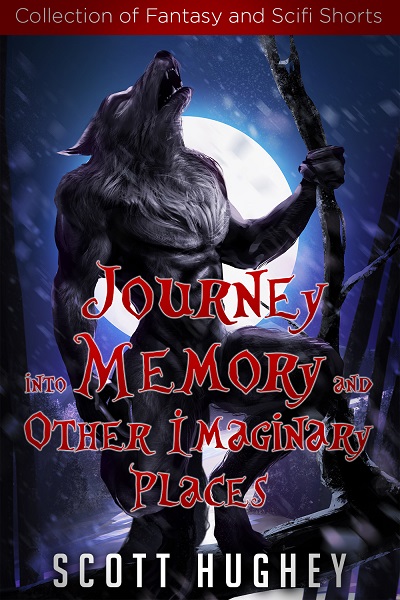
Journey into Memory and Other Imaginary Places by Scott Hughey


What happens when you can travel through feelings and memories like others can travel down the road? And what would happen if a werewolf, a vampire, and a zombie walked into a bar?

Enjoy this collection of fantasy and science fiction short stories, ranging from light-hearted comedy, to dark and poignant sci-fi drama. This collection contains two 100-word stories, for reading in a flash, two traditionally sized shorts, and end with a novelette sized story for a longer read.

This Is Not A Bar Joke- What happens when a vampire, a werewolf, and a zombie all walk into a bar at the same time?

Cheating Death- It’s Death’s first day on the job, and he’s already messed things up.

Don’t Feed the Fairies- A nine year old girl tries to manipulate the tooth fairy, and as a result has to confront her fear of wolves.

Bad News Bear- Ever wonder what really happened to Goldilocks? Surely three talking bears with (apparently) opposable thumbs wouldn’t let her get away so easily.

Journey Into Memory- Kris Lichnev had everything. A beautiful family, a new world to raise them on, and a dream job. In that world, money really could buy love, along with any other emotion, and Kris was one of the few people with the ability to sell. So why did he give up his luxurious life? More to the point, what made him suddenly willing to start digging through those memories again and sale them on the black market?

Journey Into Memory (I’m truncating the title for the remainder of this review) is an anthology containing works of several different lengths and tones. This is Not a Bar Joke is perhaps the most quintessential in terms of Hughey’s comic abilities, but my personal favorite is the longest of the collection — Journey Into Memory. As much as I enjoy Hughey’s sarcasm and often dark sense of humor, it’s his ability to craft intricate, complex narratives that really captivates me as a fan. And Journey Into Memory is nothing if not intricate.

Kris Lichnev is a broken man when we first meet him. He once had everything he wanted — a beautiful family, a dream job, all the things humanity strives for. But an accident ripped it all away, claiming his daughter’s life and his marriage in the process. Now, he wants it back, and he’s willing to do whatever it takes, including selling emotions on the black market.

The story itself is tragic and beautiful and will tug on your heart strings, but the idea of emotion mining, of sifting through memory and collecting the feelings contained within, is downright brilliant. The narrative is structured in such a way that you see both the past and present unfold simultaneously, creating a rich experience that rivals the depth of many longer works.

If you’re a fan of shorter fiction, or looking to discover a promising new writer, I recommend checking out everything by Scott Hughey. I suspect we’ve only scratched the surface in terms of what his talent has to offer, and I, for one, will be waiting not-so-patiently for him to release a full-length novel. In the meantime though, I will snatch up anything he chooses to publish, and highly recommend that you do the same.  Here are the buy links for Journey Into Memory, so you can do exactly that:

Amazon | Goodreads