Dance & Martial Arts; Not So Distant Cousins


It’s officially my favorite time of year– Dance Season! For those of you unaware, I’m an avid fan of So You Think You Can Dance. I literally never miss it. I’ve been to the live tours. I record it and save it for way longer than I should (until my DVR threatens to implode and I have to erase it). I watch Youtube videos of my favorite routines over and over (borrowing more than once from their acrobatic repertoire for my own choreography). And it is my favorite part of the summer, hands down. Can anyone say dorky Fangirl?

This week marked the first episode of Season 9’s actual competition. We’re past all the auditions, the talking, the dramatic tears, the blah blah blah. (I should probably note that I’m not really a fan of Reality TV, contrary to how it may sound.) Now we get down to the meat– the performances filled with spectacular tricks, beautiful choreography, strange concepts and engrossing musicality. This is the part I love. And this season brings an added level of excitement in the person of one Cole Horibe. This guy is my hero. Why? Because he’s proving on national television what I’ve been saying for years– that dance and martial arts are sister styles. Don’t believe me? Check out his LA audition below and see for yourself.

http://www.youtube.com/watch?v=uulp2898mmU&feature=related

Pretty cool, wasn’t it? His blend of martial arts techniques fused with dance isn’t all that unusual though. Or at least, it shouldn’t be. He’s just the first to appear on a TV show and bring it to everyone’s attention. The idea of pairing martial arts routines with music is one that’s long been a staple of the martial arts world, in the form of Demo Teams. (I promise, I’ll give the full definition of these soon). But Cole brings it to the level that I myself prefer, and that few other martial arts studios currently employ. Namely, he utilizes musicality to its full potential, putting the art in martial arts, and bridging the gap between these similar styles of physicality to create a meaningful performance that entertains.

I’m not saying that martial arts and dance were developed similarly– they weren’t. The martial arts were intended to be just that– martial. They were developed as a disciplined regimen of lethal fighting techniques used to defend country, life and honor. Dance, on the other hand, is about self-expression. It’s always been an art form shaped by the era it was born in, the emotional context of the times and stylistic innovation meant to entertain both the dancers and the audience. And nothing illustrates that divide more than comparing the ideals of Ballroom dance with those of martial arts.

But while there are definite differences between these two motion-oriented sports, they are superficial in nature. Ok, some are ideological, but if you strip all that away and just look at the movement itself, you’ll see they’re actually very similar. At the heart of martial arts you have discipline, intense training, focus, hefty muscle memory, rhythm, flexibility, power, controlled movement, balance and a fine-tuned sense of body awareness. (Trust me, you never realize how much you can be aware of every ligament, tendon, muscle and skin surface until you train in something that utilizes all of it in minute detail). Breaking dance down to the same level, you have… guess what? Discipline, intense training, focus, hefty muscle memory, rhythm, flexibility, power, controlled movement, balance and a fine-tuned sense of body awareness. If you look closely, you’ll even notice visual similarities between several dance moves and their martial art counterparts because they rely on the same muscle groups and level of control to execute properly. The only thing dance tends to have over martial arts is the inclusion of creativity. But that doesn’t always have to be the case.

Cole Horibe’s routine is a prime example. No one can look at that and say it doesn’t illustrate creativity. Breaking outside of the expected curriculum is extremely hard for a lot of martial artists, though, and the idea that the traditional forms or techniques can be morphed to fit music is a foreign concept that has the traditionalists screaming “Corruption!” Tradition is fine. In fact, the traditional aspects of Tang Soo Do are what I enjoyed the most. But eventually, performing the same forms, techniques, self-defense moves, etc. can start to feel stale. Adding some theatrical elements, especially for demonstration purposes, gives your training something fresh, and challenges you in a way that repetition doesn’t. It would be like asking a writer to only write non-fiction, never experimenting with the use of language to create a new experience for their readers. Or telling an artist they can only paint the way Van Gogh, Picasso, or Monet did, but never find their own style. And what if musicians suddenly stopped creating new songs, new fusions of styles and sounds? The world would seem rather boring and static, right? So why do the martial arts have to be stuck so firmly in tradition that only the dedicated few with a high tolerance for boredom stick with it past a few years?

My argument for why musicality and creativity are so important to the growth of martial arts is a debate for another day. I’ll just leave you to consider this– how better to impress an audience of non-martial artists and martial artists alike, than to present them with something that blends concepts of entertainment– like music, costumes, story– with technical prowess? Apparently Nigel Lythgoe and the staff at So You Think You Can Dance felt it was an idea worth merit because they put Mr. Horibe through to the Top 20. I, for one, firmly believe that dance and martial arts complement each other, and that together they can create something beautifully inspired. So I intend to show my support for their decision, and vote for Cole every week in the hopes that the longer he stays on the program, the more martial artists he can inspire to think outside of tradition.

Coming Next Week: Demo Teams: A Brief Introduction– where I finally explain what exactly a demo team is and their purpose. Told you I’d explain it soon. 😉

How Does She Come Up With This Stuff?

This is probably the second most popular question people ask me, ranking just below, “Who, or what, is the Nightwolf?” and just above, “Why do you…(insert creative verb here)?” So it seemed only fitting that I take a moment to satisfy this ever-present curiosity.

The simple answer is that all my inspiration comes from music. All of it. I would be severely handicapped creatively if I suddenly went deaf. All my muses would disappear and I’d have to find a new career path to chase after.

Where does the specific inspiration come from? The music itself. I would say that this is where my natural talent steps in, derived from an innate sense of musicality– definition to be blogged about in detail later. The short explanation is that it’s a person’s ability to hear nuances within music and extrapolate emotion (or in my case, stories) from them. (That’s entirely my own definition, by the way, don’t quote me on that.) And it’s a gift more commonly associated with dancers and musicians. But every concept I create is the direct result of this same ability, representing the visual, written, or moving interpretation of the sound itself. A somber, melancholy piece of music will likely inspire a sad, tragic, emotionally heavy story. Something fast with high intensity will likely equal a fight scene or action piece. Haunting and dramatic music? Something creepy and mysterious. I think you start to see the point. The “feel” of the inspiring music has a direct correlation to the “feel” of the idea.

As for where the actual concepts come from…your guess is as good as mine. Did I expect Linkin Park’s “New Divide” to turn into a Sci-fi story featuring shape-shifting liquid aliens? No. Could I have guessed that Havanna Brown ft Pitbull’s “We Run the Night” would spawn a story about a nightclub full of Succubi? Definitely not. And if you had told me that Carly Rae Jepson’s “Call Me Maybe” would spawn an as yet, undefined, cheesy paranormal romance, I would have laughed and said, yeah right. But those are all true. Along with a plethora of others equally as strange. If I had to hazard a guess, I would say they probably come from a voracious appetite for reading a broad mix of genres, a love for good storytelling, an almost pathological need to tell stories myself, and a keen ability to soak up reference material like a sponge, spinning it into new, weird combinations of fantasy, and a strange quirky brain that views imagination through a camera lens. Other than that, all I can say is…practice?

Creativity is a skill. True, some are born with a natural affinity for it, but it still takes time to develop. And my particular reliance on music for inspiration is no different. Just because I lucked out and was born with a slight advantage, doesn’t mean it’s a skill that can’t be learned. Where did I learn storytelling-by-music? Stuck in the back seat of a mini-van 9 hours a week, with nothing but a walk-man to entertain me. This, children, is what happens when your parents decide to live an hour from civilization in all directions. And yes, I did say a walk-man. As in, that archaic device that played 30 minutes at a time on a cassette tape. (Now I feel old. Thanks for that.) Don’t worry, I eventually graduated to a portable CD Player, and have long since traded those in for Ipods.

The point is, I have those long periods in the car to thank for my ability to write, draw and choreograph. So it wasn’t all bad. Except for the car-sickness. That part was always bad. Nothing like an hour on winding roads to teach you how not to throw up.

But back to the music.

I’ve never actually tried to describe my process with words. I’ve always just left it at “music inspires me.” But since this blog is supposed to be about offering advice along with my snarky trips down memory lane, I figured it was time I gave it a try. You will likely think me an absolute freak and in need of psychiatric help after you read this. But it’s my process, so leave it alone. It works. Who knows, some of you out there might even want to try it for yourselves.

Obviously, I start with a song. I call them Spawners, because, you guessed it, they spawn ideas. (I’m sure my penchant for ridiculous nicknames continues to impress you. But no one ever said the inner quirks of an artist’s process had to be brilliant, did they?) Is there a set formula that identifies these Spawners? Nope. They’re completely random, ranging from classical, to movie scores, to pop songs, to dubstep. Some stories require full length CD’s, others a single song. If I really dissect it, I suppose there may be a theme that runs through most of them–somber keys, dramatic drums, multi-layered melancholy. But that’s not a hard and fast rule. Maroon 5’s “Payphone” spawned two stories, for example, and I wouldn’t describe it as fitting any of the above criteria. (It’s also the only one to ever spawn two completely different concepts. So something about it must be special. I just don’t know what.)

The way I know something’s a Spawner is actually kind of weird, and the part most likely to make you think me insane. It’s actually a physical reaction. Now, I know that “feeling” the music isn’t that odd, but just wait, I’ll try to describe it for you. It goes something like this: song plays, catching the attention of my internal ears (think the way a dog’s ears prick when they hear something interesting), goosebumps shiver down my arms and the hair on the back of my neck stands up, the right side of my scalp literally tingles, my eyes unfocus, shifting to peripheral vision, and images start to play in my head, like a daydream on steroids. I don’t know exactly why it happens, or how. Maybe I have a brain tumor, or an aneurism that gets ever closer to exploding when I hear certain notes. Maybe I’m a superhero with a super-evolved storytelling ability. Maybe I’m just a freak. All I know is that it’s a sure-fire signal something creative’s about to happen.

After that initial physical response kick-starts my inner projector, I just wait and the stories come to me. Sometimes I’ll only get a fragment, a brief scene, a still shot of a character or landscape. Other times it’s an emotional context, or thematic element that will run throughout the story. And more rarely, it’s just a character. The layers and nuances of the song become an intricate map of the action, syncing to the story the way a movie score does to a film. The melody itself is my narrator, creating a cohesive storyline that embeds itself into the music so thoroughly, they’re a seamless entity.

Last week I wrote about the idea of  summarizing a story with a single phrase and this is where that actually comes into play for me. I literally have hundreds of ideas– 168 and counting, to be exact– and I can’t possibly remember every detail about every one. I don’t even pretend to try. Some writers keep journals or computer files with notes for all their ideas. My system is more primitive. I keep them all in my head. How is that possible without overloading the hard drive? Because I only try to remember the gist of each story, which boils down to the title and a brief sentence describing the main goal. Each one of those summaries becomes inextricably tied to the music that inspired it. So by the sheer power of association, I never forget. Every time I hear that song or CD, even years later, the story that’s tied to it plays in my head like a movie. Spiffy trick, wouldn’t you say?

Now that I’ve thoroughly convinced you I’m strange, we’ll wrap this up. My intention was never to say that I’m the only creative person who relies on music for inspiration. That’s definitely not true. I think most of us do, honestly. But I also think that after reading this you’ll agree that my process may be a little on the unique side. And if not, please leave me a comment. I’d love to hear from others like myself– help me feel less like a weirdo, you know? At the very least, I’m sure everyone who’s ever asked how I come up with my ideas is regretting opening that can of worms now. Bet they thought the answer was simple. Showed them!

Music Inspires T-Shirt Design“Music Inspires”

by Kisa Whipkey

Copyright 2012
All Rights Reserved

What’s in a Name?

Maybe I’m part Fey, or maybe I’m Rumpelstiltskin’s great-granddaughter, but just like those creatures of myth, I believe names are extremely important.

Or maybe it simply comes from having been graced with a somewhat unusual name myself. Wait, did I say graced? I meant cursed. Doomed to endure countless mutilations and variations including “Keisha,” “Kissah,” “Kye-sha” and my favorite, just plain old “Lisa,” because obviously that “K” has to be a typo. There was even an unfortunate incident with a telephone set-up person, where, after explaining the spelling of my name as “Lisa with a K,” he responded with, “ok, Ms. Withakay, will there be anything else?” Seriously! No joke. I actually do give my name as Lisa now, at fast food places or anywhere they’ll be calling it out randomly, just because it’s easier. As long as I remember I’m answering to that. And who knows, Lisa Withakay might just make an excellent pen-name someday. Everyone needs a good alias, right?

For the record, my name is pronounced “Key-saw.” Difficult, isn’t it? But I respond to pretty much any variation thereof, as evidenced above. I think I already mentioned that it’s Russian for kitten, didn’t I? Well, it is, as confirmed by several people I’ve met who actually speak Russian. And no, I’m not Russian, nor is anyone in my family tree that I’m aware of. German, English, a little Scottish, yes. Russian? Sadly, no.

So how did I end up with this charming pain-in-my-ass name?  Let’s just say this is what happens when soon-to-be parents stumble on those lovely little baby name books in the bookstore. And trust me, after seeing the other options my parents had circled, I ended up with the best one. As much as it has irritated me over the years.

Anyway, back to the topic at hand– names.

Finding a title for a work can be the hardest part, whether it be a novel, a masterpiece of art, or a choreographed routine. It’s one of the first impressions your audience will get, so it has to accomplish a lot of things. Summarize the plot, theme, and overall tone; provide something catchy that will make your work stand out among the masses; create a lasting impression that’s easily remembered; build a sense of mystery and intrigue about your work’s content. And all in just a few short words. No wonder many people find the process of naming their piece a daunting task.

For me, this is a critical part of the creative process, and often, I have a title before I have anything else. Naming something is my favorite part. It’s the moment when whatever I’m working on becomes a thing of substance, its existence clicking into place like the final piece of a puzzle. It’s no longer just a vague concept floating around in my head– it’s a declaration of identity. And I rarely change a title once I’ve found it, whether it’s on a story, an image, or a character.

Others aren’t so lucky, struggling under the burden of working titles or simply leaving something as “Untitled.” And still others completely miss the mark, dubbing their spectacular work with a lame, uninspired, or just plain retarded title that dooms it to obscurity forever. They say you shouldn’t judge a book (or artwork, or choreography, etc) by its cover, but the truth is, everyone does. And the title is as crucial to your work’s success as the rest of the packaging. How often have you picked a book off the shelf solely for its title and cover art? Or browsed Itunes and found new artists solely because their album covers looked cool? Or rented a movie because it had an interesting name? And how often have you done the opposite? Scoffing at something because of a lame title, stupid cover, or lackluster blurb? I think you see my point.

So what’s in a name? Everything!

Which is why you should spend as long as it takes to create the perfect title for your piece, whatever it may be. I’m afraid there aren’t any sure-fire techniques I can share for how best to choose a title, though. I’m sure there are others out there who would gladly try to tell you the correctness of their own process, but I believe creativity is too personal for that, and every artist, dancer, martial artist, writer, musician, has to find their own way of doing things. What I can offer you is a succinct version of how I go about it.

I remember reading somewhere, (and I apologize that I don’t have a direct quote for you), during my research of Disney’s story process, that they try to sum up each film’s plot in a single sentence. Being the complete fangirl I was back then, I thought that was a brilliant idea, and adopted it for myself. It’s actually a lot harder than it seems to boil a complicated premise down to a simple sentence, but eventually you get good at it. How does this pertain to titles? Well, once you can summarize your work with a single phrase (and this generally works best for writing, although it can apply to the concepts of art and choreography too), you can take it one step further and chop it down to only a few words. Something that single-handedly conveys the heart of your piece to your audience. Sometimes that will be the name of your main character, sometimes it will be an integral theme central to your work, sometimes it will be a metaphor summarizing the subtler messages you’re trying to convey. There are no hard and fast rules. The important thing is that it be inseparable with the larger work.

As an example, I’ll dissect the names of my three published short stories and show you the thought process behind them.

The Bardach” was named for the race Amyli (Nameless) comes from. They’re a central key to that world because they have the link to its gods. All the conflict revolves around them fighting against the Mages who want to destroy that link and corrupt the gods for their own purposes. Since they are essentially the heart of the story, it seemed fitting to name it after them. Plus it’s a short, interesting title that might make someone click on the link, buy the magazine, or read the excerpt.

Spinning” has a more complicated meaning. It refers to the sect of people Taylor becomes part of, but it also refers to the ability to morph time that they all have, so named because it literally spins the world around them. It also refers to the emotional turmoil Taylor feels throughout, as his world is completely turned upside down, inside out, and sideways. He’s left with a confusing mess of half-answered questions, and is emotionally off-kilter for the entire story– spinning as it were. It’s also a subtle tip-of-the-hat to the inspiring song by Jack’s Mannequin of the same name. Most of these connotations a reader wouldn’t grasp until after reading the piece, (and some they might never know), but it adds layers to the title for them to discover along the way. Plus, it’s short, to the point, and hopefully mysterious enough to draw someone in.

Confessions” has a dual meaning. It actually does refer to the characters confessing hidden truths, so it’s perhaps one of the more literal titles I’ve used. The thing that makes it interesting is its mysteriousness.  Its vague meaning hopefully makes a reader want to know what’s being confessed and would get them to buy the story to find out. But it’s multi-layered enough that they’ll get the full meaning only at the end. I can’t disclose much about this one without giving away spoilers, so I’ll just say that the obvious confession (Constia’s) isn’t the only one the reader comes across. Plus “Confessions” seemed like the perfect title for a story about losing faith.

Now, my process may not be your process, and that’s perfectly ok. The goal here was to get you to reconsider your own creative process in regards to titles. The lesson in the above examples is that what appear to be simple one or two word statements, are actually layered with meaning and perfectly embody the message of the piece. Which is the ultimate goal of a title, isn’t it? (If you answered “no” to that, then I think you seriously need to reappraise your opinions of titles, and why did you bother to read this whole huge novel of a post? Just saying.) However you go about finding your names, the important thing to remember is that they are just that– important. Don’t spend months or years of your life on a project and then give it a half-assed name. You poured part of yourself into that thing! Give it enough respect to name it accordingly. You’ll be surprised how effective a marketing tool a simple title can be. It may just be the difference between massive success, and complete failure. And I don’t know about you, but when so much hangs on a single decision, I think it deserves a few extra moments of my time to get right.

Who, (or Rather What), is the Nightwolf?

I get this question a lot. So in the interest of heading off that curiosity before it floods my inbox with repeated queries, I figured I’d explain for all those secretly dying to know. Which I would guess is currently no one, based on the silence from my Contact page. I was going to put it in my FAQ for those few who might be interested, but as I was writing, I realized it was a longer story than was appropriate for that location, and I wasn’t satisfied with the shortened version. So here goes.

(Warning: Self-Indulgence Alert! The following information is solely about me and will provide no insights into anything but my thought process. Sarcasm will still be included, but if you were looking for tips on writing, art, or opinions on whatever, this week probably isn’t for you. If you choose to skip it, I won’t be insulted. Much.  😉 )

Contrary to popular speculation, the Nightwolf is not me. Well, not in the sense of a pen-name or nickname. Although, to be fair, I have used it that way before. But no, I don’t typically run around printing Nightwolf on those little red & white “My Name Is” badges. Not if I’m trying to be serious, anyway. If I want to be an anonymous jackass, sure.

Nor do I suffer from a Jekyll & Hyde situation, becoming a homicidal werewolf when the moon is full and wreaking havoc on downtown Vancouver. At least, not that I’m aware of. I haven’t seen any news articles about random wolf attacks, so I’m gonna say we’re safe.

It’s not the name of my car (popular theory #2 thanks to the windshield tag and vanity plates that scream it to the world), which has only ever been black while sporting those plates once. And I only wish I was lucky enough to have that be the translation of my name, which is Russian for “kitten”, in case you were wondering.

No, the Nightwolf is a character I created when I was 11, dreaming of owning an animation studio that rivaled Disney. The origin of the name? Well, he’s a black wolf. Brilliant, I know. But what did you expect from an 11 year old?

Originally, he had no personality, or even a gender, although I’ve always referred to him as a he. Maybe he is some version of an alter-ego….a masculine, lupine, super-hero side whose mission is to save the world from lack of creativity? Nah, more likely I was just influenced by the super beefy, anonymous, white wolf in Balto that made me want to animate. Ironically, later movies have shown that wolf to be female, but I still think it’s a dude. That’s one burly girl otherwise.

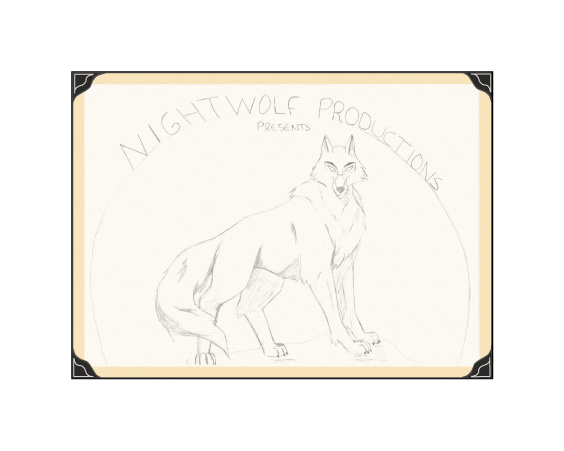
Anyway, he wasn’t a full-fledged character. As I mentioned above, he was a one-dimensional creature whose sole purpose was to announce the beginning of every movie Nightwolf Productions (the name of my fictitious studio) released. Like the castle image that opens every Disney film, or the animated lamps that herald the start of a Pixar masterpiece. And true to the nature of a logo, it was super complicated. It featured the Nightwolf standing on a cliff, backed by an impossibly large moon. He howled, then turned to face the audience, unveiling the glowing yellow eyes that are his trademark. The company name would illuminate around the edge of the moon and the movie would start. Impressive, right? But, again, did you really expect cinematic genius from an 11 year old?

Eventually he started to evolve, as I realized I wanted something decidedly less bland that would set me apart, transforming into a Living Logo, as I dubbed it. Meaning he would still grace the beginning of every movie, but be integrated into the opening sequence instead of just a static logo tacked on the front. I started to think of him as an omnipresent god of storytelling that dictated what the audience got to see. This was before Dreamworks and Pixar burst onto the scene with their ever-changing logos and subsequently shattered my hopes at originality. But it does show the first flicker of what the Nightwolf would ultimately become.

At this point in the timeline, I was around 18/19/20, and wrapped up in all the emotional drama that entailed. Testing my wings of independence and failing miserably. Trying to find my way through 4 different colleges, and about 5 different majors. Moving out again, then crawling back home with my tail between my legs when that blew up in my face too. You know, all the joys that being a young adult brings. The only constant was my dream of animating/writing/drawing/whatever-as-long-as-it-was-creative. A dream that was embodied by the Nightwolf.

Fast forward to 2005/2006 and the realization that I was short-changing one of the most important characters in my repertoire. Of all the hundreds of thousands of characters I’d created, the Nightwolf was definitely the flag-ship. And I had relegated him to the background. Doomed him to be nothing more than a pretty image without substance.  But he was more than that. He did have an actual story and deserved to have it told! I decided then, that his would be the tale to launch my writing career, just as he had fanned the flames of my animation dreams so long ago. And I’d had enough questions about whether or not Nightwolf was the name of my car, by then, to irritate me into action. A girl can only repeat herself so many times before going postal on some innocent who made the mistake of asking, after all.

My first attempt was actually a poem. Why a poem? God only knows, because I don’t write poetry. Ever. And true to form, it was atrocious. But it introduced the idea that the Nightwolf was a supernatural creature that could be sought, a guardian over the realms of creativity. Sound familiar?

Round two was a marginally better written short story. It was told in first person and centered around the never-identified narrator choosing to become the Nightwolf’s anchor–a link to the “real” world that allowed him to move freely from his realm to the realm of humans. Which led me to realize that to tell his story properly, he required a partner, a woman whose identity was essentially void–Nameless. I’m not really sure exactly where the idea came from, aside from a token nod to Nemo by Nightwish and Main Title by Christophe Beck from the Elektra Soundtrack, but finally, through her, the Nightwolf had a voice.

There was only one flaw with Nameless, (ok, only one notable flaw, anyway); it was boring. Written in overly flowery prose, trying too hard for atmospheric awesomeness and completely devoid in plot. (My writing group co-founder can attest to this.) But I refused to give up on the concept. Even though several iterations and quite a few resounding “no’s” from magazines whispered that maybe it wasn’t a premise worth pursuing.

Which brings us to The Bardach.

About 42 revisions later, (including at least one complete overhaul), a massive boost in plot, a few new characters and a definitive explanation of both Nameless (aka Amyli Farenscal) and the Nightwolf, and I finally had what I was searching for–a story that was as interesting to the rest of the world as it was to me. Or so I tell myself. Please don’t burst my bubble either.

After attaining the seal of approval from my writing group partners, I sent The Bardach (also a short story, by the way, but significantly longer than Nameless) out into the world of publishing. This wasn’t my first foray into the jungle, as I’m sure you gathered, and I already had a hefty stack of rejections for my previous, admittedly weak, attempts. So I was realistic and  expected nothing, while secretly hoping that this time would be the one–the time I got published.

And it was.

True to prediction, the Nightwolf  paved the way for my writing career to finally get off the ground. Marginally. I remember staring at that coveted acceptance letter, unable to comprehend what it said until someone else read it for me. You’d think I’d been accepted to Harvard or won the lottery or something. But I’d finally done it. I’d published something. Which meant that at least one other person thought the Nightwolf’s story was worth reading. Not a family member, who has to like what I write out of obligation, or my writing group partners, whose encouragement is kind of the point of writing group, but an Editor. One of those notoriously fickle creatures that can single-handedly decide whether you suck as a writer or not. It was even deemed worthy enough to grace the cover of Shelter of Daylight‘s inaugural issue, an honor I’m eternally grateful for.

But The Bardach was only a small glimpse of the Nightwolf’s story, an introduction and precursor to the full-length novel I hope to finish one day. In the meantime, though, he still serves double-duty as the logo for my barely-there freelance art career and continues to grace the top of my windshield like a racing tag. So you haven’t heard the last of him. Who knows? Maybe his novel will be the one to land me on the NY Times Bestseller list. Someday. If I can ever get out of the mire of my current novel-in-progress, (which has absolutely nothing to do with the Nightwolf, just FYI).

And that, my friends, concludes the rather long-winded history behind “Nightwolf”. Succinctly put, he’s my muse. And I could’ve just said that in my FAQ, but would you really have understood what it meant without all the back-story? You probably would’ve just thought me insane, and possibly Schizophrenic, hearing voices for a personality that doesn’t exist. And that’s an impression I wasn’t keen on leaving. I have enough shades of crazy without adding Multiple Personality Disorder to the list.

(End Self-indulgence Alert. We can now return to our regularly scheduled snarkiness. )

The Original Nightwolf Productions LogoThe Original Nightwolf Productions Logo Sketch

by Kisa Whipkey

Copyright: 1999
All Rights Reserved

Why Do You…(Insert Creative Verb Here)?

This is probably the most asked question of creative people–sometimes even by other creative people. And it’s one of the more irritating ones, because it’s such a hard thing to quantify. It’s like asking someone why their eyes are blue, or why they were born in the morning. How do you answer that? So, understandably, the answers to why someone’s creative vary wildly depending on the person. You’ll hear things like,

“I’m not sure, I just do.”

“Because it makes me happy.”

“Because it’s therapy for me; it helps me express myself.”

And my personal favorite, “I do it for me.”

Now the truth is, all of these answers are sugar-coated, watered-down replies meant to make the artist look more artsy; to make the listener think, “ooo, aren’t they cool? They’re so mysterious and vague.” Personal satisfaction is great, but you go to the gym for personal satisfaction, you don’t pour weeks, months, years, heart and soul into a project just for personal satisfaction. I mean, don’t answers like that just seem so full of themselves? Why narcissism is encouraged within the arts is beyond me, but the more self-involved the answer, the more prestige points an artist receives. And the more frequently you’ll hear responses like the above.

Personally, I view every one of those answers as a cop out. Because ultimately, statements like that are rarely true. And before you get up on your high horse and scream “controversy!” while flooding my comment box with all the reasons I’m wrong, hear me out. If creativity is such a personal thing (which I’m actually not arguing, because it is), why would anyone share its products? All those artists, authors, and musicians that claim they only create for themselves are lying. The proof is in the sheer fact that they made said creation available for public consumption. If it was truly just for them, it would be stashed in a vault somewhere, guarded by large, vicious dogs and fiercely protected until it’s location was lost in the afterlife. Not put on public display for all to judge. But that’s not the case, is it? Because these artists shared their work with the world.

(The only exception may be personal diaries and journals, which are never truly intended to be shared, but in reality, are almost always found and read anyway.)

When I’m asked this question of why I (insert creative verb here), I have a generalized, self-important, prosaic answer that I’ll give. (Who doesn’t want to earn some prestige points?) I simply say that the reason I (chosen creative verb of the moment) is that I never realized not (doing said creative verb) was an option. And this is partly true. Creativity just came naturally. Like breathing. But just like the answers I listed above, that lovely little sound bite, while somewhat accurate, is not the real motivator behind my masterpieces. (See? Don’t I just automatically sound more brilliant because I called them that?)

The brutal, honest truth is something none of us “Artistes” like to admit, because it makes us seem desperate and needy, and those two adjectives are a far cry from cool and mysterious. We don’t want to be put in the same category as your psycho ex that Facebook stalks you. But the reason all those artists, authors, and musicians are trying to hide from, is we create because we want validation. Public approval. Fame, Glory and all that jazz. Just like when we were little kids and we ran to Mommy looking for approval on our latest blob of mismatched crayon wax with no anatomy whatsoever that we were certain looked like the cat, waiting for the glowing ooze of motherly love to pour over us, we offer up the fruits of our labor to the public eye. With the sole intent of being lavished in praise about our awesomeness.

When you think about it, it’s not really that hard to see why this is the real motivator behind creativity. It’s the same reason that we post status updates several times a day and then check back obsessively, waiting for those little thumbs up signs to appear that means someone likes us, someone agreed. We’re cool. It’s human nature to seek praise from those around us; it makes us feel good, worthwhile, valued. Does that mean all artists are shallow, attention-seeking ho-bags? No. Do we all secretly want to preen while you sing our praises and tell us how awesome we are, so we can humbly pretend we didn’t already know that? You betcha.

Ultimately, though, it’s about receiving feedback of any kind, (although preferably of the worship-my-brilliance variety) that motivates us to hit that upload button, to submit that manuscript, or to step out on that stage. It’s often said that creativity doesn’t happen in a vacuum. And I 100% agree. Without that input from others, your creative side will shrivel and die like a thirsty plant locked in a closet. Which is why, whenever someone answers with the angelically selfish response of , “I (whatever) for me,” I find myself annoyed. Why is it ok to feed your narcissitic ego by pretending that success means nothing to you because you don’t care what anyone else thinks, but not ok to admit the truth? You did it for the same reason I do–to feel good when others tell you your creation is something wonderful.

And for those out there that feel this question is a perfectly legitimate conversation starter, it’s really not. You’re just going to be lied to. Few of us will man up and admit, “I did it to be rich and famous, duh.” You’re much better off asking questions that actually have quantifiable answers. Things that ask why we do things a certain way, or what did we mean with X, instead of something as innocuous as why do you create?

Hey, nobody said honesty always had to be pretty. And I did warn you that snarky rants were a definite possibility. But let the barrage of offended comments commence anyway. 😉