
Featured From the Archives: What is “Flow”?

Next week, I’ll be participating in a panel discussion on editing and “voice.”  (It’ll be at the NW Bookfest Conference, if you happen to be attending.) “Voice” is one of those oft-touted, rarely-defined writing terms, and as I work on compiling my thoughts on it, I figured we’d revisit another tenuously defined term — “flow.” I’ll post notes from the panel (well, mostly the material I present) for those of you who won’t be joining us there, but for now, let’s start the discussion off with . . .
 

What is “Flow”?

by Kisa Whipkey

Originally Posted on 10/19/12

 
Stop the snickering and dirty jokes, I’m not talking about that type of flow. 😉

I stumbled on an interesting and rather heated discussion this week (as most conversations involving the dissection of writing tend to be), about the use of “flow” as a literary term. The forum seemed pretty evenly divided between writers that absolutely despised it and felt it should never be used in a critique (an argument that instantly smacked of stereotypical writer pretentiousness), and those that felt it was a valid descriptor (instantly hailed as amateurs by the snobby residents of the Anti-Flow brigade). And it got me thinking. What exactly is literary flow?

Technically, “flow” isn’t recognized as a legitimate literary term — go ahead, Google it. I did. You’ll find it’s omitted from nearly every list of valid literary terms. Yet it’s probably one of the most frequently used words when discussing someone’s work. I know I’m guilty of using it — you can find it’s offensive four letters listed among the things I look for when freelance editing. So how did it become such a firm presence in our literary vernacular if it doesn’t technically exist? And why is using it tantamount to dropping another four letter word starting with “F”?

My theory is that it’s because no one really knows what it means. Is it referring to the structure of the piece as a whole, the “flow” of the words themselves, the pacing, what? It’s this vagueness that makes feedback including it seem awfully similar to:

“I loved it!”

“This sucks. I hated it.”

While those are, I suppose, acceptable reader responses, they fail to tell the writer anything useful, namely — why? In order for any critique to actually help the author, it has to explain why the reader felt the way they did, and what they would have liked to see different or not. Telling us that our work is lame, that you think it’s utter crap, or on the flip-side, that it’s the most amazing thing you’ve ever read ever, really doesn’t help us improve or repeat the success. Telling us why you hated it, or loved it, is like feeding a starving man — it’s what we really care about. Nothing will get your opinions ignored faster than failing to quantify your experience as a reader. I believe this is why “flow” causes such a divide among writers — it gets thrown around like it’s a brilliant little gem of insight when really it’s just unhelpfully frustrating.

I don’t agree that it’s a bane to literary terms, though. Actually, I think it’s a perfectly valid starting point for a critique, as long as the reviewer goes on to define it. The definition is crucial, because “flow” is one of those terms that can mean about a million different things to different people.

For me, “flow” is synonymous with “smooth.” When something flows, it should have an effortless feel that allows me to forget the words and really immerse myself in the story. It’s a visceral sensation of rightness that you only really notice when it’s disrupted. I tend to imagine storyline as a thread running through the center of a piece. Ideally, that thread should be smooth and straight, holding everything tightly in place. When that happens, the story “flows.” But if the thread gets crinkled up in a tangent, veering away into a knotted section of confusion, or frays into several disjointed, broken paths, the story’s flow feels off. Much like the way a river flows toward the sea, everything in the story should flow toward the final goal. This is part of why you need an editor, or critique partner, or random-person-off-the-street to read your work. Authors are usually too close to the story to be able to catch these flaws in the thread. But your readers sure will. They may not know exactly how to define it, but they’ll feel it.

I use “flow” to start a conversation about the structural integrity of a piece, but I can think of at least two other ways in which it could be defined. Let’s put that to the test, shall we? In the comments below, tell us what “flow” means to you. And please refrain from derailing this into the gutter. This is a serious, (ok, semi-serious), literary discussion, and I do have the power to decline your comments (Mwahaha!). So family-friendly only, please. 😉

Featured From the Archives: The Anatomy of a Successful Short Story

Reuts Publications announced the impending return of their Nano-inspired writing contest — Project REUTSway — this week. Which means that (hopefully) there is a horde of eager writers rubbing their hands together in anticipation. (If you’re not sure what I’m talking about, be sure to click above and sign up for the VIP notification list.) It also means that those same writers will be sharpening their proverbial pencils to craft — in rapid-fire succession, no less — four brand new short stories. So what better time than now to dredge this post up from the archives?

Anyone planning on entering PRW (as the REUTS team affectionately calls it), listen up. Here are three things you’ll want to keep in mind as you strive to impress the judges (*ahem* me *ahem*). Let me hand you the key to success on a silver platter; you’ll thank me later. 😉
 

The Anatomy of a Successful Short Story

by Kisa Whipkey

Originally Posted on 12/13/13

 
Short stories. Some people love them, others can’t stand them. But no one can deny they’re an entirely different creature from novels.

This week, I’ve been judging entries for the ProjectREUTSway competition held during the month of November. Buried amid 144 short stories, I started to think about what exactly makes one “successful.” I think most of you know by now that I, myself, published three, so this is a topic that hits very close to home. It’s also one I’ve never really stopped to think about. Until now. Because, let’s face it, short stories are strange. Similar to novels and yet completely dissimilar, they require a certain — almost magic — recipe to really shine. I don’t believe in the undefinable though (at least not when it comes to writing), so let’s see if we can’t identify the exact ingredients that make short stories such a unique form of storytelling.

Short stories are often considered a novelist’s training wheels, the idea being that someone can learn the basics of storytelling through short stories and then graduate into novels. But that’s not exactly what happens. Because, in reality, they require two different skill sets to pull off well. A short story is not a truncated novel, nor is a novel an elongated, rambling short story. Rarely can the concept for one be turned successfully into the other. And yet people still try. Why? Because short stories have been given a bad rap. Novels take all the glory, leaving short stories to rot in creative writing jail like fiction offenders. They’re looked down on as an inferior form of narrative, an eighth grade diploma to the novel’s PHD. After all, the only difference between them is length, right?

Wrong.

There are three things a successful short story must have: brevity, focus, and telling. Yes, you heard me, telling. But before you get your knickers in a bunch, let me explain further.
 

1. Brevity

 
Novelists are taught the value of brevity. But even the most refined novels still sprawl, meandering through details and settings and other things short story authors simply can’t afford. Literally every word matters in a short story. No detail is extraneous. If we mention the light blue collar on a random cat, you can bet that collar is important somehow.

The same holds true for the words themselves. Novelists are allowed to write sentences like this:

She paused, grabbing the handle of the stainless steel refrigerator and pulling it open with a subtle flick of her wrist.

(Hey, no comments on the quality. Clearly, I know that sentence is atrocious. I’m proving a point. 😉 )

That’s 21 words to say this:

She opened the refrigerator door.

Yes, that may be a bit exaggerated, but you see what I mean, I hope. When you only have maybe 5000 words of space, every letter has to serve a purpose. Successful short stories know this, and the language/storytelling is as finely honed as a scalpel. If it doesn’t somehow move the plot along, impart valuable information, or absolutely have to exist, it doesn’t.
 

2. Focus

 
I’m a firm believer that every story should have a message, a reason for existing. But maybe that’s because I started out as a short story author. Whenever I come up with an idea, I identify the core message first, before the setting, characters, or even plot. For example, The Bardach is a story about identity, Spinning is about fate, and Confessions is about losing faith. Even Unmoving has a focal point. At its core, its about compassion. This type of focused narrative is one of the more notable differences between a short story and a novel.

Short stories are single-minded. Like a starving man spotting food, they keep their eyes on the prize. None of this wandering off into detours, flashbacks, subplots or other shenanigans that novels get away with. Nope, they have one message, one plot, one climatic moment that everything points to. And, interestingly enough, short stories are typically driven by an event, rather than a character. The focus is on the action, not the person doing it.

How does this translate into our recipe for success? Well, you’ll be able to feel the underlying drive in a really good short story. You’ll walk away from it remembering the message, not necessarily the characters. So make darn sure you know what you’re saying, both literally and subtextually.
 

3. Telling

 
All right. I know this is the one you were waiting for. After all the times “show, don’t tell” has been beaten into your head, you simply can’t believe I’d actually stand here and advocate telling, can you? Well, I’m not really.

See, the thing is, showing is still 100% better than telling. But, telling is allowed in a short story. Due to the limited amount of time you have to impart your narrative, there’s really no way around it. You don’t have the luxury of wasting thousands of words, or even hundreds, showing us the back-story. Nor can you illustrate anything directly outside the timeline of the main event, regardless how important it may be. So that only leaves one option — telling. You should still avoid the dreaded info-dump if you can, but slipping in the occasional line of summary, or a paragraph of back-story, won’t automatically earn you peer derision. Well, most of the time, anyway.

Successful short story authors are masters of knowing when to tell and when to show. (Which, by the way, I am not. Just wanted to clarify that in case anyone thought I was going to be cocky and throw myself on that list.) They give you just enough information — typically in the form of telling — to make their worlds/characters feel as fleshed out as a novel’s, but not so much that you really notice. They cover a lot of ground in a really short amount of time, making this the hardest skill on the list. It actually requires mastery of the other two to pull off, which is why I listed it last.

And there you have it; the anatomy of a successful short story. Learn how to control these three elements and your short fiction will stand out in a pile like little beacons. And let’s all try to stop viewing short stories as the lesser form of fiction. They’re not inferior. Just different.

Serial to Series, and Self-Pubbing by Accident

The following is a guest post (and part of the blog tour for her self-published novella that I’ll introduce at the end) by my good friend and fellow editor, Cait Spivey. It’s excellent information, as usual, but stay tuned after the post for some special announcements and cool reveals regarding Cait’s non-editorial efforts. I don’t want to take up too much space, so without any more preamble, here’s Cait!
 

Serial to Series, and Self-Pubbing by Accident

by Cait Spivey


I always considered myself a traditional publishing kind of girl. I figured I’d be happy to do a little marketing, get myself out there to events, and schmooze, but would prefer to have the support of a press to help me along. Self-publishing was fine and dandy, but not my speed.

Fast-forward a year or so into my publishing journey. I’d been querying a high fantasy to agents – -angling for that New York deal — with good interest but no contracts, and working on some other side writing projects. A sci-fi inspired by the “what if the Doctor were female?” question. And a little story about a girl being stalked by spiders.

I liked this little story. I liked the main character, Erin, whose voice came to me so easily. I’d originally planned it to be a full-length novel, but as I wrote, it became clear that this wasn’t a novel. It was the groundwork for something much larger.

So I finished it at almost 17,000 words, and wondered what the hell to do with it: too short to query, too long to be a short story. I thought about cutting it down and sending it to literary magazines, but there was no way to cut 10k  words without completely changing the story. I thought about expanding it, but the ending was utterly fixed to me, and while I could have come up with more to pad the rest, it would have become out of proportion to the climax.

One of the presses for which I edit, Curiosity Quills, offers a few serials through their website, as does Kisa, my gracious host for today, and a number of other writerly friends I’d made. So I got the idea: why not put my spider story on my own blog? Otherwise, it was just going to sit rotting on my hard-drive.

I mocked up a little cover featuring a beautiful spider photographed by my friend Jo (http://thebrokenshelf.com/), scheduled all nine posts, and off we went. As the end of the run drew near, I thought it might be nice to have the whole thing available for download, as like a pdf or something. So this past March, I formatted I See the Web, made myself a less spider-rific cover that better represented the story, and uploaded it to Smashwords for free download when the serial run was over.

Then I realized: I’d self-published it.

And I’d done so with barely a scrap of marketing or other pre-launch build-up. Still, the book was downloaded pretty steadily, so after about a month of having the book up for free, I published it to Amazon through KDP and changed the price to $0.99.

I turned away from I See the Web and focused on other projects for a little while, but my little novella was still out there, still trucking along. As those other projects got more serious and as I made definitive decisions about my goals for the future, I decided it was time to come back and give Erin her due. If I wanted the book to do well, and if I wanted to bring attention to the sequel I was writing, I needed to give a proper marketing effort.

The result is this blog tour and cover reveal.

To say it’s been a learning experience would be an understatement, and if I can impart any advice, it would be this: have a plan ahead of time. While my experience with I See the Web has pretty much worked out, the past few months would no doubt have gone a lot better sales-wise if I’d thought ahead, made deliberate choices, and set specific goals.

Another important piece of advice: don’t treat any of your work as a throw-away. The reason I didn’t do much planning with I See the Web is because I thought it was going to be just a one-off, something unconnected to the rest of what I wanted to accomplish. Totally untrue! Not only is it my first published work, a place nothing else can ever supplant, it’s also become the anchor for a far-reaching series of loosely connected books, novellas, and short stories within The Web’s universe. While reading I See the Web won’t be necessary for any of those other stories, it will add to those reading experiences.

There are plenty of publishing paths available to authors these days and, for the most part, one is not better than any other. It may take some time to decide which one is right for you and your project, and that’s okay. But you can’t let publishing sneak up on you.


Pretty sound advice, no? I think a lot of us (myself included) could benefit from her lessons. I know I have a tendency to forget about certain projects, deeming them less worthy than others of time in the limelight and/or love. But she’s right; they’re all part of my writing career and deserve the respect of my attention.

But I promised goodies and reveals, and since I don’t have any for my own work that you don’t already know about, I’m happy to introduce you to Cait’s. First, here’s the information and buy links for I See the Web:

I See the Web by Cait Spivey

Seventeen-year-old Erin has a lot to look forward to, even if it suddenly seems like everywhere she turns there’s a spider staring at her. She’s finally out to her friends and family, surprising exactly no one. When Dawn, the love of her tender teenage dreams, corners her in the library, a whole new world opens up to Erin. From here on out, it’s all make-out sessions with her beautiful girlfriend in rooms stacked high with books.

Until the spiders start whispering.

Turns out the spiders aren’t just stalking her for kicks. They need her to be their voice, their vessel, whatever that means. But their timing is crap, because there’s no way Erin is giving up her human life just when things are starting to get amazing. Too bad the spiders just won’t quit. Like it or not, Erin will have to choose, and it won’t be nearly as easy as she thinks.

Amazon | Barnes & Noble | Smashwords

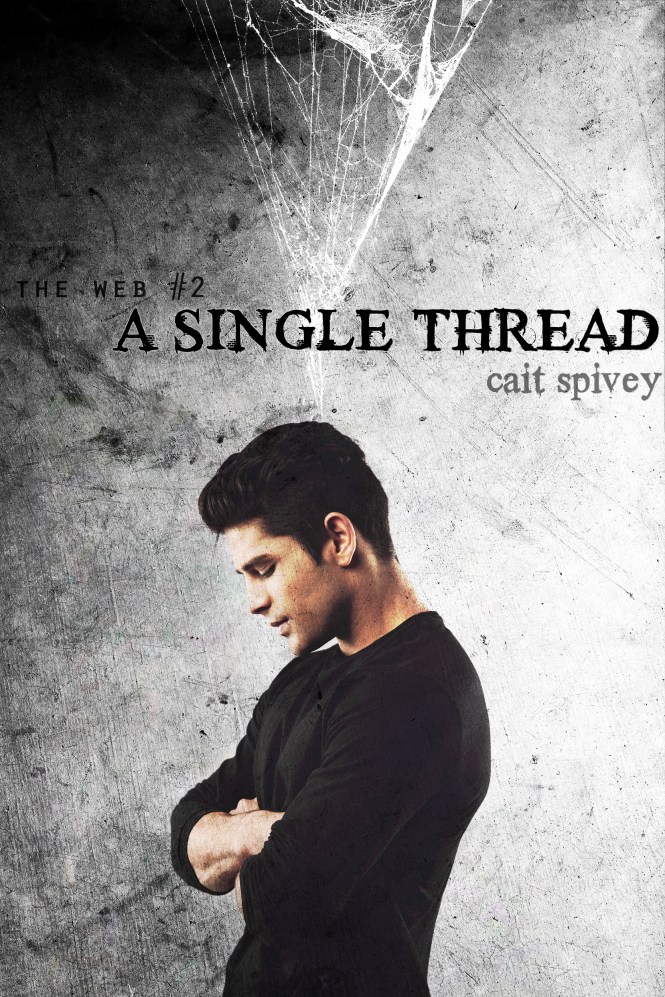
And now, I’m thrilled to help reveal the cover for I See the Web‘s highly anticipated sequeal, A Single Thread:

A Single Thread by Cait Spivey

It’s been two weeks since Morgan Fletcher’s little sister, Erin, disappeared before his eyes in a flurry of spidersilk and blood. Probability says she’s dead; but when Erin comes to him in a dream, Morgan’s eyes are opened to a level of reality where probability doesn’t mean jack. His sister sees the web of time, and she’s got news for him: trouble is coming.

A cryptic riddle and flashing images of the future are all Morgan has to go on in order to save a mystery boy from a gruesome death. That’s if he even believes what’s happened to Erin. Is her spider-whisperer persona for real, or has his grief at losing her caused him to totally crack?

With a life at stake, Morgan isn’t taking any chances. Madness or no madness, he has to solve Erin’s riddle before it’s too late.

Releasing October 31st, 2014

And, because that’s not enough to convince you that Cait’s awesome and you should totally go support her, here’s a ridiculously amazing book trailer for A Single Thread:

Featured From the Archives: Inspiration is a Fickle Wench

Ah yes, my post about inspiration, or rather, the lack thereof. As I stared blankly at the titles in my drafts folder this week, waiting for something (anything!) to spark an idea, I realized that this post would be oddly fitting. It’s also fairly old, so there’s a good chance it will be new to a lot of you. Given my complete lack of inspiration this week (I’m serious, I think my muse died, or decided to flit off to her beach with the cabana boy again), it’s safe to say this is better than anything I could have managed to drag, kicking and screaming, from the depths of my brain. It’s at least somewhat humorous, and I bet a few of you out there will be able to relate. Enjoy!
 

Inspiration is a Fickle Wench

by Kisa Whipkey

Originally Posted on 8/10/12

 
Have you ever had those days where you suffer from a complete lack of inspiration? Where you feel like a creative well that’s run dry? Yeah, me too. In fact, it happens more than I’d like to admit. For someone plagued by the never-ending breeding of plot bunnies, I have a remarkably hard time finding the motivation to actually write. Oddly, the most sure-fire way I have to motivate myself is to declare to the world that I’m not writing. (Sorry, writing group buddies. Sometimes I have to cancel just so the muses in my head will freak out, screaming, “No! You can’t write absolutely nothing this week!” and finally show me the path to the next scene they were greedily withholding.)

But inspiration doesn’t just apply to writing. We need it for all things creative. It plays just as much of a role in creating a masterpiece of art, or choreographing a moving sequence for demo team. And some days, it’ll simply refuse to come when you call it.

I find the idea of inspiration a fascinating thing. Where does it come from? Is it an invisible lightning bolt that shocks our imagination to life the way a defibrillator brings our hearts back from death? Is it a gift from some higher power, sending waves of creative energy coursing through us like sunlight? Is it the whispered voice of a muse dressed like the women of Greek mythology? Or is it just some random combination of neurons firing that creates a delusional escape from reality? Honestly, I don’t know. I’m not sure anyone does. But I do find it intriguing that when a writer talks about hearing “voices,” they’re considered brilliantly touched by inspiration. When anyone else says it, they’re considered mentally ill.  What separates inspiration from insanity? The final product? Who’s to say that people with schizophrenia or brain tumors warping their neurological pathways aren’t the most in tune with that magical force we call inspiration. Or that those of us who claim to rely on it for our careers aren’t actually suffering a slight mental meltdown. Interesting stuff, isn’t it?

All I know about inspiration is that it rarely shows up when I want it to. Case in point, I’m now suffering through week 2 of the current inspirational drought. This wasn’t even the blog post I had scheduled for today, but I was too uninspired to finish the original one. Which made this the perfect week to muse about the elusive nature of the muse, so to speak.

I’ve mentioned a few times that I find inspiration through music, going into rather lengthy, and probably creepy, detail about it here. I’m not sure why that’s my avenue of choice, but it’s always been that way. Maybe I’m mooching off the creative brilliance imbued by the composer/songwriter. Maybe I’m gifted with a finely tuned sense of musicality, and I can find stories through the nuances and layers of musical instruments the way others can through dreams or spoken words. Maybe I’m just nuts. But regardless of the reason, that reliable source of  melodic inspiration only seems to cover the initial conceptual phase. It gives me the base-line, the foundation on which I have to build, and more plot bunnies than I could ever write, even if I was lucky enough to be a writer that could finish a novel in a few months. When it comes to the actual creation part, the nitty-gritty work part, I’m left to suffer the whims of inspiration like everyone else.

Every writing website, advice article, author/artist blog out there will tell you that creator’s block is a myth. That it’s just an excuse for being lazy, for procrastinating, for giving in to your fear of failure, or for a plethora of other reasons. They’ll all tell you that you just have to power through those days when you’re lacking inspiration. That you have to discipline yourself to create every day. That you can’t wait for the muse to come to you, for the weather to align perfectly, for the fourteen cups of caffeinated beverage to kick in, or for whatever that magic combo is that ignites the fires of inspiration for you. And they’re probably right.

I, however, can’t force it. When I’m not feeling inspired, I end up with this:

“Blah, Blah, more Blah, Blaaaaaaaaaaaaaaaaaaaaahhhhhhhhhhh! Stuff and things. Blarg. Grrrrrrrrrrrrrrrrrrrr. Oh, and more Blah.”

How would you like to read an entire novel of that? I know I wouldn’t. So I ignore all those lovely professional people out there smarter than me, because their perfectly valid advice doesn’t help me. And I wait, sometimes days, sometimes weeks, sometimes even months for the return of inspiration. Does that make me a lazy, procrastinating, fear-frozen artist/writer/choreographer? Maybe. It definitely makes me slow. But one thing I’ve learned over the years chasing down my dream of making a living at something creative, is that you have to be true to yourself. You can read as many books, blogs, advice columns as you want; take a million classes to hone your skills; talk to everyone you admire who have been lucky enough to make a living doing what they love, but in the end, it’s all about figuring out your own creative style, the strategies that work for you, and the confidence to believe that just because your process may be a little different, doesn’t make it wrong.

And mostly, that inspiration is a fickle wench you can control about as much as you can control the weather.

Featured From the Archives: The Curse of Being a Slow Writer

Apologies for having to go archive-diving again this week. Let’s just say, it’s not been a great one for me and leave it at that. I wanted to find a post that could do what I couldn’t — bring some humor to my otherwise bleak mood — and this one seemed like the perfect fit. Snarky, but still inspiring, it’s a good reminder for anyone struggling to find time to write. Even if it doesn’t apply to you, I hope it will at least bring a smile to your face. After all, laughter is the best medicine, or so they say. 😉
 

The Curse of Being a Slow Writer

by Kisa Whipkey

(Originally Posted on 5/31/13)


I don’t think it’s news to anybody that I am the equivalent of a sloth when it comes to writing fiction. At least, it shouldn’t be. I’ve said it quite a few times. But usually, I try to put a positive spin on that fact, embracing my molasses-covered words and declaring it proudly, like it’s some kind of statement of quality. But the truth is, it sucks. It is the single most frustrating thing in my writing career. So today, I’m going to indulge in a moment of venting negativity. Today, I’m not going to try to convince you that it’s okay to be slow; that it’s all right to procrastinate with research, or editing, or any of the other excuses I’ve told myself are justifications for slackerhood. Because it isn’t. If you want to make it in this industry, you have to be prolific. That’s just a fact.

We had a saying at Dragon Heart Tang Soo Do: “If you can’t be a good example, then you’ll have to be a horrible warning.” So let me be your horrible warning. Being a slow writer isn’t a blessing, it’s a curse. Here are the top 5 reasons you don’t want to be me.
 

#1: Limited Productivity Potential

 
At my current rate, I’ll be lucky to finish a novel a decade. And since I also conveniently dragged my feet in deciding to take my writing career seriously, that means I’m joining the party late. So that puts my productivity level at direct odds with the amount of life I have left. If (fingers crossed) nothing horrific happens, I could potentially be looking at a long and happy life. But how much of that will I realistically spend writing? I’m going to say that probably by my 70’s, I’ll be running out of oomph, and likely, Carpal Tunnel will get me before then. So, given my late admittance that I really wanted to be a writer after all, that optimistically gives me a productivity potential of 4 books. (4?! That’s pathetic. This is why I dislike math; it never pans out in my favor!)

Now, say you were smarter than me and realized early on that you were destined to write for a living. I’m not so ancient that you’d have that much of a head start. Most people figure out their life’s passion during their twenties, and a lucky few know by their late teens. So at best, you’re a book and a half ahead of me. That’s still not a rosy picture of successful writerdom. I suppose there is a chance that you don’t see yourself being prolific. That you only have one or two titles in you and then plan to call it good. But I think the majority of us choose to be writers because we’re bursting with ideas waiting to find their way to the page. Am I wrong?

Which leads us to reason #2 why you don’t want to be me.
 

#2: Royally Pissed Off Plot Bunnies

 
The thing about plot bunnies is they breed like, well, bunnies. I have yet to go longer than a month without finding another cute and fluffy little detour hopping innocently across my path. (Innocently? Yeah, right. Those little buggers know my muse can’t resist them. They’re about as innocent as creepy children in a horror film.) So when I compare my maximum potential output (the measly 4 books) to the avalanche of rabbit fur weighing me down, you can guess what happens.

Personally, I don’t want face the legions of plot bunnies running around in my head when they realize that only 4 will ever get their moment in the spotlight. They’ll probably start a riot. They might even turn carnivorous. I don’t know. But I do know that they’ll be royally pissed off, and that can’t be good for my muse. Or anyone, really.

So unless you’re one of those rare writers content to write only a couple books, I’m guessing you’ll be facing the same predicament. And in case the thought of angry, carniverous plot bunnies hasn’t scared you away from my path of slackerness, let’s move on to reason #3.
 

#3: Getting Lost in the Discoverability Jungle

 
It’s a well-known fact that the fastest way to gain momentum in a writing career is to continually publish new content. Whether you’re self-publishing (especially if you’re self-publishing) or traditionally published, name recognition is everything. In an ever-growing jungle of titles, being prolific enough to constantly have your work in front of readers is the only way to survive. No problem, right? I just established that, like me, you have a plethora of ideas to choose from. “Prolific” will be easy!

Hear that screeching of the brakes? Yeah, you forgot about one key element — reason #1. When you’re as slow as I am, your chances of consistently staying on your readers’ minds goes out the window. I’ll survive in the Amazon jungle about as long as a fruit fly with that level of productivity. There’s no amount of marketing in the world that can save me from sinking into the mire of oblivion.

Pretty convincing case for not being me, no? But, just for kicks, let’s say the issues of discoverability aren’t really that bad. That I’m being over dramatic in my snarkiness. (I did warn you I would be venting negativity.)

Welcome to reason #4.
 

#4: Being Stuck in a Permanent Day Job

 
Every writer dreams of waking up every day and spending the entire time writing. But the reality is that most of us still have to work day jobs. The fridge doesn’t fill itself, unfortunately, and the bill collectors don’t look kindly on IOU’s. So chances are, unless you’re secretly a billionaire, married to a billionaire, or homeless, you need some source of income. Where do you get it? The dreaded day job.

Now, some of you may be lucky enough to actually have a career you enjoy. But the rest of us punch the time clock like we’re signing in for a prison sentence. The only thing that gets us through the day is that shiny dream of someday getting to say “F you!” to the boss and walking away with certain fingers held high.

But what happens to that shiny dream when you write like a snail? It shrivels up and disappears. Yep, that’s right, your shiny dream is now a rotting, wrinkled hunk that looks like a dried apricot. Why? Because you’re too slow to be considered prolific. And since you’re not prolific, no one knows who you are. And because no one knows who you are, your books don’t sell. And when your books don’t sell, you get to offer that chicken-scratched IOU to the bank and pray they let you keep your house.

Such a pretty picture isn’t it? I think I’m rather gifted at casting the most depressing slant ever on the situation. But in case you missed the lesson in that dreary portrayal, let me reiterate it. If you don’t want to be stuck permanently in that day job you hate, don’t be me!
 

#5: The Burden of Emotional Turmoil

 
By now, I hope you’re seeing the downfall of succumbing to the slow-writing curse. If not, (man, you’re a hard cookie to convince!) here’s one final reason.

I’ve already covered the practical, tangible reasons it sucks to be a slow writer. But there’s also an emotional aspect. When you move with the agility of a tortoise, you tend to find yourself battling things like frustration, irritation, depression, anger, all the lovely turmoil that goes with swimming in the negative side of life. That self-doubt all writers experience? Yeah, quadruple it about a gazillion times. That lure of perfectionism? You’ll be chasing after it like a siren’s song. The regret over letting your dream slowly starve to death and die? You’ll carry it around until you start to look like Atlas, carrying the world on his back.

My point is, eventually, you’ll find yourself so immersed in the quicksand of negative emotions that you’ll end up writing a blog post just like this. 😉

So, there you have it. The top 5 reasons why you shouldn’t be me; why you shouldn’t succumb to the curse and let your writing career languish on the back burner. If you already find yourself hovering dangerously close to joining my sinking ship, don’t despair. There’s still hope. All you have to do is kick your lazy booty into gear. Figure out where you have the time to write and commit to it, even if it means sacrificing sleep, weekends, and watching Celebrity Game Night. (Seriously, though, that last one’s not a sacrifice. Whoever decided that sitting around watching celebrities play board games was quality television needs to be fired. Immediately.) You can do it. I have faith in you. In fact, how about we make a pact? Let’s take all the negativity and turn it on it’s head. Let’s laugh in the face of frustration and prove to everybody, including ourselves, that we do have what it takes to be writers, and we can be prolific. Let’s break the curse together. Deal?