
Featured From the Archives: Dark and Urban and Contemporary, Oh My! (Defining Fantasy Subgenres)

To say this past week was exhausting would be an understatement of epic proportions. So would saying that I have more than two brain cells left firing at the moment. I’m sure it’s no surprise then, given my publicly proclaimed zombie status (I seriously almost cried over the lack of egg salad at the deli the other night, I was so tired. It wasn’t pretty, people) that I have nothing to offer by way of brilliant new blog content. But, that doesn’t mean I have nothing to offer you at all. There are always my trusty archives, there to fill the void when ingenuity doesn’t. And since we’re heading into what I’m affectionately dubbing Twitter Pitch-Party Season, this series of posts may be quite helpful to those of you getting ready to brave the query trenches. (It will also give me a much needed break so I can actually create some decent — new — content for you.) So, without further ado, and before I face-plant on my keyboard and walk away bearing the letters like a horrible face tattoo, I give you your refresher course on the various genres and subgenres in literature. Do with it what you will.

Dark and Urban and Contemporary, Oh My!

(Defining Fantasy Subgenres)

By Kisa Whipkey

Originally Posted on 5/24/13

I remember, back in the day, (nothing makes you feel old like starting a sentence with “back in the day”) fantasy and sci-fi were commonly known by only two genre names — fantasy and sci-fi. Okay, maybe that’s not 100% accurate. There were probably a few subgenres, but those only really mattered if you were inside the publishing industry. Readers didn’t care about the distinction. Maybe they still don’t. I don’t know. But bookstores do, agents and editors do, and the Mighty Zon’s recommendation algorithms definitely do. Classifying your book with the correct genre headers can mean the difference between actually finding readers and getting lost in a sea of other titles like a piece of driftwood. But with a plethora of subgenres to choose from, how is a writer supposed to figure out where their book fits?

Fantasy alone has 31 recognized subcategories. 31! So it’s no surprise that the distinctions between them can begin to blur. I know. I’m guilty of doing it myself. On any given occasion, I’ll declare Unmoving either Urban Fantasy, Contemporary Fantasy, or some combination of the two. Because the truth is, I didn’t really understand the difference. In my mind, they were virtually the same thing. (And, in the years since I first wrote this post, I’ve learned that neither actually apply to Unmoving. It is, in fact, Magic Realism. So you see why this post is necessary. Even I got it wrong!)

Further research proved that although Urban and Contemporary are indeed very similar, they also have distinct differences that set them apart. Curious what those distinctions are? I thought you might be. Which is why I’m going to use my newfound knowledge to give you a breakdown of the more common fantasy subgenres. That way you can declare your work a Comic/Arthurian/Steampunk masterpiece with confidence. Or, you know, whatever combination of subgenres it happens to be. 😉

Alternate History Fantasy

This type of fantasy takes real world events and creates an alternate outcome, resulting in a fictitious world that may still resemble ours. For example, Alternate History asks questions like, “What if we had lost World War 1 or 2?” The resulting progression of history from that deviating point would be the goal of the story, allowing the author to play with imaginary elements (including the light use of magic) while keeping the believability of the timeline.

Arthurian Fantasy

Just like the name implies, this includes any story inspired by the King Arthur legends. Whether it’s a literal retelling or simply based within that world, this subgenre is fairly straight-forward. Probably one of the most well-known examples of this is The Mists of Avalon by Marion Zimmer Bradley.

Comic Fantasy

This is the spoof category, where you’ll find over-the-top situations featuring fantasy elements. Whether humorous or satirical, this subgenre is meant to amuse. Common examples include the Xanth novels by Piers Anthony, Monty Python (I know, not a book), and to some extent, The Princess Bride by William Goldman.

Contemporary/Modern Fantasy

Contemporary Fantasy simply means it’s fantasy set in modern times. Magic and magical creatures mix with the everyday world we all know. The important thing that distinguishes this from Urban Fantasy is the location. Unlike Urban Fantasy, Contemporary can take place in any setting, as long as the time period is current. It also tends to be lighter in tone than its Urban counterpart.

Cross-Over Fantasy

When I first saw this, I thought it was referring to the blending of fantasy with other non-fantasy genres. But actually, it refers to stories where the characters can cross between realms and/or time periods. The only example I can think of that fits would be the Magic Kingdom of Landover series by Terry Brooks.

Dark Fantasy

Ah, my favorite subgenre and the one that most of my work falls into. Dark Fantasy contains elements of horror, so you’ll see a lot of the darker supernatural creatures appear here. But it also refers to the overall tone of a piece. Dark Fantasy is grittier than it’s more traditional brethren, dealing with the nastier bits of humanity’s psyche. There can be (and often is) a significant amount of violence and gore, and it usually contains themes meant to make a reader slightly uncomfortable. So even if there are no vampires, werewolves, demons, etc, a novel can still be classed Dark, simply by it’s voice and subtext.

Epic/High Fantasy

Otherwise known as your stereotypical idea of fantasy. This is the bread-and-butter of the genre, and the one I expected to write in when I first started out. (It wasn’t until I was much older that I realized I found the intricacies of personality and psychology far more fascinating than the intricacies of politics and fictitious cultures.) Hallmarks of this subgenre include immense, sprawling worlds with rich histories and more detail than most readers would ever care to know. Expect to see hand-drawn maps and be introduced to intricately crafted cultures, magic, and political maneuvering. Think Tolkien’s Lord of the Rings. Enough said, right?

Fairy Tales/Mythology

What would fantasy be without Fairy Tales and Mythology? Although many of the original Fairy Tales have been watered down for modern sensibilities, the original stories were often violent, dark, and twisted, meant to terrify children into learning a lesson. This is a subgenre rich in the history of storytelling, drawing on thousands of years of cultural traditions and is an endless well of inspiration for fantasy writers. Many of the books currently on the market can be boiled down to the retelling of a Fairy Tale or Myth, including my own WIP, which draws loosely from Sleeping Beauty.

Heroic Fantasy

Where Epic Fantasy focuses on the world and the overarching idea of good vs. evil, Heroic Fantasy focuses on the characters, primarily — you guessed it — the hero. Think of Epic Fantasy as a bird’s eye view and Heroic Fantasy as the close-up. Often, it will feel very similar to Epic/High Fantasy, with medieval settings, magical creatures, and good vs. evil. But it will stay closer to the hero’s personal journey and growth as a character, and often features a true damsel-in-distress.

Historical Fantasy

Historical Fantasy is the long-lost brother of Historical Fiction. It takes an actual time or event from history and blends in fantasy elements similar to the way Contemporary and Urban Fantasy do. Starting to get confused yet? Yeah, me too.

Low Fantasy

High Fantasy consists of large sweeping worlds, epic battles, and a ton of detail, right? So it’s safe to assume that Low Fantasy is the exact opposite. It usually contains little to no magic and more ordinary surroundings. This is a subgenre that is rarely used anymore, since it appears that writers who want this sort of thing tend to aim for the more contemporary variations — Modern or Urban or even Juvenile (strictly for kids). Kind of makes you wonder why it’s still considered a thing if no one uses it, huh?

Literary Fantasy

Literary Fantasy was created for all the snobby writers who didn’t want to be left out of the fun. (Just kidding.) This subgenre focuses on the actual writing rather than the other elements of storytelling. It uses things like format and style to deliver its message, often creating progressive narratives that don’t appeal to the mass market. Just like the Literary genre is aimed at a niche of highly intelligent readers, Literary Fantasy targets readers who like a little imagination in their pretension. 😉

Magic Realism

This refers to the type of magic included in a tale, and as such, is most often seen paired with another subgenre. Magic Realism means that magic is an accepted part of the story’s world and operates under a strict set of rules. There are no unexplained, miraculous saves by magic allowed in this subgenre and using magic is often followed by negative consequences. The need for implements and tools to channel magical abilities is also commonplace here, giving magic a requirement of skill and work rather than mere blessed luck.

New Weird/Slipstream

This is a sister subgenre to Literary in that it actively tries to break the conventions of fantasy. The landscapes and characters are often bizarre, and the language can be highly stylized or poetic.

Paranormal Fantasy

This subgenre has seen a massive boost over the past decade, thanks to the ever-popular variation of Paranormal Romance. By its most basic definition, Paranormal means anything not normal. (Well, no S*** Sherlock, you don’t say.) So the same cast of inhuman creatures that show up in Contemporary, Dark, and Urban Fantasy show up here. (Man, those vampires and werewolves really get around!) The most common plots seen in this subgenre are the romantic ones, which are often combined with a detective/police element. (Because only sexy cops can see the supernatural, apparently.) But you will also see the age-old battle of good vs evil and heroes trying to stop the nonhuman from taking over the world.

Romantic Fantasy

This subgenre combines Romance with fantasy in one powerhouse combination. How is that different from Paranormal Romance, you ask? Paranormal Romance is usually dark and gritty, and Romantic Fantasy doesn’t have to be. Romantic Fantasy focuses on the romance itself, relying on the question of “will they or won’t they” to drive the plot, while the love story can simply be an added bonus in Paranormal Romance.

Sword and Sorcery

This is another staple of the fantasy genre. Back in the early days, (Ack! There it is again! The reminder that I’m old) if you weren’t writing Epic Fantasy, you were considered Sword and Sorcery. This is an action-driven subgenre, with sword-wielding heroes facing off against magic-wielding villains in brutal battles to the death. It’s kind of similar to Heroic Fantasy in that way, where the war between good and evil takes center stage. But where Heroic Fantasy focuses on the character, Sword and Sorcery cares only about the badass fight scenes.

Steampunk Fantasy

This is another fairly new subcategory. Pulling from the Steampunk movement, Steampunk Fantasy lives in an alternate universe where combustion was never discovered. Technology is reminiscent of the old west, with steam-powered everything, and the settings are usually Gothic or Victorian with a definite feel of the Industrial Revolution. Plots in this subgenre typically pull from similar themes as Dark and Urban Fantasy, with those promiscuous vampires, werewolves, and demons popping up yet again. The important thing about this subgenre is the adherence to the rules of Steampunk.

Urban Fantasy

Last, but not least, we have Urban Fantasy. As mentioned above, during our definition of Contemporary Fantasy, Urban Fantasy is dark by nature. It’s gritty and bloody and showcases the uglier side of humanity. And it absolutely has to take place in a city. Hence the “urban” designation. But, unlike Contemporary/Modern Fantasy, that city can be in any time period. Most often, it will be current times, but it doesn’t have to be. Which is why you’ll also see a lot of the Urban style in Steampunk and Paranormal.

So, there you have it. A cheat sheet to some of the more popular fantasy subgenres. This is by no means a comprehensive list, so if you feel I’ve overlooked an important one, (or gotten the definitions completely wrong) feel free to add/fix it via the comments below. As you can see, many of these subgenres overlap, or can be combined to create new ones, making the task of defining your book all the harder. But hopefully I’ve helped clarify things, at least a little. I know I’m much more confident defining my work now, after learning all of these. Are you?

What Not to Do When Querying

As Editorial Director for REUTS Publications, I’ve been privy to first-hand knowledge of publishing’s “mysterious” acquisitions process.  And over the past two years, I’ve witnessed innumerable querying blunders that hurt the author’s chances, rather than helping them. I’m not the first to offer up this kind of advice-oriented post, but armed with personal insight and pet-peeves, I thought I’d add my own thoughts into the mix.

So, with only a modicum of tongue-in-cheek snark (okay, make that a lot of snark), I give you:

What Not to Do When Querying

(aka How to Piss Off an Acquisitions Editor)

There are plenty of posts out there that explain what you’re supposed to do when querying, the steps that are supposed to lead to that coveted moment where someone offers you representation. There are also posts that tell you what to avoid. But I don’t know that I’ve seen anyone really say the following, in all its blunt glory. Because the truth of the matter is this: there are definitely things you can do as a writer to increase your chances of a book deal, but there are also plenty of ways to blow it. (Also, it should be noted that this information applies to agents as well, not just acquisitions editors.)

So let’s break down some of the worst publishing faux pas you can make, yes?

DO:

Submit to publishing houses and agencies that interest you.

DON’T:

Submit to them blindly, and then ask a bunch of questions about how they operate. That’s something that needs to come first and is a dangerous game to play. Vet the places you’re planning to query before you hand them your work. Not after. That wastes everyone’s time, and there’s nothing agents and editors hate more than wasting time. We have precious little of it as it is. Be courteous and ask your questions up front, please. Most of us are more than willing to answer.

DO:

Query agents and small presses.

DON’T:

Query them both simultaneously, and definitely, definitely don’t use a small press as leverage for attaining an agent’s interest.

This one’s two-fold, so let’s start with the first half: don’t query agents and editors simultaneously. Small presses are fantastic. So are agents. But they lead to two completely different publication paths. And there’s nothing we despise more than falling in love with something, only to discover that the author wasn’t serious about working with us after all. It breaks our literary-loving hearts. So please, know where each publication path leads and which one is right for both you and your project.

Which brings us to the second half. This is a serious faux pas, and one I hope none of you ever commit. Never ever use a small press for the sole intent of gaining interest from an agent. Leveraging an offer of publication from a small press to get an agent’s representation (or even a bigger publisher) is like dangling a wedding proposal from someone you pretended to like in front of the mate you really want. It’s mean, and cruel, and makes you a horrible person. It’s also a sure-fire way to end up on a publishing house’s Black List. Yes, we have those. And publishing is a small world; we talk. So be careful which bridges you burn. Treat all parties involved with respect and professionalism. If you want an agent, don’t query small press editors. If you receive an offer from somewhere else, tell us. There’s a perceived divide in publishing, the us vs them mentality, but we’re all just people. And we all just want a little consideration. Is that too much to ask?

DO:

Research the various agents and editors you’re querying. Find out what they like, personalize your query, follow their submission guidelines, and all that other stuff you’ve seen touted a million times. It’s good advice. We appreciate that.

DON’T:

Spam your submission to everyone at the agency/publishing house. And definitely don’t resubmit the same query, after receiving a rejection, to someone else within the company. Publishing houses are like families. We all know everyone else, and we know what they like. So if we see a submission cross our desk that isn’t a fit for us, but would be for one of our colleagues, we’ll tell you. Better yet, we’ll tell them. (Or, alternatively, acquisitions can be a team effort, as it is at REUTS, and everyone who has a say has already read your work prior to the decision being issued.) Talking about books is one of the reasons we got into publishing, so you can bet our water cooler conversations revolve around that too. If you receive a rejection, accept it gracefully and move on.

DO:

Keep track of your submissions and the response times associated with each.

DON’T:

Incessantly hound an agent or editor for a decision. Wait until the listed response time has passed and then politely — key word there: politely — nudge for a response. Submission in-boxes are the first to brim over with a plethora of time-consuming tasks. And as I said above, editors and agents are incredibly busy people. Reading actually falls low on our priority scale, as our days are usually spent dealing with the various tasks associated with producing the projects we’ve already signed. So reading the new queries that rain down like, well, rain, is a luxury we don’t have on a daily basis.

We know you’re excited for your work, and that you can’t wait for that glorious day when someone from our side of the fence is equally excited for it, but constantly yapping at our heels like a chihuahua does nothing but annoy us. We don’t appreciate being backed into corners, and if you push too hard, guess what the answer is: NO. That’s not the relationship you want to have with your potential publishing allies, is it? You want someone to appreciate those words you slaved over, to savor the story you carefully crafted, and to join you in screaming its brilliance from the rooftops. Rushing a decision allows for none of those things. The most you’ll get is a half-assed read-through and a reluctant yes. Patience really is a virtue here, people. As much as it sucks, it will benefit you in the long run.

DO:

Follow agents, editors, and publishing houses on social media and interact with them. Forming networking connections is a fabulous way to form relationships that further your career. But be careful. There’s a fine line between creating useful contacts and this . . .

DON’T:

Abuse the accessibility social media gives you. We’re there because we genuinely want to meet the authors behind our next favorite read. We want to support the writing community and foster a kinship that bridges the gap between publisher and author. And we want friends who like what we like. We’re human. It happens.

We’re not there so you can harass our every waking moment with status requests, update requirements, or attempts to pressure us into taking your work by leveraging the opinions of others who have read it. That’s not the best impression to make, so just don’t do it, okay? There are a lot of factors that go into an acquisitions decision, but endorsements from random Twitter buddies isn’t one of them. Now, maybe if your random Twitter buddy is Stephen King or JK Rowling, that might be different. But still, save that for the query letter, or better yet, get them to blurb your book after it’s signed.

DO:

Create an online persona, platform, and all that good stuff.

DON’T:

Parade things you don’t want the world to see. One of the biggest factors in an acquisitions decision is actually whether or not the team involved would want to work with the author. So, in that sense, submitting a query is on par with a job interview. And guess what? We do our research. We may love your talent, falling all over your manuscript with gushing adoration, but if we discover that you’re the world’s biggest Prima Donna on social media, guess what? Your appeal just went down. Don’t get me wrong, opinions are great. Everyone has them, along with a certain piece of anatomy that usually accompanies that phrase. But think about how your opinions may be perceived by someone on the outside.

Shaming other authors, railing against other publishers, responding horribly to a rejection, and whining like an attention-starved kitten are not appealing things in a potential partner. Would you date someone who checked those boxes? Probably not. So can you blame us if we don’t want to work with that person either? Publishing is a long-term relationship, taking months or years to come to fruition, and you can be darn sure we’re not going to want to work with someone who will make that time an ulcer-inducing, grey-hair creating pain-fest. You could have the most brilliant masterpiece, but if you yourself are a piece of work online, I’m pretty sure you can guess what the verdict will be. So the moral here is this: think about your online persona. Craft one that will be appealing to both your audience and your potential publisher. And generally try to avoid things that would fall under the heading “authors behaving badly.”

The take-away from this candid look at the publishing process is simple, really. It all comes down to common courtesy. Editors and agents are people. As in human. As in we have lives and obligations and families too. And just like you want us to shower you with glowing praise and go to the ends of the earth to champion your project, we want you to understand that your manuscript is not God’s gift to publishing. We may think it’s brilliant, it may be among our favorite reads of all time, but it’s definitely not the only one we’re working on. Show respect of that fact, handle your interactions with poise and professionalism, and you’ll manage to avoid every single one of the querying faux pas I just listed. Sound like a plan? 😉


Video Games: The Future of Book Publishing?

There are whispers in the halls of publishing about how the future of books will slowly evolve into the business model seen in the video game industry. But no one seems to be able to define exactly how that will happen, or which facets will be adopted. And frankly, I just don’t see it. In fact, I’d even go so far as to posit that the people spreading these whispers have little to no understanding of how the video game world actually works. I realize that’s a potentially polarizing assertion to make, but here’s why I think this: see, I actually come from the video game industry. I have a degree (that I rarely talk about) in video game art and design, and I’ve been to the Game Developer’s Conference multiple times. So I know how the video game industry works. And publishing is already structured similarly; there’s nothing left to glean from the video game industry that hasn’t already been incorporated into publishing, or vice versa.

But, just for the sake of argument (and because no one else out there seems willing to break this prediction down and explain it), let’s do a little compare/contrast analysis.

From where I stand, there are only four possible areas where the business models of the video game industry and publishing coincide:

  • Distribution
  • Interactivity
  • Production
  • Content

So let’s explore each one and see if we can’t figure out exactly what these vague whispers and predictions are talking about.
 

Distribution

 
Since I’ve heard these claims from people who are largely on the indie side of the spectrum in publishing, this is my top contender for what they’re looking at. And largely why I suspect people haven’t done their research. There seems to be a misconception floating around about the distribution channels involved in producing a video game. The assumption is that games go direct from the developer to the audience. That’s not exactly true. Even for casual games (otherwise known as the time-killing awesomeness on your phone).

Games, just like books, have multiple parties involved in the making and publishing of a title. It starts with a developer, yes, but that developer then has to secure the interest of a publisher (sound familiar?), and then said publisher needs to find a distributor to actually disperse the thing into the world. So, to simplify, it looks like this:

Game Developer –> Publisher –> Distributor –> Audience

And, in comparison, this is what traditional publishing looks like:

Author –> Publisher –> Distributor –> Reader

There are varying steps that factor in to each that I’m not documenting, (such as agents in publishing, or outside investors in video games), but the basic formula, is, at its heart, very similar. Even if you look at the indie side of things in both industries, the model is the same, minus one step in the middle:

Game Developer/Author –> Distributor –> Reader/Audience

 Video games also struggle with the same divide between traditional publishing and indie, where the AAA titles (as they’re called) are the ones that are mass distributed to brick-and-mortar stores and garner media attention, acclaim, and the all-important exposure needed to succeed. While, on the other hand, the indie titles are left to duke it out for visibility in the digital jungle of the various app stores. Again, it all sounds very familiar, doesn’t it? So where is the innovation and industry-changing business model we’re supposed to be looking to? Not here, unless I’m missing something. So let’s move on.
 

Interactivity

 
This would be another possibility for what the self-proclaimed Seers of Publishing are predicting, and in some ways, I can see why they’d say it. But I still don’t think it will ultimately come to pass, and here’s why:

Video games are a very different form of entertainment from books. Both rely on the idea of escapism, of transporting the consumer to another world where they can step outside their own reality and immerse themselves in someone else’s. But the way they accomplish it is fundamentally different. Games are an active form of entertainment, requiring the user to literally interact with the game world. Books are passive, relying on the reader’s ability to visualize and imagine the words on the page as a real scenario. (Note that I’m basing this observation on a scale of  interactivity, and not on the level of imagination/brain involvement required.)

So, in theory, if books were to go this direction, we’d need to increase the level of interactivity to simulate the gaming experience, right? Well, then let me point you to these lovely things, which already happen to exist:

  • Choose your own adventure books: Immensely popular with young readers in the 80’s, these books required their audiences to put themselves in the character’s place, choosing how they would handle the scenario and seeing the immediate consequences of that action. Notice I said they were popular in the 80’s, though. Meaning they fell out of favor almost as quickly as they rose. They still exist, but they’re rare and outnumbered, by far, by the more traditional forms of reading material.
  •  

  • Enhanced books/eBooks: Yes, this is a thing. There are experimental authors and publishers out there who are trying to find ways to bridge the gap between traditional print and multimedia. Some examples include Booktracks (which pairs a soundtrack with your novel, using auditory cues and music to create a richer immersion for the reader), puzzles deciphered while reading, and enhanced books that are almost more like apps, featuring animations and sound effects. Cool ideas, yes, but again, not very popular with readers.
  •  

  • Supplemental Materials: These are almost more marketing related than anything, but I’ve seen authors create real-life scavenger hunts and multimedia apps that go along with their story and world, engaging their fans in new and immersive ways. Essentially, they quite literally marry the video game industry with publishing, but not in a way that truly enhances the reading experience. It’s additional to that basic action, rather than replacing/modifying it.

 
Which brings us to my point, the reason why I don’t see books becoming more like video games — books were never meant to be truly interactive. If anything, they compete with film for their audience’s attention, because film is another passive form of entertainment. Both of these mediums have always been about observing. Yes, they can affect us, making us feel emotions and form bonds with fictitious beings in ways that might have us wondering about our sanity, but their point is to detail observations, impart information, and deliver messages that transcend our day-to-day lives and make us empathize with, or understand, the world around us. Gaming is entirely different, more akin to physical activity in the way it engages the brain. You won’t often find gamers who spend hours mulling over the morality of murdering that NPC (non-player character) they saw appear on the screen for half a second. Because the act of gaming is about reflex, instinct, and less about deep philosophical thoughts and musings.

But that’s a conversation for a later day. Today’s point is that readers don’t necessarily want to interact with books. They simply want to read them. And until that changes, I don’t see interactivity becoming the hot trend publishing will steal from the gaming industry.
 

Production

 
Ah yes, production. This is where I most often see a lack of understanding about how games are made. There’s this underlying idea out there that games are easy to create, that the time invested in them is minimal in comparison to the profit. And just like the first point, distribution, that’s not entirely true.

The AAA titles — the big ones everyone hears about, the Halos and Dragon Ages and Skyrims of the world — take, on average, 3-5 years to produce. And that’s with teams of several hundred people. You have game designers, artists/animators, programmers, actors, PR/marketing/administrative staff, and sound engineers involved, and it’s as time intensive as creating a feature film. The reason these are considered AAA titles is because they have budgets that rival cinema blockbusters. It’s no small feat to release a game of this scale, and with the advances in technology, gamers are becoming more and more expectant of this level of quality. Anything that falls below this often earns derision and ridicule.

The casual games (think the ones on your phone that most people consider mindless wastes of time) are less intense, but still generally require at least a small team of people to invest months or even years of their life into their creation. There are a few really astounding individuals that have found success doing it all on their own, but those are the exception, not the rule.

All right, how much of what I just said sounded familiar to all you writers out there? I’m guessing all of it. Because again, it’s not dissimilar to the way the book industry already operates. You have the Big 5 publishers (with the equivalent of blockbuster budgets) publishing a select few, super prominent titles, and guess what? On average, it takes 2-3 years from the time they sign you to the time your book is in stores. And then we have the indies, where the timeline is much shorter, but you still have a team of experts (editors, cover designers, formatters, etc.) helping you put out a product that is largely under-respected by the world.

So what’s to be learned from the gaming industry here? They’re fighting the same equality battle that publishing is, and frankly, they’re not doing any better than we are on that front.
 

Content

 
This is the last possible area that could potentially be what the predictions are talking about. But they have it backwards. See, the divide between gaming and books isn’t being bridged because books are becoming more like games, it’s because games are becoming more like books. There’s a movement within the gaming industry to include stronger storytelling in games. Let’s face it, up until maybe five years ago, games were not hailed for their storytelling prowess. And that’s because 90% of games were written by game designers, people who focus more on what makes a game fun than anything else. They created the game mechanics (the rules) and built from there.

And then along came companies like Bioware and Bethesda and Square Enix, and suddenly storytelling started to become more important, leading to the employment of actual game writers. So now we have video games that actually include epic narratives with quality writing, bringing the worlds of literature and gaming one step closer together. But that’s not publishing noticing the strengths in the gaming industry and adjusting accordingly, that’s the gaming industry glomming onto the strength publishing already had — story.

Which brings us to the conclusion of our analysis. As you can see, for someone standing with a foot in both industries, this prediction of publishing turning into the gaming industry makes little sense. I simply don’t see the shiny new path these people are touting. But that doesn’t mean it doesn’t exist. If someone out there has a better understanding of exactly what this vague statement for publishing’s future means, I would love to be enlightened. Please share  your thoughts on this interesting topic in the comments. Do you see publishing moving toward video games, and if so, in what way? I’m sure I’m not the only one out there dying to know. 😉

Serial to Series, and Self-Pubbing by Accident

The following is a guest post (and part of the blog tour for her self-published novella that I’ll introduce at the end) by my good friend and fellow editor, Cait Spivey. It’s excellent information, as usual, but stay tuned after the post for some special announcements and cool reveals regarding Cait’s non-editorial efforts. I don’t want to take up too much space, so without any more preamble, here’s Cait!
 

Serial to Series, and Self-Pubbing by Accident

by Cait Spivey


I always considered myself a traditional publishing kind of girl. I figured I’d be happy to do a little marketing, get myself out there to events, and schmooze, but would prefer to have the support of a press to help me along. Self-publishing was fine and dandy, but not my speed.

Fast-forward a year or so into my publishing journey. I’d been querying a high fantasy to agents – -angling for that New York deal — with good interest but no contracts, and working on some other side writing projects. A sci-fi inspired by the “what if the Doctor were female?” question. And a little story about a girl being stalked by spiders.

I liked this little story. I liked the main character, Erin, whose voice came to me so easily. I’d originally planned it to be a full-length novel, but as I wrote, it became clear that this wasn’t a novel. It was the groundwork for something much larger.

So I finished it at almost 17,000 words, and wondered what the hell to do with it: too short to query, too long to be a short story. I thought about cutting it down and sending it to literary magazines, but there was no way to cut 10k  words without completely changing the story. I thought about expanding it, but the ending was utterly fixed to me, and while I could have come up with more to pad the rest, it would have become out of proportion to the climax.

One of the presses for which I edit, Curiosity Quills, offers a few serials through their website, as does Kisa, my gracious host for today, and a number of other writerly friends I’d made. So I got the idea: why not put my spider story on my own blog? Otherwise, it was just going to sit rotting on my hard-drive.

I mocked up a little cover featuring a beautiful spider photographed by my friend Jo (http://thebrokenshelf.com/), scheduled all nine posts, and off we went. As the end of the run drew near, I thought it might be nice to have the whole thing available for download, as like a pdf or something. So this past March, I formatted I See the Web, made myself a less spider-rific cover that better represented the story, and uploaded it to Smashwords for free download when the serial run was over.

Then I realized: I’d self-published it.

And I’d done so with barely a scrap of marketing or other pre-launch build-up. Still, the book was downloaded pretty steadily, so after about a month of having the book up for free, I published it to Amazon through KDP and changed the price to $0.99.

I turned away from I See the Web and focused on other projects for a little while, but my little novella was still out there, still trucking along. As those other projects got more serious and as I made definitive decisions about my goals for the future, I decided it was time to come back and give Erin her due. If I wanted the book to do well, and if I wanted to bring attention to the sequel I was writing, I needed to give a proper marketing effort.

The result is this blog tour and cover reveal.

To say it’s been a learning experience would be an understatement, and if I can impart any advice, it would be this: have a plan ahead of time. While my experience with I See the Web has pretty much worked out, the past few months would no doubt have gone a lot better sales-wise if I’d thought ahead, made deliberate choices, and set specific goals.

Another important piece of advice: don’t treat any of your work as a throw-away. The reason I didn’t do much planning with I See the Web is because I thought it was going to be just a one-off, something unconnected to the rest of what I wanted to accomplish. Totally untrue! Not only is it my first published work, a place nothing else can ever supplant, it’s also become the anchor for a far-reaching series of loosely connected books, novellas, and short stories within The Web’s universe. While reading I See the Web won’t be necessary for any of those other stories, it will add to those reading experiences.

There are plenty of publishing paths available to authors these days and, for the most part, one is not better than any other. It may take some time to decide which one is right for you and your project, and that’s okay. But you can’t let publishing sneak up on you.


Pretty sound advice, no? I think a lot of us (myself included) could benefit from her lessons. I know I have a tendency to forget about certain projects, deeming them less worthy than others of time in the limelight and/or love. But she’s right; they’re all part of my writing career and deserve the respect of my attention.

But I promised goodies and reveals, and since I don’t have any for my own work that you don’t already know about, I’m happy to introduce you to Cait’s. First, here’s the information and buy links for I See the Web:

I See the Web by Cait Spivey

Seventeen-year-old Erin has a lot to look forward to, even if it suddenly seems like everywhere she turns there’s a spider staring at her. She’s finally out to her friends and family, surprising exactly no one. When Dawn, the love of her tender teenage dreams, corners her in the library, a whole new world opens up to Erin. From here on out, it’s all make-out sessions with her beautiful girlfriend in rooms stacked high with books.

Until the spiders start whispering.

Turns out the spiders aren’t just stalking her for kicks. They need her to be their voice, their vessel, whatever that means. But their timing is crap, because there’s no way Erin is giving up her human life just when things are starting to get amazing. Too bad the spiders just won’t quit. Like it or not, Erin will have to choose, and it won’t be nearly as easy as she thinks.

Amazon | Barnes & Noble | Smashwords

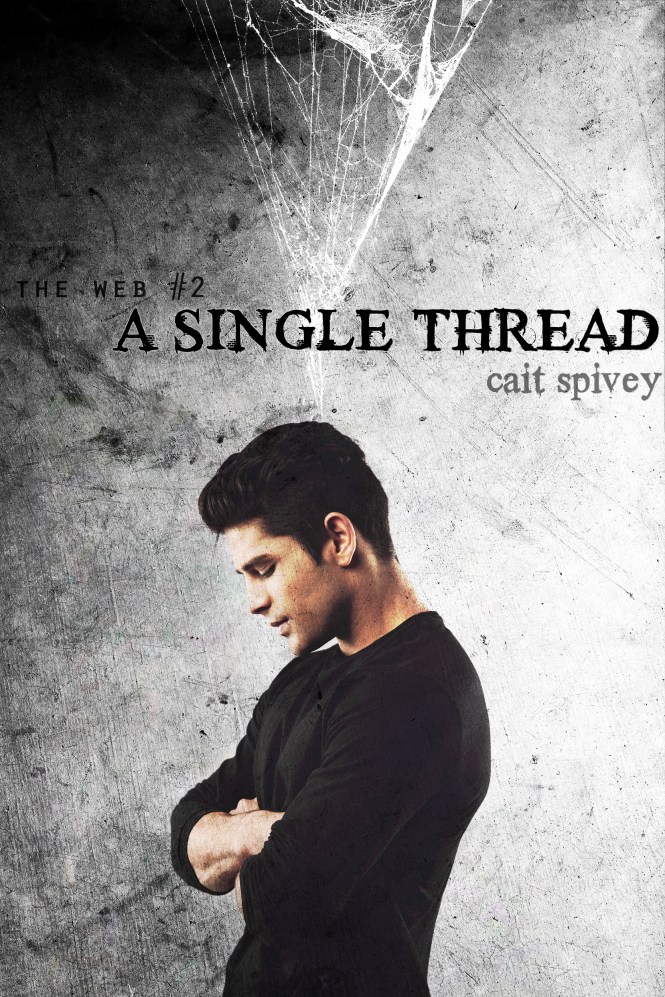
And now, I’m thrilled to help reveal the cover for I See the Web‘s highly anticipated sequeal, A Single Thread:

A Single Thread by Cait Spivey

It’s been two weeks since Morgan Fletcher’s little sister, Erin, disappeared before his eyes in a flurry of spidersilk and blood. Probability says she’s dead; but when Erin comes to him in a dream, Morgan’s eyes are opened to a level of reality where probability doesn’t mean jack. His sister sees the web of time, and she’s got news for him: trouble is coming.

A cryptic riddle and flashing images of the future are all Morgan has to go on in order to save a mystery boy from a gruesome death. That’s if he even believes what’s happened to Erin. Is her spider-whisperer persona for real, or has his grief at losing her caused him to totally crack?

With a life at stake, Morgan isn’t taking any chances. Madness or no madness, he has to solve Erin’s riddle before it’s too late.

Releasing October 31st, 2014

And, because that’s not enough to convince you that Cait’s awesome and you should totally go support her, here’s a ridiculously amazing book trailer for A Single Thread:

Storytellers & Grammarians: The Different Types of Editors

A few months ago, Hubs and I were at one of our favorite restaurants, enjoying a nice basket of Cajunized tots and a couple cold beers. And, being the creepers that we are, we eavesdropped, I mean overheard, a conversation from the next table that started me thinking. While waiting for their food, the boy at the table would challenge his sister on rules of writing, definitions of obscure words, and other English-related stuff. After the first couple rounds, Hubs started looking to me for verification, mouthing, “Is he right?” Because, as an editor, this should be my realm of expertise, yes?

Eventually, though, I honestly wasn’t sure without having to use some sort of reference guide. See, the boy had transitioned from the basic rules of grammar we all abide by into things like the roots of words and obscure facts about the structure of language and grammar that I rarely need to know while editing. But he clearly loved it as much as I love talking about the techniques of storytelling. And right there, the proverbial light bulb went off, clarifying something I’d been witnessing for a while, but that I hadn’t put into words — there are two fundamental types of editors.

I know what you’re thinking: there are way more than two types of editing. And you’re right, there are. For argument’s sake, here’s the list of the most common editing activities:

  • Developmental (Overall storytelling)
  • Line Editing (Word Choice, Smoothness, Clarity, etc.)
  • Copy Editing (Grammar, Spelling & Punctuation)
  • Technical Editing (One specific aspect of a manuscript)
  • Proofreading (Formatting issues, Typos, etc.)

Note that I called those editing activities. Because, while there are five different areas an editor can be skilled in, there are still only two types of editors — the storytellers, and the grammarians. What I’ve witnessed over the past few years is that, regardless of the type of editing activity, the person doing it will invariably fall into one of these two categories. Why? Because I’m talking about the core way they view a manuscript, their fundamental perspective.

You’ve heard me talk before about how editors are not all the same, how it’s important to know whether you’re working with a copy editor or a developmental one. And this is why. The core philosophy of your editor will dictate the quality and type of editing you receive.

Grammarians are fantastic line editors because they’re brilliant with the actual words. They love the English language will the zeal of an English professor and will be the first to call you out when you deviate from the grammar laws. In short, they’re the grammar Nazis I mentioned in my post on the different types of critiques. But in the grand scheme of things, they’re superficial editors. Meaning they never dive past the actual words on the page, the specific combinations of letters and symbols on a white background. This is the main reason you’ll see some editors charge tiny little fees and have a turn-around rate of two weeks. Because all they’re doing is polishing the surface of your work, putting a band-aid on wounds they may or may not even see.

I’m sure I’ve just offended a large portion of the editors out there, and for that, I’m sorry. But it’s true. A grammarian editor will never look at the deeper problems of a story. For that, you need a storyteller. Storyteller editors are a rare breed, capable of doing the same level of line edit quality as a grammarian, but also capable of seeing past the words to the story underneath. They’re the equivalent of literary surgeons. They’ll spot the weird bone spurs, the fractured character arcs, the fatal plot holes that bleed the life from your story, the illness that keeps the emotional context from resonating with readers. And this is true whether you hire them to only do line edits, or whether you want the developmental side. Because they can’t help but see those things.

Storytellers understand elusive concepts like voice and style, and they’ll help you bend the rules of grammar to fit your story. Grammarian editors won’t. To them, that’s a cardinal sin, and they don’t understand why you would want to do that. Storyteller editors will ensure all the pieces of your manuscript work to form a cohesive narrative. Grammarians won’t. They’ll make sure all your words look pretty. Storyteller editors will challenge you, pushing you become a better writer. Grammarians will fix your typos and call it good. I’m sure you’re starting to see the pattern here.

So, how can you tell the difference? When you’re looking for a freelance editor, or you meet your publishing-house-assigned person for the first time, how can you know which type of editor you’re getting? That’s the tricky part. Ideally, you’ll want to look at any previous work they’ve done. Buy (or borrow) one of the books listed on their resume and see how you feel about it. Is it solid grammatically, but riddled with storytelling problems? (Readers are surprisingly attuned to these kinds of issues, so you’ll be able to feel it, even if you don’t know exactly why it didn’t work.) Chances are, they’re a grammarian.

Another option would be to track down other authors the editor has worked with and ask them for their impressions. Did the editor help them with a particularly tricky part of their story, or were they fast? (Speed is an indication of quality, remember? It’s much faster to skim the surface of something than it is to really internalize and think about someone’s work.)

The final clue will be in the feedback itself. If you’ve found a storyteller, they’ll always start with in-depth feedback that delves into the core of your story. Their first email to you will likely contain information on theme, character development, pacing, and any potential problems with those areas. Or, alternatively, if you’ve hired someone solely for line edits, watch for feedback that steps out of that territory. Trust me, storytellers can’t help but point out flaws in logic or areas that are murky/underdeveloped. Whereas grammarians will stick exactly to that — the grammar.

It is my opinion, in case you couldn’t guess, that storytellers are the stronger editors, and whenever possible, you should seek one of them. But grammarians have their place as well. They’re excellent proofreaders, and if you’re confident in the integrity of your story (as in it passes your critique partners and beta readers with flying colors) and simply need someone to double-check/polish your grammar, they’re perfectly acceptable.  The important thing to take away from this is that there is a difference. So know exactly what you’re looking for, and who the best editor is for that. Don’t ask a grammarian to do developmental edits, and don’t expect a storyteller to ignore structural flaws while line editing. Understanding the way your editor is likely to view your manuscript will give you a better idea of what to expect in terms of feedback. Which, in turn, leads to a better working relationship, and everyone likes when projects go smoothly, right?