Blog Tour Feature: Night of Pan by Gail Strickland

Blog Tour Banner Graphic


As you read this, I’ll be on my way to attend the Pubcamp Writer’s Conference in Seattle, WA. Which means, finally (FINALLY) you can expect to see some more posts about the craft of writing, and not just about my book recommendations. But before that happens (and because it’s awfully hard to write while also driving), I have another such recommendation for you, courtesy of the blog tour mentioned above. So let’s jump right into, shall we?

Night of Pan

by Gail Strickland
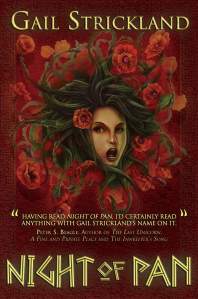
 

cover1000


My Rating: 4/5 Stars

The slaughter of the Spartan Three Hundred at Thermopylae, Greece 480 BCE—when King Leonidas tried to stop the Persian army with only his elite guard—is well known. But just what did King Xerxes do after he defeated the Greeks?

Fifteen-year-old Thaleia is haunted by visions: roofs dripping blood, Athens burning. She tries to convince her best friend and all the villagers that she’s not crazy. The gods do speak to her.

And the gods have plans for this girl.

When Xerxes’ army of a million Persians marches straight to the mountain village Delphi to claim the Temple of Apollo’s treasures and sacred power, Thaleia’s gift may be her people’s last line of defense.

Her destiny may be to save Greece…
…but is one girl strong enough to stop an entire army?

I’ve always had a soft spot for books based in mythology, and this one definitely doesn’t disappoint on that front. The story starts with fifteen-year-old Thaleia’s wedding day. A strong, independent heroine, though, she has other plans for her future, plans that don’t involve marrying a man she’s been betrothed to since age five. She escapes and starts to flee, but is stopped by Pan and a prophecy — the Persian army is on its way to Delphi, and she’s the only one who can save her people.

This is an interesting coming-of-age story about how the Oracle of Delphi comes to be. Strickland has clearly done a ton of research into the culture of the region, from the well-known pantheon of gods, to the day-to-day customs and warfare practices of the time. And from that standpoint, it’s phenomenally written. But I did find myself struggling with some of the other aspects. Namely, that the character development felt shallow. I would expect a coming-of-age story to be largely character-driven, but this fell flat on that for me, reading instead like more of a plot-driven action-adventure. I didn’t connect with Thaleia emotionally (nor with any of the supporting cast), and often struggled with her voice. She seemed to be both too mature and too young for fifteen, and some of the modern turns of phrase were jarring against the historical backdrop. While I do feel that she’s a good role model for young girls, she almost borders on a cliche’ed example of the “strong, independent woman” stereotype. I would have liked to see her be a littler more fully developed and multi-faceted as a character.

That said, I do think the prose itself is beautifully written. Lyrical and smooth, Strickland’s style is effortless, and I could appreciate her voice as an author (not to be confused with Thaleia’s voice, as mentioned above.) The additional material included in the book makes this a well-rounded choice for younger readers interested in mythology. It is a YA, and I think it targets it’s market effectively. However, unlike some YA, it doesn’t translate quite as well outside of that target readership. I would definitely recommend it for the 12 + age range it’s intended for, though. And I will probably finish the trilogy, if only to see more of the richly developed, detailed world.

**Disclosure Statement: I received a copy from the publisher in exchange for an honest review. **

About the Author:

Gail Strickland — classicist, poet and musician — was recognized by The Baltimore Review & Writers’ Digest and published by the Oxford University Journal New Satyrica. While studying the classics in college, Gail translated much of Homer’s Iliad and Odyssey. Always passionate about music and bringing the richness of Homer’s language and culture to today’s youth, Gail mentored young poets and novelists and introduced thousands of youngsters to piano and Greek mythology.

Gail was born in Brooklyn, New York and grew up in northern California. She raised her children, read French philosophers in French and played in an eclectic country band called the Prairie Dogs whose claim to fame was being the only band to play Candlestick Park between the Beatles and the Rolling Stones.

Her first book, NIGHT OF PAN … a mythic journey of a young Oracle in ancient Greece, was published by Curiosity Quills Press November 7, 2014. NIGHT OF PAN is book one of THE ORACLE OF DELPHI TRILOGY.

Gail Strickland Author Photo

Website | Facebook | Twitter | Goodreads
Featured From the Archives: Story vs. Concept; A Demo Team Showdown

Tonight, I’ll be teaching my annual class on demo teams. I know I haven’t posted about the martial arts recently, and that the majority of you out there reading this are writers, rather than martial artists, but this particular post holds helpful tips for both. And since this is what I’ll be discussing over the next two days with the students of Dragon Heart Tang Soo Do, I thought it would be appropriate. However, for the writers out there, I’ll provide annotated notes, indicating the literary terms that correspond with my demo team lingo. So even if you aren’t a martial artist and you have absolutely no desire to learn about demo teams, give it a read. I think you’ll be surprised to see just how much the two worlds intersect.
 

Story vs. Concept; A Demo Team Showdown

by Kisa Whipkey

Originally Posted on 5/10/13

 
Recently, I found myself on the wrong side of an angry, pitch-fork touting mob after I eloquently shoved my foot in my mouth. (Turns out, there’s a fine line between snarky and jackass. Especially when it falls on the wrong ears.) And as I was being schooled by a student who naively believed I was a demo team idiot, I was amazed at how often the terms “concept” and “story” were used interchangeably, as if they were the same thing. I’m not sure if this is a common misconception, but since I was due for a demo team post, I figured why not take a moment to clarify the definitions and try to make something good out of my embarrassing mistake. And what better way to do that than to pit story against concept in an epic battle of demo team terminology. Sounds fun, no?

So, here we go! Contestants to your places, aaaaaaand . . . fight!

Round One: Concept

(2014 Annotation: Writers, this is the same for you. Everything said below applies to the same definition we use in literature.)

Concept does not, in fact, equal story. If it was synonymous with any word, it would be theme. And what is theme? The point of your project. It’s the message or idea that you want to convey to your audience. Let’s check out some examples.

(These are some of the more common demo themes/concepts I’ve seen over the years.)

  • Video Games such as Mortal Kombat, Street Fighter, Etc. (I’m guessing there’s a secret sect of Comic-Con Cosplayer geekhood within the martial arts.)
  • Medieval Asian Warlords (Yes, the Asian part is particularly important. How else can you create something as awesome as a D-grade Kung Fu movie brought to life?)
  • The Korean and/or Association Flag (Especially prevalent in the WTSDA. Apparently, we have a lot of association pride. And unoriginality.)
  • Badass little kids taking over the world (Cute factor combined with awesomeness. Who doesn’t love that?)
  • The Matrix movie franchise (Does this really need further explanation? The Matrix was just, like, the most epic movie ever!)
  • Pretty much any popular movie franchise (Further proof of my statement on example one. Maybe we’re all nerds at heart?)
  • Women’s self-defense (The only thing better than badass kids is watching a bunch of girls pummel a bunch of dudes, right?)
  • Peace, Love and Unity, man (Otherwise known as the undefinable, “high” concepts.)
  • The Elements (Because there can never be too many interpretations of wind, fire and water.)

(I hope, by now, you’re laughing with recognition.)

But despite my mockery, these are all perfectly acceptable examples of concept. I’ve used some of them myself. (There may or may not be multiple versions of Mortal Kombat costumes lurking in Dragon Heart’s demo team archives. 😉 ) The problem comes when that’s all there is to your demo (2014 Annotation: same is true for writing). The concept should be the foundational element, the first spark of creativity. Not the entire focus. Here’s why: concepts are simple. They contain absolutely no allusions to the story they might evolve into, making them a two dimensional, cardboard cut-out experience guaranteed to bore the life out of your audience. Don’t believe me? Let me show you. A concept’s inception typically looks something like this:

Student One: “Dude, let’s do a demo about the Korean flag!”

Student Two: “Like, oh my god! That would be totally awesome!”

Ok, maybe that’s a little facetious, but it’s not that far off the mark. A concept is that first burst of enthusiastic direction, not the ultimate goal. Don’t get me wrong, concept is very much an important part of any demo. Not only does it provide the inspiration, it has influence over decisions like costuming (aka genre, if you’re a writer), set/prop design (setting), characters, and overall presentation (POV/Voice/etc.) as well. But it’s focus remains purely on technique, and will rarely impart any lasting impression or emotion on the audience. For that, you need story.

Round Two: Story

(2014 Annotation: This is more commonly known as “premise” in the written world. But same basic idea.)

If concept is the idea, then story (aka premise) is the way you impart said idea to the audience. It builds on the foundation concept provides to create something with a far richer experience for everyone. However, story is often misconstrued to mean flash. As in, an overly theatrical fluff-fest that’s trying to compensate for a lack of technique. That, my friends, is sadly mistaken. And probably the reason story is given so little respect in the creativity division. (2014 Annotation: “flash” in literature can take on many forms, but most commonly it’s seen as an over-indulgence in world building, or an over-wrought, heavy-handed style that gets in the way of the story.)

All those components that instantly scream flash – costuming, props, etc – are not actually controlled by story. They reside within concept’s domain. (Cheeky bugger, fooling everyone by pointing the finger at story.) The only thing story controls is choreography (aka plot, for writers). Why? Because choreography is how you tell a narrative in a demo (See? Plot). The rest is bonus to help ensure the audience understands. But you don’t actually need anything beyond choreography.

Story is defined in the literary world as conflict. Meaning, there has to be something happening. A journey from Point A to Point B. I’ve written about this topic at length in my previous post, Storytelling for Demo Teams, so rather than repeat myself, I’ll provide an example of how story elevates concept. And how it doesn’t necessarily have to be complicated to be effective. (There’s only so much you can cram into a 5 minute span, after all.)

I’m going to use one of my own demos for this exercise – The Dream Sequence – which I have featured before.

The concept for this demo actually came from the music itself. (As do all my ideas, which many of you know by now.) I wanted to show a dreamy, ethereal world that matched the tone of the music. But since that isn’t enough for a competition-grade demo in my opinion, I needed a story that would deliver that message to the audience. So I created one about a little boy who falls asleep and finds the dolls he was playing with have come to life around him. When he wakes up, the dolls disappear. Literary genius, isn’t it? But that’s my point. No one said you had to be a master storyteller; you just have to tell something.

So, to recap:

Concept = dreamy, ethereal imagination.

Story = slightly creepy dolls coming to life inside a child’s dream.

(2014 Annotation: This same equation applies in literature, and is quite handy for figuring out things like queries. 😉 )

See how neither of these statements is really that complicated or involved? And how, when combined, you end up with an idea that’s far more powerful and interesting than the concept alone? That’s the beauty of story. (If you haven’t seen the demo I’m referencing, take a moment to go watch it. I’ll wait. 😉 )

And the Winner is . . . ?

Neither.

That’s right, our epic showdown actually ends in a draw. Anti-climatic, I know. But that’s because one isn’t better than the other. They work in tandem, not competition. The ideal demo (or novel) is a balance of both, pulling from the strengths of each to create a wonderful masterpiece people remember for years. But, because the two terms are separate elements, it is possible to create award-winning demos using only one of them. You can have a traditional demo that focuses primarily on technique, with no storyline, just concept. And you can create a moving, story-driven demo featuring absolutely no costumes, props, or flash. (Technically, though, if you have a story, you have a concept, regardless of the addition of flashy elements. Concept can live without story, but story needs concept to survive.) The trick is knowing your ultimate goal and utilizing your team’s talents to their fullest. (I’ve given out a lot of helpful tips about how to do this.)

And remember, if you find yourself having to explain what your demo is about, you failed. (Harsh, but true.) Whether your aim is traditional/concept-driven, or theatrical narrative, your audience should always receive your message clearly. That is, after all, the entire point of demos (and storytelling in general), is it not?

Featured Image: “Sweetheart Ronin” Illustration

Happy Halloween! Originally, I was intending to post my thoughts on literary voice this week, but given that it’s a holiday (and the fact the conference I was supposed to speak at was cancelled), I’ve decided to showcase something a little more spooktacular (yes, horrible pun intended) instead. Some of you may be familiar with the Project REUTSway competition Reuts Publications hosted last year, challenging writers everywhere to pen new and twisted versions of your favorite fairy tales. No? You don’t remember that? Well, you’re in luck then, because it just so happens to have released today. That’s right, FAIRLY TWISTED TALES FOR A HORRIBLY EVER AFTER is available in eBook now! And will be available in a special hardcover edition in a couple weeks. I highly suggest you all check it out; it’s amazing!

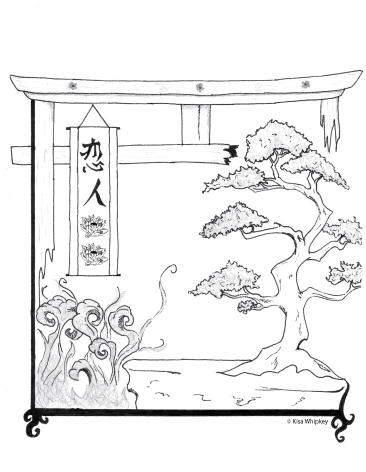
But that’s not the point of today’s post (okay, not the whole point). I’m actually going to do a rare art feature. See, I was lucky enough not only to be involved with the selection of the gruesomely fantastic tales in the anthology, but also to create one of the many illustrations included within its pages. And trust me, there are some truly beautiful works of art in this thing. Want a taste? Well then, let me present my illustration for a story called “Sweetheart Ronin” by the talented Suzanne Morgen:

"Sweetheart Ronin" Illustration by Kisa Whipkey


Created to evoke the style of the setting (Japan, in case you’re wondering), this piece is a combination of traditional drawing with pencil and Sharpie (yes, Sharpie. Who knew, right?) and digital vector graphic created in Adobe Illustrator. In order to understand the significance of the elements, you’ll have to read the story, which can be located here. Buy it. Seriously.

And for those of you curious about Project REUTSway, click here. The 2014 competition, featuring challenges rooted in world mythology, kicks off tomorrow and runs all November long. So if you’re looking to flex those writing muscles, but NaNoWriMo is too daunting/impossible, head on over and check it out. Who knows? Maybe I’ll end up drawing an illustration for you in next year’s anthology. 😉

Featured From the Archives: What is “Flow”?

Next week, I’ll be participating in a panel discussion on editing and “voice.”  (It’ll be at the NW Bookfest Conference, if you happen to be attending.) “Voice” is one of those oft-touted, rarely-defined writing terms, and as I work on compiling my thoughts on it, I figured we’d revisit another tenuously defined term — “flow.” I’ll post notes from the panel (well, mostly the material I present) for those of you who won’t be joining us there, but for now, let’s start the discussion off with . . .
 

What is “Flow”?

by Kisa Whipkey

Originally Posted on 10/19/12

 
Stop the snickering and dirty jokes, I’m not talking about that type of flow. 😉

I stumbled on an interesting and rather heated discussion this week (as most conversations involving the dissection of writing tend to be), about the use of “flow” as a literary term. The forum seemed pretty evenly divided between writers that absolutely despised it and felt it should never be used in a critique (an argument that instantly smacked of stereotypical writer pretentiousness), and those that felt it was a valid descriptor (instantly hailed as amateurs by the snobby residents of the Anti-Flow brigade). And it got me thinking. What exactly is literary flow?

Technically, “flow” isn’t recognized as a legitimate literary term — go ahead, Google it. I did. You’ll find it’s omitted from nearly every list of valid literary terms. Yet it’s probably one of the most frequently used words when discussing someone’s work. I know I’m guilty of using it — you can find it’s offensive four letters listed among the things I look for when freelance editing. So how did it become such a firm presence in our literary vernacular if it doesn’t technically exist? And why is using it tantamount to dropping another four letter word starting with “F”?

My theory is that it’s because no one really knows what it means. Is it referring to the structure of the piece as a whole, the “flow” of the words themselves, the pacing, what? It’s this vagueness that makes feedback including it seem awfully similar to:

“I loved it!”

“This sucks. I hated it.”

While those are, I suppose, acceptable reader responses, they fail to tell the writer anything useful, namely — why? In order for any critique to actually help the author, it has to explain why the reader felt the way they did, and what they would have liked to see different or not. Telling us that our work is lame, that you think it’s utter crap, or on the flip-side, that it’s the most amazing thing you’ve ever read ever, really doesn’t help us improve or repeat the success. Telling us why you hated it, or loved it, is like feeding a starving man — it’s what we really care about. Nothing will get your opinions ignored faster than failing to quantify your experience as a reader. I believe this is why “flow” causes such a divide among writers — it gets thrown around like it’s a brilliant little gem of insight when really it’s just unhelpfully frustrating.

I don’t agree that it’s a bane to literary terms, though. Actually, I think it’s a perfectly valid starting point for a critique, as long as the reviewer goes on to define it. The definition is crucial, because “flow” is one of those terms that can mean about a million different things to different people.

For me, “flow” is synonymous with “smooth.” When something flows, it should have an effortless feel that allows me to forget the words and really immerse myself in the story. It’s a visceral sensation of rightness that you only really notice when it’s disrupted. I tend to imagine storyline as a thread running through the center of a piece. Ideally, that thread should be smooth and straight, holding everything tightly in place. When that happens, the story “flows.” But if the thread gets crinkled up in a tangent, veering away into a knotted section of confusion, or frays into several disjointed, broken paths, the story’s flow feels off. Much like the way a river flows toward the sea, everything in the story should flow toward the final goal. This is part of why you need an editor, or critique partner, or random-person-off-the-street to read your work. Authors are usually too close to the story to be able to catch these flaws in the thread. But your readers sure will. They may not know exactly how to define it, but they’ll feel it.

I use “flow” to start a conversation about the structural integrity of a piece, but I can think of at least two other ways in which it could be defined. Let’s put that to the test, shall we? In the comments below, tell us what “flow” means to you. And please refrain from derailing this into the gutter. This is a serious, (ok, semi-serious), literary discussion, and I do have the power to decline your comments (Mwahaha!). So family-friendly only, please. 😉

Blog Tour Feature: God’s Play by H.D. Lynn

As you read this, I may or may not be slightly hungover from too many shots of Fireball whiskey, striving valiantly to survive a business trip to Vegas (yes, Vegas, baby, and no, it’s not at all as fun as it sounds) for the Day Job of Doom. (Fun fact, though, one of the products we sell at the Day Job of Doom, and the lovely sponsor of said business trip to Vegas, is responsible for the water fountain show at the Bellagio hotel. You’re welcome, World.) But, since I have never missed posting something for your entertainment, I managed to find a few moments to schedule this post.

Today’s offering is an excerpt from a newly released title by Curiosity Quills press. But before we get into that, here’s the scoop on the book itself:

God's Play by H.D. Lynn

Sixteen-year old Toby was trained by a family of hunters to kill shape-shifters—but he has a unique weapon in his arsenal. With a touch of his hand, Toby can lift the magical protection shape-shifters use to disguise themselves as human. It’s an unusual skill for a hunter, and he prefers to kill monsters the old-fashioned way: with a blade.Because of his special skill, Toby suspects he may be a monster himself. His suspicions deepen when William, a jackal-headed shape-shifter, saves him from an ambush where Toby’s the only survivor. And Toby doubts William helped him for purely altruistic reasons. With his list of allies running thin, Toby must reconcile his hatred of shifters and the damning truth that one saved his life. It’ll take both of them to track down the monster who ordered the ambush.

And Toby needs his unlikely alley because he has a vicious enemy—the infamous Circe, who has a vendetta to settle against the hunters. Toby has to unravel the mystery of his dual nature. And he has to do it on the run—before Circe finds him and twists him to her own ends.

Sounds cool, doesn’t it? I found the blend of mythology and fantasy to be fascinating. But anyway, on to the excerpt!


One of the shifters growls and sprints across the carpet. It pounds down on me like a speeding train. I pivot, duck, and thrust upwards with my hunting knife. I connect with flesh, slitting the stomach when it leaps over me. The canine shifter staggers into a mattress column, howling with rage, splitting my ear drums. Deafened, I can’t hear the other one attack. It flashes by, maybe some type of feline, pinning me underneath it. My mother screams. Claws dig into my chest, but I thrust upwards and kick it off like I’m launching from the gymnastics vault. My vision bursts into a thousand colors. I punch my knife hand into the feline, and the blade glints in the flashlight beam after each strike. The animal wheezes, and in its death spasms, falls down on top of me. I gasp under its weight, avoiding the last snaps of its jaw before it goes limp, but my eyes are still popping. The flashlight rolls, spinning the world in dollar store yellow lighting. I fumble for my Bowie knife, numb hand grasping chunks of cheap carpet. There’s a scuffle, and in the beam of light, on the other side of a stack of off-white mattresses, my mum is crouched. She only has her butterfly knife left, and she’s swinging it at the giant wolf approaching her. Its eyes glow like a hell hound’s. She backs up, and through neon color pops, I watch the wolf jump at her. She thrusts the knife into its throat. Its breath gurgles as it dies, but I can’t see either my mother or the wolf over the mattresses now. The scent of blood floods the air like after a shark attack. It can’t be my mum’s―there’s too much of it. My heart is still beating, and it’s driving the bile up my throat. I’m rocking on one of those cheap county fair rides. The world tilts up and down, whirling me until the little cart breaks and goes flying through the cotton candy stands and into the parking lot. A hand grasps the flashlight, pulling it off the floor, and turning the world dark. Footsteps crunch over the carpet. The soles are heavy, not practiced and light, so it’s not a hunter. I’m hearing through a tunnel now, so maybe I don’t know. The world is all neon lights and animal stench. Someone speaks, and I think it’s a man, but I can’t understand him. The voice is stretched like it’s in slow motion. The footsteps come near me. A man leans down, and I look up into the face of a jackal.

When I lurch awake like a car with no brakes skidding on ice, I see a monster’s face―the jackal. It slips away, turning into the face of all the monsters I’ve hunted. But that’s a hallucination, and I slip back into nothingness. He’s carrying me―it feels like floating. The rain pours over him while he changes back to a man, but it smells like alcohol and the bitter sting of antiseptic.

And lastly, a bit about the author herself:

H.D. LynnH.D. Lynn is like Harry Potter in one way: she’s currently renting an apartment with a bedroom under her building’s stairs. Other than this, she explores fantasy worlds through storytelling like anyone else. She loves books with a mix of humor, adventure, and horror, and especially enjoys the urban fantasy genre. GOD’S PLAY is her first published novel.

When not writing, she enjoys hiking, climbing, and running. She’s a voracious reader, and has found listening to audiobooks while backpacking to be a perfect mix of two of her favorite things. She currently lives in Connecticut, but finds herself on the road often.

Purchase Links: Amazon | Goodreads


Blog Tour Banner