Encore of My Review for Gambit by C.L. Denault

Happy Friday, everyone! I can’t believe another week’s already gone. Sheesh! Of course, trying to survive it while under the haze of cold medicine probably didn’t help my sense of time. (Yay for the Dreaded Summer Cold. -_-) But that’s okay, because I get to make two people’s days a bit brighter. That’s right, it’s time to announce the lucky winners of the signed Gambit copies.

Thank you to everyone who entered! Your support always means the world to me. And even if you didn’t win, I hope you’ll check out Gambit on your own. It really is a fantastic read. To remind you of that, I’ve posted my review (along with the links to buy it) below. But first, the winners!

Congratulations goes to:

Alexandra P. & Priya K.

Enjoy the book, ladies! ❤

All right, now that we’re all on the same page, I bring you the encore performance of my review:

Gambit

by C.L. Denault

Gambit by C. L. Denault


In Earth’s battle-ridden future, humans have evolved. Those with extraordinary skills rise to power and fame. Those without live in poverty.

Sixteen-year-old Willow Kent believed she was normal. But when a genetically-advanced military officer shows up in her village and questions her identity, long-buried secrets begin to emerge. With remarkable skills and a shocking genetic code the Core and its enemies will do anything to obtain, Willow suddenly finds the freedom she craves slipping through her fingers. Greed, corruption, and genetic tampering threaten every aspect of her existence as she’s thrust, unwilling, into the sophisticated culture of the elite Core city. To ensure peace, she must leave the past behind, marry a man she’s never met, and submit to the authority of a relentless officer with a hidden agenda of his own.

Her life has become a dangerous game. How much will she sacrifice in order to win?

Gambit lays the foundation for a traditional coming-of-age tale, following Willow Kent’s journey — metaphorically and physically — as she grows from a young woman into the woman she’s destined to become. However, it’s definitely the beginning of a much larger tale, so don’t expect to see that journey encapsulated in this initial book. It’s a trilogy, and this is only the first third.

What you should expect is to be introduced to a world that is at once fresh and yet familiar at the same time. Set in a future where our current society has crumbled and humans have evolved, Willow starts her life in what feels like a medieval throw-back, a village in the remnants of what used to be Scotland. Infused with all the charm of Pixar’s Brave, we’re shown a snapshot of Willow’s life as a tavern keeper’s daughter.

But that life is soon swept away when an officer from the highly technological Core arrives. He’s looking for a missing heiress, a child stolen from one of the prominent Core families and hidden away in the Outlying Lands. That child is Willow. Suddenly faced with an identity she knew nothing about, Willow is forced to sacrifice everything she knows in order to protect the ones she loves and is thrust into the terrifying, fast-paced, intricate world of high society at the Core’s very center, where your DNA defines your worth.

Denault’s prose is captivating, painting her world with a mastery that instantly had me swooning. (Yes, editors swoon over words. Why are you surprised?) And speaking of swooning, the romance. While the hot and cold relationship between Commander Reece and Willow may bother some, it reminded me of the type seen in the classic narratives of Jane Austen and the Bronte Sisters. It evoked a subtler, highly charged and passionate style of romance that is rare in modern literature. The kind where things like differences in social station and perspectives on propriety create tension and subtext that goes beyond physical attraction. Does Willow have a tendency to fall for gorgeous men, feeling pulled in several directions at once? Yes. But you know what? She’s sixteen. That’s what sixteen-year-old girls do.

In fact, that’s one of the things I loved most, that the protagonist, Willow, is actually allowed to be a teenager. She’s sixteen and catapulted into a world she has no idea how to navigate. She throws tantrums and makes mistakes, and it’s okay, because she’s sixteen. Unlike other young adult books that often have characters acting with a maturity well beyond their supposed years, I appreciated that Willow’s struggle felt genuine to her age.

I’ve loved Gambit from the second I stumbled on it on Figment.com (under its then title ofProdigy), and I still think about it, months after I’ve finished reading. It’s engraved in that special part of my brain reserved for all-time favorite titles, and I expect the characters and world will haunt me for years to come in the best possible way. For me, that’s the ultimate goal, finding a book that gives me a book hangover so intense I never truly recover. Gambit fit that bill for me.

One part Pixar’s Brave, one part X-Men, one part Pride and Prejudice, and one part My Fair LadyGambit is a magical debut from a brilliant new author. And all I can say is, “Sequel now, please!”

Book Links: Goodreads | Amazon | Barnes & Noble | REUTS Publications Bookstore

The 10 Best Things About Being an Editor

There have been a lot of articles floating around the interwebs lately detailing the uglier side of editing, the harsh reality and bitter truth that publishing generally prefers to keep hidden. And I’d guess a lot of you are wondering why anyone would sign up for a job that clearly comes with a large side of misery. Or, if you’re a fledgling editor, you’re probably thinking it won’t happen to you, that those of us “griping” are just jaded old farts yelling “GET OFF MY LAWN!” at anyone who comes near. But trust me, you’re wrong. It will happen to you. I said I’d never fall prey to it either, and now look. I struggle daily to hold on to the passion and enthusiasm I started out with, to avoid turning into that hateful, jaded editor I said I’d never become. Because, you see, being an editor is a lot like being a statue in a sandstorm. Each stressful project wears down a little more of that initial optimism and joy, replacing it with marble-lined walls nothing can get through.

But it’s not all bad. And this isn’t going to be one of those bare-all-the-skeletons-in-the-closet type of articles (in case you didn’t glean that from the title above). No, to counter-act the very valid, albeit depressing, truth behind the editing life, I’m going to show you the good, the reasons we battle our way through the ugly, day after day after day. The reasons, when asked, we’ll still tell you we love it and it’s the best job on Earth.

I give you, the ten best things about being an editor, in no particular order and with just a touch of snark. 😉
 

1. Nerdery Welcome

If you’re an editor, you’re an avid reader. You have to be. It’s literally job requirement #1. Okay, proficiency in grammar is probably job requirement #1, but you know what I mean. You are a self-professed book nerd and you wear that label proudly.

But growing up, you were likely teased for it. A lot. While others spent their afternoons playing video games, sports, or lusting after the opposite sex, you were Belle from Beauty and the Beast, walking around with your nose stuck in a book. Admit it, this was you:

20120817-084704

Well, one of the best things about being an editor is that your unabashed love of all things books is returned and fed by others who also unabashedly love books. All those things that riddled your childhood with taunts are no longer a weak point. The fact that you’re a book nerd is par for the course, and in fact, nerdery in all forms is highly encouraged. They say that nothing beats finding your people, your tribe. Well, book nerds, the land of editing bears its nerd flag proudly, and if you have the skills, you’re more than welcome to add your sigil to our banner.
 

2. Buying Books Becomes a Business Expense

This is legit. Seriously. Part of an editor’s job (especially an acquisitions editor) is knowing the ins and outs of the book-buying market. And how do you accomplish this? By buying books. No joke. Therefore, those extensive receipts from Barnes & Noble, Amazon, and whatever other book haven you haunt, become what is known as “market research” and according to my tax professional, that is a deduction. **Note: I’m not a tax professional and make no claims to be. Make sure you talk to someone who is before taking my word for it.

As if we needed another reason to buy books, right?

excited-baby
 

3. Hoarding Books No Longer = Mental Disorder

Ah, yes. This is probably one of my favorites. I am a book hoarder. There, I admitted it. My apartment is crammed to the gills with books, to the point that one of the first comments any visitor says when they walk inside is, “Man, that’s a lot of books!” The second is always “Cool weapons,” but that’s a story for another time.

The point is, I like books. No, scratch that, I LOVE them. I love their smell, their feel, their beautifully linear sqaureness (Don’t ask. It’s been noted before that I have a touch of OCD). And someday, I will own that library from Beauty and the Beast. I will!

Anyway, this habit to collect books in droves has long been considered strange, obsessive, and cause for concern for any who have to help me move. But guess what? No one bats an eye now that I’m an editor. All that judgment I used to have to fend off gets checked at the door. It’s considered normal and, apparently, is completely understandable now that I live my life surrounded by words and literature and the soothing smell of printed paper. Now my only problem is my lack of shelf space. (Thank God for Kindle!)

Books
 

4. You Become a Mystical Rainbow Unicorn with Super Powers

No, not really. But it will feel that way sometimes. I believe I wrote before about how I considered “Editor” to be an unattainable, near-mythical job title when I was younger. Well, apparently, I’m not alone in that. People seriously look at us like we’re some shimmery Fae creature that can’t possibly exist in real life. And I’m not talking about writers, whose reaction is usually more akin to the fangirl/fanboy response of a super-fan at a rock concert angling to get backstage. No, I’m talking about everyday people who have no affiliation to the publishing industry whatsoever. There’s an impressed awe that tends to come across someone’s face when I mention what I do for a living (no, not the Day Job of Doom part). And honestly, who doesn’t want to feel like a rock star, even the literary kind?

magic-unicorn-meme-generator-i-am-splendiferous-watch-me-sparkle-ae7515
 

5. Books! Books! Books!

read-all-the-books-meme

I think that’s self-explanatory, don’t you? Moving on . . .
 

6. It’s Intellectually Challenging

Now we’re starting to get into the more serious reasons editors become (and stay) editors. So I’ll try to hold the sarcasm in check.

This one in particular is probably one of the main things I find appealing. Editing is like Crossfit for your brain. It’s often mentally taxing and can leave you feeling like you’re seconds away from having your eyeballs abandon ship, but that’s also part of why it’s fun. Not the mutinous eyeballs part. The mental gymnastics.

The best editing projects are like a massive puzzle, requiring you to shift and move and tweak and tune things until, like a camera lens, the focus snaps into place and the picture becomes perfectly clear. I love that feeling, and for me, it is a visceral feeling. I know the rules and regulations, but honestly, I edit primarily by instinct. I’m lucky to have been born with an innate sense of storytelling (and yes, I have had people tell me its a super-power) and I can actually feel in my bones when a narrative clicks into place. That sensation alone makes all the hard work, all the sweat and blood and tears (because editors expend those just as much as the authors do in this process) worth it.

puma
 

7. Proud Teacher Moments

If the last point wasn’t enough to convince you that being an editor is awesome, this one should. Yes, I just said that feeling a story find its groove makes it all worth it. And it does, but this is the icing on the cake. Completing a project definitely feels good, I’m not going to lie. But there’s one thing that feels even better:

Watching your author step into the much-deserved spotlight, their polished, perfect new book-baby clutched in their hands.

I call it the Proud Teacher Moment, because that’s the only way I could think to describe it. I imagine it’s very similar to the swell of pride and emotion teachers feel when they watch their students graduate. It’s sort of a bittersweet sensation — one part love, one part pride, one part sadness. Most people don’t realize how invested editors become in the projects they work on. Yes, the author wrote the thing, but we helped train it, helped shape it into the perfect piece of literary brilliance flourishing out in the world. And that creates a special bond. We may be relegated to the shadowy corners of Hell writers call the Editing Cave, but we watch from those shadows, cheering our authors on with proud tears glittering in our eyes.

Make Good Choices
 

8. Discovering Hidden Gems of Awesome

Okay, now that we had our little moment of seriousness, back to the fun. This one is a perk that most people automatically know — we get to read (and find) awesome books before they’re published. Boom. Go ahead and be jealous. You know that’s totally awesome.

Bejealous
 

9. Creating Magic

Writing is a magical process. I mean, come on, authors paint fully-realized worlds, characters, and plots that elicit emotions in readers with words. Letters on a page. That’s pretty magical, if you ask me.

Editing may not seem all that magical — it’s more like polishing a car than say, painting one — but it has its own kind of magic. Especially in the developmental phase. Editors are like spirit guides, helping authors find their way when they get lost in a forest of words. The best ones can actually step into an author’s voice, mimicking their syntax, their style, with the efficiency of a Pooka. Which, come to think of it, may be the perfect analogy for editors in general, given the oft touted love/hate relationship writers have with us.

DoctorWho

Anyway, what I’m trying to say is that writers create magic, but editors help contain it. And for that, we need our set of spells.
 

10. For the Love of All Things Books

When it really comes down to it, there’s only one true reason someone decides to pursue editing: a genuine, deep-rooted for all things books. The reasons listed above are great, but if I lost all of them tomorrow, I know I’d still have a love for books. Because nothing beats the ability to escape into a million other lives and worlds. It’s even been scientifically proven that reading enhances our ability to empathize. It’s a fundamental human gift, storytelling, and it’s one I will always cherish.

And that, my friends, is why I adore being an editor. Why I strive to look past the gritty, harsh truth of an editing life. I love storytelling. Plain and simple. And I love editing because it lets me pursue that love of storytelling. I enjoy the process, as painful as it may be sometimes, because I love the challenge, and I love helping others achieve their literary dreams. And best of all, I love that I get to spend my days surrounded with all things books.

I can’t sum up this last point any better than with this quote:

7afa052705168d8936aadee57b7a5f3a

Happy reading!

Featured From the Archives: A Brief Introduction to Demo Teams

Wow, what a week! I don’t know if the planets aligned for you as horribly as they did for me, but let’s just say there’s a bottle of Fireball in my freezer that will soon be empty. ;/

I was intending a different post today, but as the sun is now creeping lower toward the horizon and I have all of maybe two brain cells left, I decided it was time for the back-up plan. Hooray for archive-diving! I have plenty of writing/publishing/editing related posts I could recirculate, but I haven’t touched on one topic in a long time. And I’ve noticed the bio pertaining to this part of my life keeps showing up in my stats feed, so perhaps there’s some curiosity out there as to what I mean when I say I’m a “martial arts demo team expert.” Perhaps some of you are even thinking, “what the heck is a demo team?” Today, you’ll get to find out.

The following post will make the most sense to fellow martial artists, but for those of you who have wondered about my various online bio claims, here’s a glimpse into my martial artist past and my particular specialty in that realm. (You’ll notice it’s again related to storytelling. And yes, some of it translates into my current job choice as an editor.) Enjoy!

Demo Teams: A Brief Introduction

by Kisa Whipkey

Originally Posted on 7/20/12

I’ll be the first to admit that my views on the martial arts — especially demo teams — are a bit progressive. And as such, probably rankle the feathers of the traditionalists out there. For the record, let me just state that I’m not devaluing traditionalism. Quite the opposite actually. There’s something powerful about being a part of a legacy that’s steeped in the history of thousands of years, having been passed down for generations upon generations. That said, I also think that tradition without innovation can cause a style to stagnate and eventually disappear into the dust of ages. So, yes, I’m a progressive martial artist, but it’s not meant to offend.

When you reach Sam Dan (3rd Degree) in Tang Soo Do, there’s an underlying expectation that you begin to specialize in something. You’ve already semi-mastered the basics (no one’s ever perfect, after all), you can competently defend yourself and can adequately pass your knowledge on to others. Now it’s time to find your niche, to declare your martial arts identity, if you will. Some specialize in self-defense techniques, some in empty hand forms, some in specific weapons. Others choose to extensively research the history behind their art, and still others focus simply on the intricacies of instructing.

My specialty is demo teams.

What is a demo team? At their heart, demo teams, short for demonstration team, are a marketing tool. Anytime you give a performance geared toward attracting new students, you’re essentially using a demo team in its most basic form. The vernacular may vary from school to school (I’ve heard them referred to as Performance Team, Demonstration Squad, Creativity Team, etc) but the principle is always the same. And they’re very poorly utilized by the vast majority of schools out there.

Usually, they are thrown together last minute with volunteer students. They’re rarely given much rehearsal, and there’s usually even less thought behind the organization or presentation of the performance. Which gives you, not surprisingly, a highly disorganized group of students milling around looking lost, boring displays of generic techniques, and absolutely no originality. Some of you may be shaking your heads right now, thinking I’m being overly judgmental, but admit it, we’ve all seen these types of demos. Performances comprised of kids in rumpled uniforms who can barely form a straight line, displays of adequate-at-best techniques, poorly practiced routines where students end up flinging their weapons all over the place, absolutely no music except for the chaotic ki-haps of the students or maybe the counting of the instructor, and my favorite: people breaking boards any civilian could flick in half with a couple fingers, they’re so thin. There may be one or two high-ranking students that really dazzle, but overall, I think we can all agree that these types of demos are, in a word, uninspired.

Every audience is comprised of only a few things — the family of the students, who will cheer no matter how bad their person does; fellow martial artists vaguely curious how your style differs from theirs; the hecklers who think it’s amusing to shout horrible impressions of the Karate Kid at you; and potential students. That’s it. Really. So in any given audience, you maybe have 25% that can be enticed into enrolling. That’s a pretty small window in a lot of venues. How do you reach this small minority of potential customers? By entertaining them.

We live in a society flooded by the martial arts. It’s included in every action-oriented movie or TV show. It’s in nearly every video game on the market; it’s even crept it’s way into literature. So the mystique is gone, folks. It’s no longer enough to show the world what your classes look like on a daily basis. We’ve all seen it a thousand times. We’re not impressed. Doesn’t matter if we train in the martial arts or not.

Give us something original, something flashy, something that makes us pause in that parking lot or mall, or gets us in the door to your studio’s open-house. In short, give us a performance. None of this last minute, non-rehearsed, reliant-on-cute-factor, traditional uniforms stuff. What you need is a dedicated Demo Team — the elite of your student body, trained to perform, proficient in things like musicality, synchronization, advanced techniques, and storytelling/acting. These are the people who impress. They’re the ones who will entice new students to walk in the door, who will make the hecklers shut up, get the other martial artists to nod in appreciation and floor their family with their abilities. They are your secret weapon. And every studio has them. Unless you just opened your doors yesterday. In which case you have white belts. And white belts are never impressive. Sorry.

In the coming weeks, I’ll be posting what I’d call a master class in demo teams à la me (you can find this master class via the Index above, if you wish). I’ll go over every aspect involved in my style of “professional” grade teams, including how to create your team, the principles of musicality, staging, and storytelling, and the intricacies of performing — all in regards to martial arts demonstrations. For those of you more interested in my advice/opinions on writing, don’t worry, those posts will be mixed in too. I even have one dedicated to art, (The Genesis of a Logo Design), upcoming on the schedule, for any who were starting to doubt whether I’d actually tackle that subject. 😉

For now, I will leave you with this video of my most popular demo, “The Dream Sequence.” As with all recordings, there’s something lost in the translation that would have been better experienced in person. But it will still illustrate my particular demo team style, and what I hope to impart to you in following posts. Is it the most brilliant thing ever? I wouldn’t say so. It’s actually rather slow, and I was shocked by the acclaim it received. Is it entertaining? Hopefully. After all, that’s the whole point, isn’t it? To entertain.

(Before you ask, yes, the little boy on Wheelies is part of the routine, not some random bystander. And yes, I am in there, though I challenge you to figure out which performer is me. 😉 )


From the Editor’s Desk: Gambit by C. L. Denault

Welcome to Book Review Wednesday! This week’s edition brings you a post type that I haven’t done in a while and that I will be resurrecting periodically. (I’ve been horribly remiss in posting all the awesomeness REUTS Publications unleashed into the world over the past year. Sorry to all those authors who are still waiting! A review from me is coming, I promise.)

But first, let me remind you what these posts are all about. As an editor, (both freelance and under REUTS Publications), I have the wonderful opportunity to see amazing novels during their developmental phase. And I wanted to find a way to share them with all of you as they became available. (I also wanted to find a way to help support the authors that trusted me with their manuscripts.) So think of these posts as my own personal book recommendations, straight from the editor’s desk.

All right, now that we’re all on the same page, I bring you my review of . . .

Gambit

by C. L. Denault

Gambit by C. L. Denault


In Earth’s battle-ridden future, humans have evolved. Those with extraordinary skills rise to power and fame. Those without live in poverty.

Sixteen-year-old Willow Kent believed she was normal. But when a genetically-advanced military officer shows up in her village and questions her identity, long-buried secrets begin to emerge. With remarkable skills and a shocking genetic code the Core and its enemies will do anything to obtain, Willow suddenly finds the freedom she craves slipping through her fingers. Greed, corruption, and genetic tampering threaten every aspect of her existence as she’s thrust, unwilling, into the sophisticated culture of the elite Core city. To ensure peace, she must leave the past behind, marry a man she’s never met, and submit to the authority of a relentless officer with a hidden agenda of his own.

Her life has become a dangerous game. How much will she sacrifice in order to win?

Gambit lays the foundation for a traditional coming-of-age tale, following Willow Kent’s journey — metaphorically and physically — as she grows from a young woman into the woman she’s destined to become. However, it’s definitely the beginning of a much larger tale, so don’t expect to see that journey encapsulated in this initial book. It’s a trilogy, and this is only the first third.

What you should expect is to be introduced to a world that is at once fresh and yet familiar at the same time. Set in a future where our current society has crumbled and humans have evolved, Willow starts her life in what feels like a medieval throw-back, a village in the remnants of what used to be Scotland. Infused with all the charm of Pixar’s Brave, we’re shown a snapshot of Willow’s life as a tavern keeper’s daughter.

But that life is soon swept away when an officer from the highly technological Core arrives. He’s looking for a missing heiress, a child stolen from one of the prominent Core families and hidden away in the Outlying Lands. That child is Willow. Suddenly faced with an identity she knew nothing about, Willow is forced to sacrifice everything she knows in order to protect the ones she loves and is thrust into the terrifying, fast-paced, intricate world of high society at the Core’s very center, where your DNA defines your worth.

Denault’s prose is captivating, painting her world with a mastery that instantly had me swooning. (Yes, editors swoon over words. Why are you surprised?) And speaking of swooning, the romance. While the hot and cold relationship between Commander Reece and Willow may bother some, it reminded me of the type seen in the classic narratives of Jane Austen and the Bronte Sisters. It evoked a subtler, highly charged and passionate style of romance that is rare in modern literature. The kind where things like differences in social station and perspectives on propriety create tension and subtext that goes beyond physical attraction. Does Willow have a tendency to fall for gorgeous men, feeling pulled in several directions at once? Yes. But you know what? She’s sixteen. That’s what sixteen-year-old girls do.

In fact, that’s one of the things I loved most, that the protagonist, Willow, is actually allowed to be a teenager. She’s sixteen and catapulted into a world she has no idea how to navigate. She throws tantrums and makes mistakes, and it’s okay, because she’s sixteen. Unlike other young adult books that often have characters acting with a maturity well beyond their supposed years, I appreciated that Willow’s struggle felt genuine to her age.

I’ve loved Gambit from the second I stumbled on it on Figment.com (under its then title of Prodigy), and I still think about it, months after I’ve finished reading. It’s engraved in that special part of my brain reserved for all-time favorite titles, and I expect the characters and world will haunt me for years to come in the best possible way. For me, that’s the ultimate goal, finding a book that gives me a book hangover so intense I never truly recover. Gambit fit that bill for me.

One part Pixar’s Brave, one part X-Men, one part Pride and Prejudice, and one part My Fair Lady, Gambit is a magical debut from a brilliant new author. And all I can say is, “Sequel now, please!”

Book Links: Goodreads | Amazon | Barnes & Noble | REUTS Publications Bookstore

And, as a special surprise, the author has donated two signed copies for a couple of you lovely folks to fight over. That’s right, I said SIGNED! Whether you’ve read it and love it as much as I do, or whether you’d just love to get your hands on it, here’s your chance. It is open internationally, and the winners will be announced on Wednesday, June 17th.

To enter, simply click HERE. Good luck!


The Editing Life Laid Bare: A Brutal Look at the Statistics

This is a post I’ve been wanting to write for weeks now, but true to The Editing Life, I simply haven’t been able to find the time. Or the brain cells, for that matter. But today, I’m finally going to do it. I’m going to show you exactly what it looks like to be an editor, not with words, which would perhaps be the obvious choice, but with numbers. Why numbers? Well, nothing puts things into perspective quite like seeing the break-down of exactly what goes into something. Or so I’ve heard.

Now, I’ll be the first to claim that numbers are not my friend, so these “statistics” I’m about to lay down are only about as accurate as my math. And sometimes, that’s not terribly accurate at all. But even though it’s not going to be an exact science, it should still give you a snapshot of what my life as an editor truly looks like. The key words there are “snapshot” and “my,” meaning that this is in no way a comprehensive look at all the various things I work on as an editor, nor is it all inclusive for every editor. Others will be different. But based on experiences I’ve heard recounted from fellow editor friends, this is pretty close to what it looks like more often than not.

Let’s get to it, shall we?

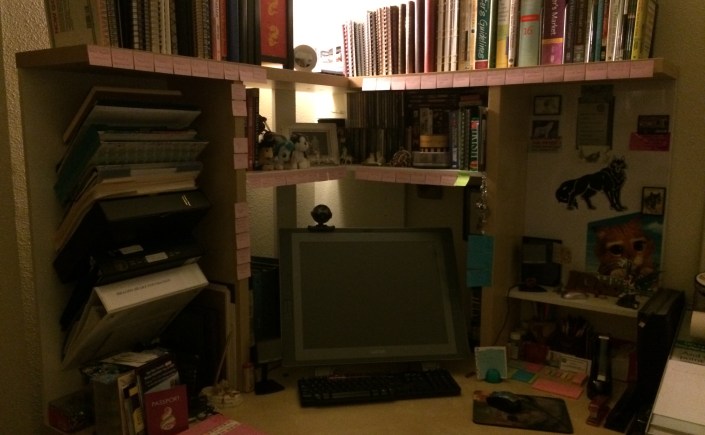
How many of you have heard us (us = editors) say that we work on multiple projects at once? Most, if not all, right? It’s a pretty common fact. But what does “multiple” truly mean? Well, cast your eyes over that photo at the top of the post. That’s my actual desk. No comments on the content/mess, please. 😉

See the lines of pink around the edges? Those are post-it notes. And yes, I realize it looks like an exercise in insanity, but trust me, it’s actually a very efficient method. Now, count them. How many did you get? Here’s the thing, each one of those post-its represents a project in various stages of completion. Not the stages, the project. I purposely kept it distant so you can’t see the names, but yeah, that’s what it means when editors say they’re working on multiple projects at once. Daunting, isn’t it?

On top of constantly being buried up to our eyeballs in work, we’re also generally underpaid. I’ve featured an article on this before, written by the lovely Cait Spivey, which can be found here. But let’s actually turn the microscope on it and dissect what that means in terms of my life.

On average, a manuscript clocks in somewhere around 75,000 words. Some will be more, some less, but that’s a good solid representative of a standard novel. Every editor has a different way they figure out what to charge. Common methods are by page, by hour, or by word. If you’ve looked at my freelance editing page, you know I charge by the word. So a full edit on that 75,000 word manuscript runs $1500. Ouch, right? That’s a hard number to stomach for most authors, and I get it. It seems really expensive. Until you break it down to see what you’re actually paying me for.

75,000 words is roughly 300 pages (according to the age-old school-paper formula of 250 words = a page). Most editors I know that are worth their salt average a pace of about 6-7 pages an hour for line edits. (I’ll cover why it takes this long in a future post.) So 300 pages equates 50 hours of work. If we take that $1500 fee from above and divide it by 50 hours, you get about $30 an hour. That seems like good money, doesn’t it? And in fact, that’s considered average for a professional freelance editor according to the Freelance Editor’s Association.

But we’re not done yet.

That 50 hours is solely what I spend during one round of line edits. There are things that happen before and after that stage. Remember, I said that $1500 rate was for a full edit, which consists of structural edits, line edits, and proofreading. So let’s factor in those things.

Structural editing is the process of reading a manuscript, analyzing it, and then diagnosing and finding solutions to any problems that are weakening the overall story. Tell me, does that sound like an especially fast process to you? It shouldn’t. If an editor is actually qualified and trained to do this (and not all of them are), it looks like this: reading — not just speed-reading, but really truly reading and seeing every letter and space and punctuation mark on the page — and analyzing 300 pages takes me approximately 2-3 full days, so, at 8 hours per day, that’s 24 hours of reading time, give or take. Figuring out what, exactly, is affecting the manuscript and how to deal with it will vary, but let’s say another 3-ish hours is spent on the mental gymnastics of curing an ailing story, and then another 2-3 are spent compiling all my notes and thoughts into an edit letter explaining all that to the author. These are super rough, ball-parky type figures because I don’t think I’ve ever truly tracked this part of the process. Anyway, when it’s all said and done, that’s about 30 hours invested into just the structural edits. And that’s without any follow-up discussion or brainstorming with the author, things that often occur after I hand them the aforementioned edit letter.

Proofreading is the last step and is probably the fastest portion of the process for me. Most projects, I can average 10-15 pages per hour. So if the manuscript is in good condition, that’s only about 20 more hours of work. However, that’s for a base proofread. If I have to do an editorial proofread (which is somewhere between a line edit and a proofread) the pace drops dramatically.

So, where are we at with our project overall? We have 30 hours for structural edits, 50 hours for line edits, and 20 for proofreading. That’s 100 hours of effort from start to finish, bare minimum. Suddenly, that $1500 flat fee isn’t looking so grand, is it? That’s only $15 an hour. Minimum wage in many larger cities.

I should also point out that most projects take at least two rounds of line edits to truly shine, which, if you’re lucky, is only an additional 30 hours of labor, and there are probably easily 20 hours of time invested in various discussions and emails and hand-holding with the author. Making the total time expended on any full project easily 150 hours. Honest to God. What does that make my hourly wage? $10 an hour. You can flip burgers in some states for more than that.

Now, maybe that doesn’t seem so bad to you. $10 an hour is a livable wage, barely. Until you realize this: normal people work 40 hours a week. Even doctors and lawyers (who make a hell of a lot more money than editors) will only clock 70-80. So how many projects do you think we can realistically fit into a month? The answer is one. From start to finish, with no other obligations, family or social life, etc. an editor can comfortably complete one project in a month’s time. But we don’t live in a perfect world, do we? And we rarely get the luxury of only working on that one project and nothing else. (Photo of project management via post-it being exhibit A.) We also don’t get paid everything up front. So, if we only schedule that one project in a month, because 150 hours equals 3.75 weeks of normal human work-time, that’s a grand income of $750. For the month. I’ll let you do that math. Is that a living wage in your book? Because that barely covers my car payment.

Are you completely depressed now? Because I am. But the point of this post was not to whine, or complain, or guilt-trip anyone. I simply wanted to show you exactly what life as an editor looks like. It’s not sitting around and reading all day. It’s arduous, mentally-taxing, long hours for very little pay and often even less appreciation. It’s not a life that will lead to riches, or fame, or maybe even a full-time income. Which begs the question, why would anyone do it?

The answer is easy — love. Editors truly love what they do. But the sad truth is that editors also have one of the highest burn-out rates of any career. The average life-span of an editor is only 2 years, and now you see why. In an industry that refuses to pay a living wage (freelance editors who charge less than $500 for a full edit and indie presses that offer $350 for two rounds of full edits, I’m looking at you), we’re required to go to super-human levels in order to stay afloat. We take on burdens that would make Atlas tired, and we do it all for you guys, the authors. Because we truly want to help you produce fantastic, beautiful pieces of art. We’d just kind of like not to starve while doing it.

So, there you have it. That’s what the editing life looks like in all it’s stress-filled, brutal glory. I hope it’s been enlightening and that you take away three key things:

1. If you’re looking to hire an editor, please consider what their rate actually means. As in every industry, you get what you pay for.

2. If you’re already working with an editor, try to remember that they may have a desk covered in post-its too, and that your project is not the only one on their plate.

3. If you are an editor, set your rates appropriately. When you charge less than $500, you harm not just yourself, but the rest of the industry. You deserve to eat. You deserve to have a roof over your head.

That is all. Thanks for reading! 🙂